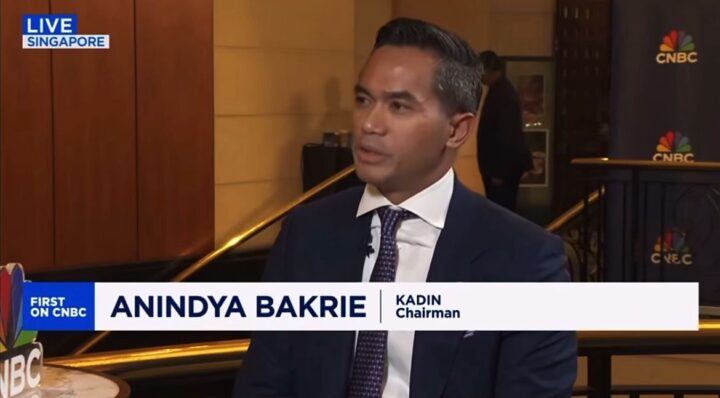
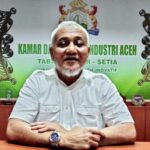
Singapore - Chairman of the Indonesian Chamber of Commerce and Industry (Kadin), Anindya Novyan Bakrie, emphasized the importance of economic growth that aligns with social justice values and greater youth participation.
“Economic growth must go hand in hand with society’s belief in equality,” said Anindya commonly known as Anin in an exclusive interview with CNBC International during the Milken Asia Summit 2025 in Singapore on Friday (October 3, 2025), local time.
Anin noted that Indonesia has experienced an average growth of 5% annually over the past three decades. However, he pointed out that today’s society particularly the younger generation is seeking more than just economic figures.
“The current President has set a target of pushing growth to 8%. But it’s becoming increasingly clear that young people want not just growth, but also equitable distribution,” Anin explained.
Based on Kadin’s internal surveys, Anin highlighted four key areas that are top concerns among Indonesia’s youth 40% of whom are under the age of 30. These are: entrepreneurship, employment, equality, and the environment.
“These are important signals for all of us. And at Kadin, we are taking them seriously,” Anin said.
As the umbrella organization representing all business sectors across Indonesia, Kadin, Anin stressed, is committed to ensuring that government programs are inclusive of businesses of all sizes.
“We want to make sure that every government plan involves the business sector both large and small so we can foster entrepreneurship and job creation,” Anin stated.
One such initiative supported by Kadin is the development of 80,000 cooperatives across the country, which are expected to become a backbone of the national economy.
“This is where Kadin can play a role in enhancing the capacity of professionals and cooperatives,” Anin added.
Furthermore, Anin pointed to the government’s plan to build 3 million homes for low-income citizens out of a total housing need of around 20 million units as another opportunity for Kadin members to actively contribute.
“In essence, the key is ensuring that large-scale investments flowing into Indonesia also create real benefits for the broader population. If that happens, Indonesia will become more stable and peaceful,” Anin emphasized.
Strategic Cooperation with the U.S. and European Union
In a separate interview with Channel News Asia (CNA), Anin also addressed Indonesia’s trade agreements with the United States and the European Union, particularly concerning critical minerals such as nickel and copper.
“These agreements are not just about imports and exports they're also about joint investment. The government has made downstream processing a core policy, and this creates added value not just for Indonesia, but also for global consumers,” Anin noted.
He described the target of doubling trade with the U.S. from the current USD 40 billion within the next five years as a positive step, especially if accompanied by joint investments in strategic sectors.
“The agreement with the European Union is also a major breakthrough. The EU market has 500 million people and an economic value of around USD 21 trillion bigger than the U.S. This presents a major opportunity for Indonesian products, including palm oil,” Anin explained.
Responding to questions about President Prabowo Subianto’s nearly one-year economic leadership, Anin highlighted the importance of synergy between the government and the business community.
“The government is working closely with Kadin. By law, all business organizations whether private companies, state-owned enterprises, MSMEs, or cooperatives fall under Kadin’s umbrella,” he said.
Anin concluded by stressing that strong collaboration between the government and the private sector is crucial in realizing Indonesia’s long-term vision for future generations.
“That’s the core of the President’s message development must involve all stakeholders actively,” Anin concluded.