

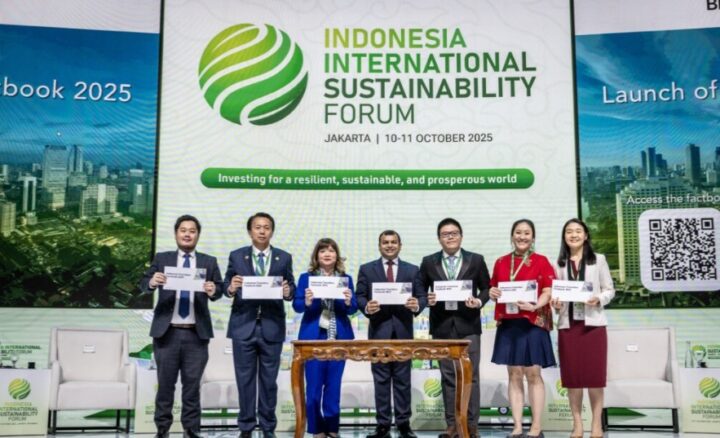

Jakarta, 11 October 2025 — The first day of the Indonesia International Sustainability Forum (ISF) 2025 officially opened with a strong spirit of cross-sectoral collaboration. ISF 2025 serves as a platform that transforms dialogue into commitment, and vision into collective action. By uniting leaders and innovators, the forum accelerates sustainable growth that delivers benefits for both people and the planet.
ISF 2025 marks a pivotal moment for Indonesia to assert its central role in advancing the global sustainability agenda. A wide range of panel discussions and thematic dialogues on the first day explored key strategic issues including water security, agricultural productivity, blue economy, net-zero carbon emissions, climate and global trade, waste management, clean energy transition, and air quality.
Rachmat Kaimuddin, Deputy for Basic Infrastructure Coordination at the Coordinating Ministry for Infrastructure and Regional Development, emphasized the importance of multi-stakeholder synergy in delivering tangible sustainable development outcomes.
“ISF 2025 is concrete evidence that Indonesia is not only acting as host to a global forum, but also as a driver of collective action for sustainable development. We want to ensure that every commitment made at this forum moves forward into real action. Through cross-sector collaboration, we accelerate sustainable growth and bring together leaders and innovators to invest in a better life. By strengthening green infrastructure and increasing total sustainable investment, we are building a resilient, sustainable, and prosperous future for Indonesia and the world,” said Rachmat Kaimuddin.
From the investment perspective, Nurul Ichwan, Deputy for Investment Promotion at the Ministry of Investment and Downstreaming (BKPM), highlighted that the event has gathered valuable insights from many exceptional speakers.
“The objective of ISF 2025 is to provide a cross-sector collaboration platform that brings together government stakeholders, the business community, international investors, and academia to co-create action-oriented solutions, not just jargon. The government emphasizes building infrastructure that supports sustainability, while the Ministry of Investment plays a key role in **facilitating the entry of sustainable investments into Indonesia,” said Nurul Ichwan.
Meanwhile, Shinta Kamdani, Vice Chairwoman for Human Development, Culture, and Sustainable Development at the Indonesian Chamber of Commerce and Industry (Kadin), highlighted the critical role of the business sector in accelerating the green transformation and supporting Indonesia’s national low-carbon development goals.
“ISF is a key moment to strengthen the role of the private sector as a catalyst for the green economy. The transition to sustainable development cannot be achieved by the government alone — it requires cross-sector collaboration to ensure that the investments we mobilize today truly generate positive impact for both people and the planet. Through this forum, we aim to ensure that the business community actively supports the transition towards an inclusive, resilient, and sustainable economic future for the next generations,” said Shinta.
The first day of ISF 2025 welcomed over 10,000 registered participants and 187 journalists from both national and international media. The forum featured plenary sessions, thematic discussions, high-level dialogues, as well as an exhibition and science corner showcasing sustainable innovation and research from Indonesia’s leading universities — including Universitas Indonesia (UI), Institut Teknologi Bandung (ITB), Institut Pertanian Bogor (IPB), Institut Teknologi Sepuluh Nopember (ITS), and Universitas Gadjah Mada (UGM).
One of the highlight sessions, the High-Level CEO Dialogue, was facilitated by the World Business Council for Sustainable Development (WBCSD) and attended by more than 30 global CEOs from various industries, energy, and financial sectors. (*)