Jakarta - Chairman of the Indonesian Chamber of Commerce and Industry (Kadin) Anindya Novyan Bakrie emphasized that the business sector plays a crucial role in maintaining purchasing power and driving national economic growth.
Anindya, commonly known as Anin, noted that one of Indonesia’s main challenges today is the need to create between 2.5 million and 3 million new jobs each year.
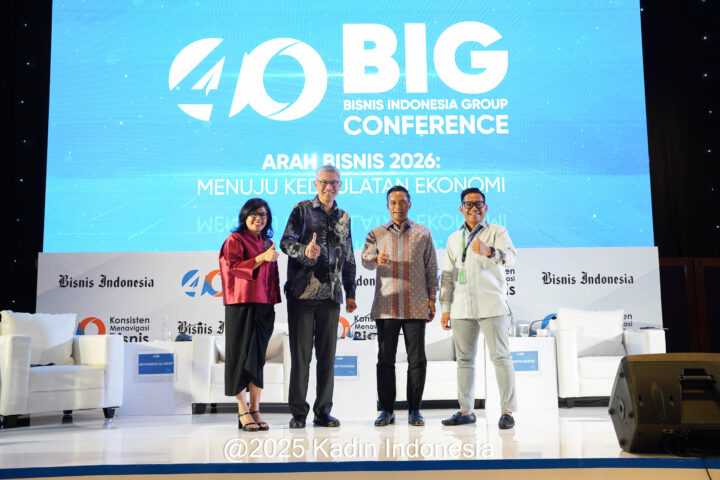
“From the perspective of the business community, the focus is on how to increase job creation. The demand reaches 2.5 to 3 million jobs annually,” Anin said during the 40th Bisnis Indonesia Group Conference themed “Business Outlook 2026: Advancing Economic Sovereignty” at the Raffles Hotel, South Jakarta, on Monday (09/12/2025).
Anin explained that Indonesia’s Gross Domestic Product (GDP) structure illustrates how the business sector serves as the main engine of the national economy. Government spending accounts for around 8% of total expenditure, while domestic consumption contributes 57%, investment 28%, and the remaining 7% comes from net exports-imports.
“So the business sector truly plays a very important role in strengthening purchasing power and investment,” Anin stressed.
Furthermore, Anin said Kadin continues to maintain a balance between the interests of large businesses and micro, small, and medium enterprises (MSMEs). According to him, the current “mood” or sentiment among business leaders is relatively positive.
Large corporations—Indonesia’s biggest job providers—are considering new investment opportunities, he said. However, Anin reminded that a conducive business climate must be maintained.
“(Like raising chickens) you don’t want the chickens—in this case, the business owners—to become stressed,” Anin remarked.
He added that the spirit of collaboration promoted by the government through the Indonesia Incorporated or gotong royong concept provides renewed optimism for large businesses. Collaboration models now extend beyond co-investment to include joint asset management and various shared projects.
On the other hand, Anin continued, small and medium-sized businesses—which represent the majority of Kadin’s members—tend to feel economic pressure more quickly, especially in the regions. Budget cuts to regional allocations have created additional challenges.
“Most of them are based in the regions. From the national budget (APBN) of around Rp3,600 trillion, about one-third is cut by 30–40%. So the funds flowing to the regions are smaller,” Anin explained.
Even so, Anin believes several government social programs are helping sustain optimism, including the Free Nutritious Meals (MBG) program. Of the planned 30,000 central kitchens, Kadin is involved in developing 1,000, with 500 already operational.
“Those 500 kitchens, multiplied by Rp1.5 billion each, amount to Rp750 billion. That’s not small. And the only guarantee they get is this: if the Chairman agrees, the government pays,” said Anin.
According to him, the kitchens that have begun operating typically achieve a return on investment within 10–12 months and earn around Rp170 million per month—an outcome he considers significant for regional businesses.
In addition to MBG, Anin also highlighted the importance of monitoring the Merah Putih Cooperative program and the nationwide initiative to build 3 million livable homes per year. He stated that the success of these major programs depends not only on APBN funding but also on consistent oversight and implementation.
“The budget is huge, and we must guard it. But secondly, the benefits can be substantial. So ensuring the expected outcomes is essential. To answer the simple question—are we optimistic or not? I believe our duty is to be optimistic,” Anin concluded.