Jakarta – The Indonesian Chamber of Commerce and Industry (Kadin) Aceh is pushing to accelerate investment in integrated poultry farming and the development of an integrated corn agroindustry as part of a broader strategy to strengthen food security, stabilize chicken and egg prices, support the Free Nutritious Meals (MBG) Program, and position Aceh as a new hub for the halal food industry and export center in western Indonesia.
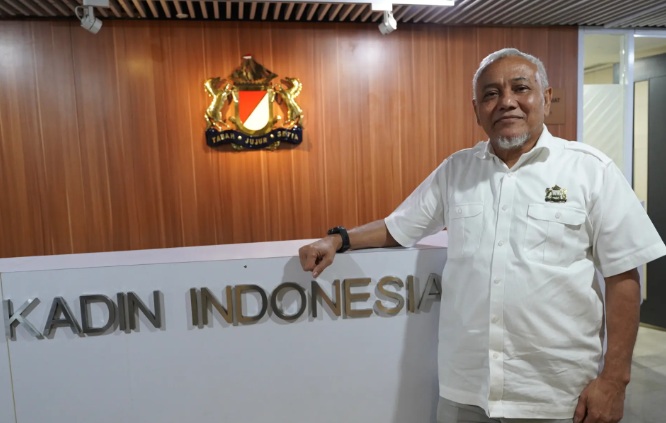
Chairman of Indonesian Chamber of Commerce and Industry (Kadin) Aceh, Muhammad Iqbal, stressed that Aceh’s primary challenge today is not food oversupply, but rather limited local production capacity, particularly in poultry protein commodities and the feed industry.
“Aceh’s problem today is not overproduction, but a lack of production capacity,” Iqbal said during a special interview with Investortrust at Menara Kadin in Jakarta on Monday (11/05/2026).
According to Iqbal, chicken and egg prices in Aceh have consistently been higher than in many other provinces across Sumatra and above the national average. The situation is driven by limited local production capacity, heavy dependence on supplies from outside the region, the absence of an integrated poultry industry, and high logistics and feed costs.
As a result, market prices remain unstable, the burden on consumers increases, risks to food supply for supporting the MBG program grow larger, and regional economic opportunities remain underdeveloped. To date, Aceh still lacks both a strong corn export commodity and a robust feed industry.
Iqbal explained that although Indonesia currently records a national surplus in chicken and egg production, the surplus does not automatically translate into evenly distributed food security across regions because the poultry industry remains concentrated in Java and parts of North Sumatra.
Based on data from the Statistics Indonesia (BPS), national chicken meat production in 2025 reached approximately 4.28 million tons, while demand stood at around 3.92 million tons. National egg production reached approximately 6.5 million tons against demand of around 6.3 million tons.
“Aceh has not yet become a national poultry industry base. Aceh’s supply resilience remains weak and prices remain high because local supply is limited. If local production becomes stronger, prices will become more stable,” he said.
For this reason, Kadin Aceh is encouraging large-scale investments aimed not merely at constructing poultry houses, but at building a fully integrated modern food industry ecosystem spanning livestock farming and feed agroindustry from upstream to downstream.
The integrated industrial concept includes breeding and hatchery operations, broiler and layer chicken farming, feed mill development, feed corn cultivation areas, modern poultry slaughterhouses, cold storage and distribution logistics, downstream food processing industries, as well as regional export orientation toward India, the Middle East, South Asia, and parts of Africa.
“What is being built is not merely chicken housing. What is being built is a modern food industry ecosystem,” Iqbal said.
Within this concept, corn is positioned as the most strategic sector because it serves as the primary raw material for the feed industry, while feed costs account for the largest component in the modern poultry business.
Currently, Aceh’s feed corn demand still relies heavily on external supplies, resulting in high poultry production costs, unstable chicken and egg prices, and limited growth of local industries.
“Without a corn industry, the poultry industry will never become efficient,” he stated.
Therefore, the investment is also directed toward developing industrial-scale corn cultivation through partnerships with local farmers, constructing corn dryer and storage facilities, strengthening the feed manufacturing industry, and directly integrating it with modern poultry operations.
According to Iqbal, this approach will generate far broader economic impacts because farmers will gain market certainty, corn prices will become more competitive, Aceh’s feed industry will grow, and poultry production costs can be reduced.
He believes Aceh possesses highly strategic geo-economic advantages for developing food and feed agroindustries. Aceh is located at Indonesia’s western gateway, close to the international trade routes of the Malacca Strait and the Indian Ocean.
This position opens more efficient logistics access to markets in the Middle East, India, South Asia, and parts of Africa.
“Aceh’s corn will not only be directed toward fulfilling domestic demand, but will also become one of Aceh’s leading export commodities in the future,” he said.
Iqbal added that investment studies, market assessments, licensing readiness, local and regional market absorption potential, and export opportunities have been prepared seriously. Demand is projected to continue rising from households, hotels-restaurants-catering sectors, the food processing industry, the MBG program, and regional and international markets.
In this context, Kadin Aceh has begun exploring foreign investment partnerships, including with partners from China. According to Iqbal, this move is not intended to sideline local businesses, but rather reflects the reality that integrated poultry industry development requires massive capital, modern technology, high biosecurity systems, and supply chain integration that have yet to be optimally established in Aceh.
Therefore, Iqbal believes narratives claiming that this investment will “destroy local poultry farmers” should be viewed objectively and based on data. In reality, Aceh still faces shortages in chicken and egg supply, local production remains insufficient to meet market demand, and market opportunities remain wide open.
According to him, modern industries can coexist with smallholder farmers through partnership schemes, production contracts, DOC and feed supply support, technology transfer, and modern production management assistance.
“This is not about displacing local farmers, but about expanding Aceh’s economic capacity,” he stressed.
He further explained that the integrated poultry investment is projected to create significant economic multiplier effects for Aceh. These include stabilizing chicken and egg prices, strengthening food supply resilience, and creating new employment opportunities ranging from farm workers, logistics personnel, distribution staff, technicians, veterinarians, to supporting SMEs.
In addition, the local feed industry is expected to grow stronger, corn farmers’ incomes are projected to rise, and downstream industries such as frozen food, organic fertilizer, and food processing are expected to expand, while simultaneously strengthening Aceh’s readiness to sustainably support the national MBG program.
Kadin Aceh also sees major opportunities to position Aceh as a poultry protein base, feed industry hub, corn agroindustry center, regional halal food hub, and export gateway for western Indonesia.
“Investment is not a threat to Aceh. The real threats are dependence on external supply, high food prices, weak local industries, and the loss of future economic opportunities,” Iqbal stated.
Therefore, he continued, Aceh needs investments capable of expanding production capacity, strengthening local farmers, lowering food prices, creating jobs, and encouraging sustainable regional economic self-reliance.
“If local capital is not yet ready, Aceh must not lose its momentum for growth,” he concluded.