By Primus Dorimulu
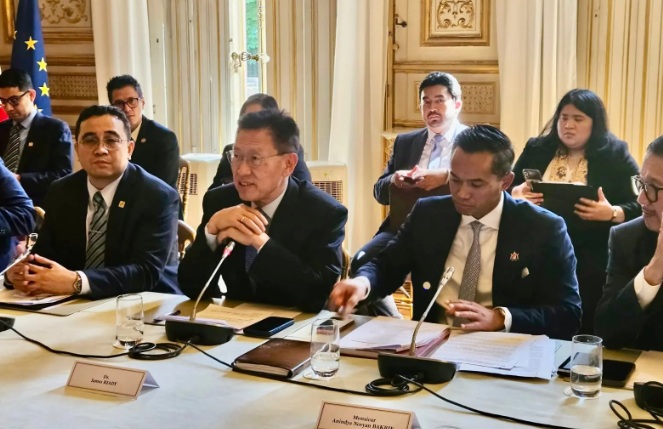
Paris – Human capital development is no longer merely a social agenda; it has become an economic strategy that will determine a nation’s future. This message was delivered by Coordinating Vice Chairman of the Indonesian Chamber of Commerce and Industry (Kadin Indonesia) and Chairman of Lippo Group, Dr. James Riady, during the Human Capital Development session at the Indonesia–France CEO Forum 2026 and the launch of the France–Indonesia High-Level Business Council (FI-HLBC) at Hôtel de Marigny, Palais de l’Élysée Complex, Paris, France, on Thursday (May 28, 2026).
Speaking before a high-level business forum that brought together leading industry figures from Indonesia and France, James emphasized that the world is entering an era of unprecedented disruption driven by artificial intelligence (AI), automation, aging populations, food security challenges, pressures on healthcare systems, geopolitical fragmentation, and accelerating technological change.
“Twenty years ago, human capital development was often viewed primarily as a social agenda. Today, it has become an economic strategy. Tomorrow, it may determine which nations rise and which are left behind,” James Riady said in his keynote address.
According to James, in today’s rapidly changing global landscape, natural resources alone are no longer sufficient to guarantee prosperity. The principal multiplier of national wealth now lies in the quality of a country’s people—their health, education, adaptability, productivity, technological capabilities, and commitment to lifelong learning.
Indonesia, he noted, possesses significant advantages, including a young population, a large economic scale, a strategic geographic location, and abundant natural resources. However, a demographic dividend does not automatically translate into prosperity.
“A young population without adequate nutrition, education, skills, discipline, and opportunities can become a burden. But when equipped with capabilities, good health, and technological readiness, it becomes an extraordinary economic force,” he said.
For this reason, he argued, human capital development cannot be separated from food security, healthcare systems, educational transformation, and the strengthening of digital capabilities across society.
James also linked the human development agenda to the policy direction of President Prabowo Subianto’s administration. He noted a growing recognition that investment in human capital is not merely social spending but a nation-building strategy.
Programs related to nutrition, food security, healthcare access, educational strengthening, vocational readiness, and industrial downstreaming are interconnected elements in building a stronger Indonesia.
At the same time, James highlighted France and Europe’s deep institutional strengths in science, advanced manufacturing, research, healthcare systems, food science, engineering, technological innovation, and world-class education. Indonesia, meanwhile, offers market scale, economic growth, energy resources, abundant natural assets, and dynamic demographics.
As such, Indonesia–France relations, he argued, should not remain limited to transactional trade ties but should evolve into a long-term strategic partnership aimed at preparing future generations that are productive, adaptable, and globally competitive.
“The future competitiveness of nations will not be determined solely in factories, boardrooms, or financial markets. It will also be shaped in schools, universities, laboratories, nutrition systems, healthcare institutions, and society’s ability to prepare people for an AI-driven future,” he said.
James stressed that human capital development is no longer a peripheral issue but lies at the heart of a nation’s destiny.
“Human capital development is no longer a side issue. It is now at the very center of national destiny,” he concluded.
James Riady’s remarks were delivered in the context of the launch of the France–Indonesia High-Level Business Council (FI-HLBC), a premier business platform that formed one of the key agendas during President Prabowo Subianto’s state visit to France.
President Prabowo Subianto and French President Emmanuel Macron attended the launch of the FI-HLBC at the Élysée Palace complex in Paris on Thursday (May 28, 2026), following bilateral talks and a one-on-one meeting between the two leaders.
Cabinet Secretary Teddy Indra Wijaya, in a statement posted on the Instagram account @sekretariat.kabinet and cited on Friday (May 29, 2026), said the business forum—initiated by Kadin Indonesia and MEDEF International—brought together approximately 30 leading executives and industry leaders from both countries, representing a combined market capitalization of approximately US$1.3 trillion.
“Following their bilateral meeting and private tête-à-tête, President Prabowo and President Macron also attended the launch of the France–Indonesia High-Level Business Council, initiated by Kadin Indonesia and MEDEF International,” Teddy said.
The FI-HLBC is co-chaired by Antoine de Saint-Affrique, Chairman of the France–Indonesia Business Council at MEDEF International and Chief Executive Officer of Danone, and Anindya N. Bakrie, Chairman of Kadin Indonesia and Chief Executive Officer of Bakrie & Brothers.
During the opening session, Antoine de Saint-Affrique and Anindya Bakrie outlined their vision for strengthening the Indonesia–France economic corridor. The forum continued with keynote addresses from French Minister for Ecological Transition Monique Barbut and Indonesia’s Minister of Investment and Downstreaming, Rosan Roeslani, who discussed opportunities for sustainable economic cooperation and industrial transformation.
One of the forum’s key highlights was the signing of several commercial deliverables, demonstrating the tangible progress of business cooperation between the two countries. During President Prabowo’s state visit, four new commercial agreements worth a total of US$3.5 billion were announced, focusing on strengthening energy security, trade, and defense-sector cooperation.
The forum also committed to overseeing the implementation of previously signed memoranda of understanding (MoUs) and investment commitments. Teddy noted that during President Macron’s state visit to Indonesia in May 2025, the two countries signed 27 MoUs valued at more than US$11 billion.
President Prabowo’s state visit began with an official state ceremony at Les Invalides in Paris, one of France’s most prominent national landmarks, where he was welcomed by French Prime Minister Sébastien Lecornu. From there, President Prabowo proceeded to the Élysée Palace escorted by a ceremonial guard consisting of 146 mounted cavalry personnel and 27 motorcycle officers before being formally received by President Macron and First Lady Brigitte Macron at the palace’s main entrance.
According to Teddy, the ceremonial reception reflected France’s high regard for President Prabowo’s visit and underscored a new chapter in Indonesia–France strategic relations—one that is no longer anchored solely in trade and investment, but increasingly in human development as the foundation of future competitiveness.