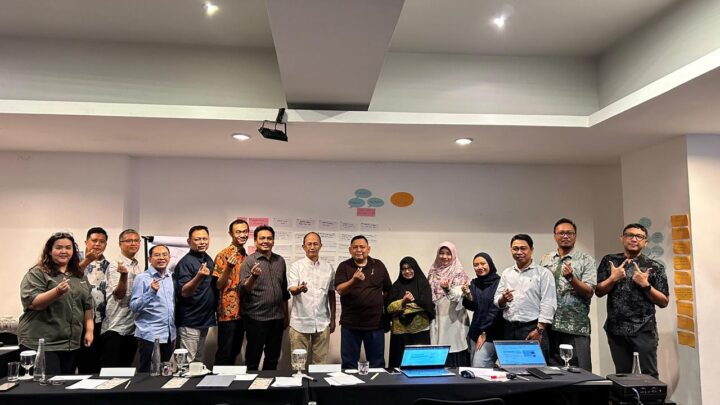
Surabaya – The East Java Chamber of Commerce and Industry (Kadin East Java), in collaboration with Kadin Institute and the Swiss Foundation for Technical Cooperation (Swisscontact), has launched a training program to develop Job and Occupational Analysis (JOA) facilitators through the Industry-Based Curriculum (IBC) initiative. Held in Surabaya from June 29 to July 3, 2026, the program aims to strengthen the development of vocational education curricula that are genuinely aligned with industry needs.
The JOA facilitator training marks the first step in preparing professionals capable of conducting comprehensive occupational analyses. These analyses cover job duties and responsibilities, required competencies, future workforce trends, basic qualifications, and other key information related to workforce competencies.
Chairman of Kadin East Java, Adik Dwi Putranto, said participants—particularly those from Kadin East Java—will later assist industries in collaborating with schools, universities, and polytechnics to ensure that vocational curricula are closely aligned with the needs of the business sector.
"Industry needs, particularly in the field of information technology, are evolving rapidly, while curriculum revisions often take much longer. Therefore, support from JOA facilitators provides a practical solution to keep curricula relevant to the latest industrial developments," Adik said in Surabaya, East Java, on Friday (July 3, 2026).
According to Adik, curriculum harmonization will benefit both educational institutions and industry. Graduates are expected to possess competencies that match employers' needs, while internship programs can be implemented more effectively because learning materials at schools and universities will already reflect industry requirements.
"Through Kadin East Java Institute, we will teach industries how to harmonize curricula. At the same time, we will assist teachers and lecturers in developing a shared understanding of how to design curricula based on industry needs," Adik said.
He added that each facilitator is expected to support at least 10 companies and their partner educational institutions. With 10 facilitators participating in the first training cohort, Kadin East Java expects the program to reach approximately 100 companies in its initial phase before expanding across the province.
"We will also equip Kadin chapters at the regency and municipal levels with the same capabilities. Our hope is that more industries can be supported, enabling more schools and universities to implement curricula that meet labor market needs," Adik explained.
Meanwhile, Swisscontact Senior Program Officer for Vocational Education and Training (VET) Development, Ilham Hasbiullah, said the trained facilitators will play a crucial role in producing occupational analysis documents that serve as the foundation for developing vocational education curricula.
"Facilitators will be able to develop comprehensive occupational analyses covering job duties and responsibilities, required competencies, future employment trends, basic requirements, and various other aspects related to workforce competencies," Ilham said.
According to Ilham, the JOA results will serve as references for curriculum development across multiple levels of education, including vocational high schools, higher education institutions, and vocational training centers. This approach ensures that learning materials are built around competencies genuinely required by industry.
Ilham explained that curriculum development has traditionally been initiated by educational institutions before being validated by industry. He noted that this approach has contributed to the competency gap between graduates and labor market demands.
"If we want to reduce the skills mismatch, the process needs to be reversed. Job analysis should begin within industry, and only then should the findings be translated into curricula. In other words, curricula should be driven by industry demand—not the other way around," he said.
He added that this approach is expected to help reduce the competency gap that has long contributed to the relatively high unemployment rate among vocational education graduates, particularly those from vocational high schools. However, he emphasized that unemployment is influenced by many factors beyond curriculum alone.
In addition to serving as the basis for curriculum development, JOA findings will also determine how learning responsibilities are divided between educational institutions and industry. Competencies that can be taught effectively in classrooms will be distinguished from those that should be acquired through direct workplace experience.
"Through JOA, we can determine which competencies are best taught at school and which should be learned directly in industry. This will strengthen the implementation of the dual education system," Ilham explained.
The five-day training program brought together 10 prospective facilitators from industry, higher education institutions, and government agencies. Participants received theoretical instruction on the JOA methodology, interviewing techniques for gathering information from industry experts, occupational analysis documentation, and practical simulations as both facilitators and industry panelists.
Ilham noted that the implementation team has so far completed approximately 80 Job and Occupational Analyses across various sectors through partnerships with Indonesia's Ministry of Industry and other stakeholders. The training organized with Kadin East Java marks the first JOA facilitator program conducted within the Kadin network, expanding the application of the methodology beyond educational institutions.
"We hope that, in the future, every vocational education curriculum will begin with a Job and Occupational Analysis. That way, curricula will truly be demand-driven and aligned with industry needs, ensuring graduates possess relevant competencies and are better prepared to enter the workforce," Ilham concluded.