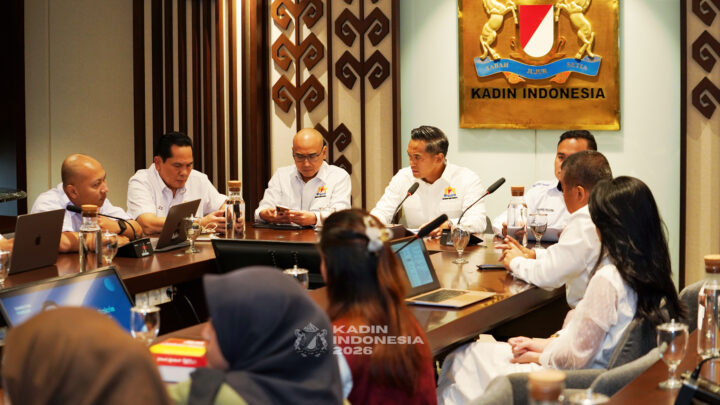
Jakarta – The Indonesian Chamber of Commerce and Industry (Kadin) Indonesia Institute released the results of the Q2 2026 Kadin Business Pulse, titled “Business Resilience Amid Rupiah Depreciation and ICA-CEPA Opportunities,” at Menara Kadin Indonesia, South Jakarta, on Wednesday (15/07/2026).
The Chairman of Kadin Indonesia, Anindya Novyan Bakrie, stated that the Kadin Business Pulse is an instrument routinely published every quarter to capture the landscape of the business world, while simultaneously serving as input for the government in formulating economic policies.
Anindya, familiarly known as Anin, explained that the Business Pulse serves as a dashboard for the business community to monitor various economic indicators, ranging from business conditions, regulations, bureaucracy, and government policies, to public purchasing power. The survey also encompasses businesses of various scales, ranging from micro, small, and medium enterprises (MSMEs) to large corporations.
According to Anin, the business world faced various challenges throughout the second quarter of 2026, spanning from geopolitical uncertainty due to conflicts in the Middle East, pressure on the rupiah exchange rate, regulatory certainty, and public purchasing power, to rising energy costs.
Nevertheless, Anin assessed that global investors' attention toward Indonesia is no longer focused on the scale of its economic potential, but rather on Indonesia's capability to execute various policies.
"Today, the outside world no longer questions Indonesia's potential. They already understand and believe in it. What is constantly asked is whether Indonesia can execute its policies, whether its regulations offer certainty, and whether Indonesia has the talent to achieve Golden Indonesia (Golden Indonesia)," Anin said.
According to Anin, this situation has actually driven Kadin to become more active in visiting various regions to strengthen communication with business actors, while delivering information and policy advocacy.
“That is where we see the greatest need. Kadin must be present as a strategic partner to the government, while also serving as a home for the business community,” Anin stated.
Furthermore, Anin emphasized that Indonesia's economic fundamentals remain strong amid various global challenges. He expressed optimism that Indonesia's economic growth could still be sustained in the range of 5 percent in 2026.
“Inflation is also well-contained, and our debt-to-GDP ratio is one of the best in the G20,” Anin added.
In addition, Anin noted that global geopolitical pressures have begun to ease, accompanied by the emergence of positive sentiment toward Indonesia. Anin assessed that Indonesia is currently entering an economic transformation phase, shifting from a natural resource-based economy to a human resource-based economy.
“Indonesia is transforming from being natural resource-based to human resource-based. In every transition, there are certainly challenges, so we must prepare to improve the quality of our human resources,” Anin said.
On the other hand, Anin viewed that the business world also needs to adapt to a new global economic order (new equilibrium). According to him, this condition must be faced realistically while maintaining optimism.
“This is the new equilibrium. We certainly want the rupiah to strengthen and interest rates to drop, but we also have to look at the situation as it is with a cool head. Usually, after one to three years, when confidence returns, the situation will reverse,” Anin remarked.
To that end, Anin encouraged business actors to continue driving efficiency, accelerate technology adoption, maintain employment, and expand export markets by utilizing various international trade agreements.
Furthermore, Anin highlighted the low utilization of trade agreements by the business community, including the Indonesia-Canada Comprehensive Economic Partnership Agreement (ICA-CEPA), despite the massive export opportunities available.
“It would be a great shame if we do not increase exports, considering that around 80 percent of business actors are unaware of the details regarding CEPA utilization. This is despite the agreement with the European Union coming into effect soon, and the one with Canada having already been signed early this year,” Anin explained.
Meanwhile, the Director of Insights at the Kadin Indonesia Institute, Fakhrul Fulvian, stated that the survey results showed that business sentiment in Q2 2026 continued to experience a slowdown compared to the previous quarter. According to him, the depreciation of the rupiah exchange rate and uncertainty regarding fiscal policy were the primary concerns for business actors.
“The Q2 results indicate that business sentiment remains weaker compared to Q1. The main concerns of business actors are the weakening rupiah and the certainty of the government's fiscal policy,” Fakhrul said.
Nevertheless, Fakhrul observed that optimism among business actors has begun to improve as global geopolitical risks ease, particularly the conflict in the Middle East. According to him, export-oriented business actors are starting to see opportunities for improvement in international market conditions.
“Business actors are beginning to look at global developments with more optimism, as the risk of war in the Middle East is lower than in Q1. Export-oriented companies are starting to feel an upside from this condition,” he said.
From an operational standpoint, the weakening rupiah is deemed to have exerted the greatest pressure on rising business costs. At the same time, business actors face challenges in maintaining profit margins because they have not been able to fully pass on the increase in raw material costs to consumers, whose purchasing power remains limited.
“The most significant concern is the rise in operational costs due to the weakening rupiah. On the other hand, business actors cannot fully pass on the increase in raw material prices because public purchasing power has not fully recovered,” he stated.
Based on the survey results, the Kadin Indonesia Institute concluded that there are four priority steps the government needs to address to rebuild business optimism: maintaining the stability of the rupiah exchange rate, providing regulatory certainty, presenting a clear direction for fiscal policy, and boosting public purchasing power through strong and credible fiscal stimulus.
He also hopes that various regulatory uncertainties, particularly those related to flagship commodity sectors, can be resolved swiftly so as not to disrupt export performance or Indonesia's current account.
“From the business world's perspective, the expectation is naturally for it to be done as quickly as possible. Regulatory uncertainty, especially regarding flagship commodities, must be resolved immediately because it can disrupt exports and put pressure on the rupiah,” he said.
On another note, the Executive Director of the Kadin Indonesia Institute asserted that the government needs to prioritize stabilizing the rupiah exchange rate, ensuring policy direction certainty, and simplifying bureaucracy, given that these three factors are both the main sources of pressure and the primary hopes of business actors amidst weakening business sentiment.
In addition, affirmative support, such as easier access to financing, needs to be directed toward small and medium enterprises (SMEs) which are the most vulnerable. The socialization of the ICA-CEPA also needs to be expanded so that the benefits of the agreement can be optimally utilized by the business community.
“The findings of the Q2-2026 Business Pulse confirm that the Indonesian business world is facing multi-layered pressures, ranging from the weakening rupiah and bureaucracy to a lack of understanding regarding new cooperation opportunities like the ICA-CEPA. Our collective task is to ensure that policy certainty arrives faster than the pressures felt by business actors, while also expanding socialization so that opportunities like the ICA-CEPA can truly be utilized, especially by the most vulnerable small and medium enterprises,” concluded Mulya.
Key Findings of Q2-2026: Business and Investment Sentiment Continues to Weaken
-
Business conditions weakened further. A total of 47.1% of business actors assessed that Q2-2026 business conditions deteriorated compared to the previous quarter, up from 40.5% in Q1-2026, while those who felt it improved fell to 22.8% from 25.2%. Small and Medium Enterprises were the hardest hit segment, with 50.6% reporting that their business conditions worsened.
-
The industrial sector weakened more sharply. Around 51.8% of business actors assessed that conditions in the industrial sector deteriorated, up from 44.3% in Q1-2026, indicating that demand and cost pressures are increasingly felt on the production side.
-
Investment appetite remains constrained. A total of 43.5% of business actors stated they have no plans to invest in the next six months, up from 39.0% in Q1-2026, while those planning to invest fell to 34.4% from 38.6%. Small and Medium Enterprises were once again the most pressured group, with 58.4% stating they have no plans to invest.
-
Bureaucracy & regulation became the highest challenge. Bureaucracy & regulation challenges rose to 16.4% from 14.3% in Q1-2026, driven partly by the RKAB (Work Plan and Budget) regulations in the mining sector, displacing government policies & programs (14.8%) which was previously the top challenge.
-
Market and technology remain sources of optimism. Market developments (26.6%) remained the primary driver of positive business growth, supported by improving international market conditions as geopolitical conflicts in the Middle East subsided, although technological developments declined to 19.1% from 22.0%.
Also present on the occasion were the Vice Coordinator Chairman of Organization, Communication, and Regional Empowerment of Kadin Indonesia, Erwin Aksa, and the Vice Chairman of Regional Autonomy of Kadin Indonesia, Sarman Simanjorang.