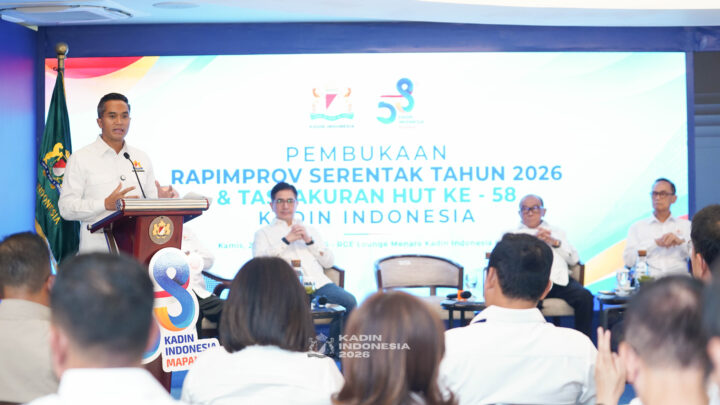
Jakarta – The Indonesian Chamber of Commerce and Industry (Kadin Indonesia) officially opened the 2026 Simultaneous Provincial Leadership Meetings (Rapimprov), held across all provinces and accompanied by a thanksgiving event commemorating Kadin Indonesia’s 58th anniversary on September 24, 2026.
Chairman of Kadin Indonesia Anindya Novyan Bakrie said the simultaneous Rapimprov meetings, held in all 38 provinces, serve as a forum to gather aspirations and input from the business community at the regional level, which will subsequently be brought to the national level.
According to Anin, as he is commonly known, one of the main focuses of the Rapimprov is to encourage micro, small, and medium enterprises (MSMEs) to move up the value chain and become reliable exporters. He said this was important as Kadin seeks to strengthen the organization and increase the contribution of the business community to the national economy.
“But most importantly, here we also emphasize how MSMEs can move up the value chain and eventually become reliable exporters. Because when the organization is strong, the results will certainly be good,” Anin said.
Anin said the simultaneous Rapimprov meetings are also part of efforts to strengthen cooperation between the business community and the government in addressing various economic challenges, both domestically and internationally.
“We realize that the government is currently working hard to address the many economic challenges, both domestic and international, to create more jobs and, of course, ensure that we remain competitive and move out of the middle-income trap,” Anin said.
Furthermore, Anin explained that the Rapimprov meetings are being held simultaneously in all 38 provinces together with their respective governors. Various inputs from the regions will subsequently be consolidated and brought to the Kadin National Leadership Meeting (Rapimnas), scheduled to take place on October 29–31, 2026.
“This shows that whatever we present at next month’s Rapimnas will be the result of today’s Rapimprov meetings, which will provide highly valuable input, inspiration, and aspirations,” Anin said.
Anin added that the outcomes of the Rapimprov meetings in all 38 provinces would serve as input for the government to strengthen synergy between the business community and the government, including ensuring that policies and regulations are aligned with the needs of the business community.
Anin noted that Kadin has identified several key areas of focus, including energy resilience, food resilience, strengthening MSME capacity, economic diplomacy to boost exports, job creation, and the development of a conducive business climate.
“Energy resilience is a priority, food resilience is also a major priority, and helping MSMEs move up the value chain is another key focus. We are also focused on how economic diplomacy can generate better export performance,” he said.
Furthermore, Anin said these efforts are aligned with the Indonesia Incorporated concept, which emphasizes collaboration among the business community, government, and academia at both the national and regional levels.
According to Anin, this spirit is also in line with the people-centered economy mandated by Article 33 of the 1945 Constitution. Therefore, the benefits of economic development are expected not only to be enjoyed by established groups, but also to help MSMEs, regional businesses, and corporations move up the value chain.
“That is why the people-centered economy must be present and must also be developed. This can actually strengthen Indonesia’s competitiveness, especially amid the slight decline in the middle class,” Anin said.
Meanwhile, Chairman of the Advisory Board of Kadin Indonesia Arsjad Rasjid said there are four areas that should be prioritized in the 2026 Rapimprov meetings. First, strengthening the role of Provincial Kadin as an accelerator of regional economic growth. Second, strengthening the growth of regional entrepreneurs, including MSMEs, so they can move up the value chain.
Third, helping address cross-sector business challenges by strengthening coordination with regional governments and other stakeholders. Fourth, strengthening the organizational governance of Provincial Kadin as well as Regency/City Kadin and consistently implementing organizational regulations.
“The strength of Kadin Indonesia starts with active, solid, and business-oriented Provincial Kadin and Regency/City Kadin. I hope the 2026 Kadin Rapimprov meetings run smoothly and constructively, and produce decisions that can genuinely be followed up in their respective regions,” Arsjad said.
The 58th anniversary commemoration of Kadin Indonesia continued with the symbolic presentation of donations to orphans, a joint prayer with the children, and the traditional tumpeng-cutting ceremony.
Also attending the event were members of the Kadin Indonesia Honorary Board, including Aburizal Bakrie, Adi Putra Tahir, and Suryo Bambang Sulistyo, as well as member of the Kadin Indonesia Business Council Putri Wardhani.
Also in attendance were members of Kadin Indonesia’s leadership, including Coordinating Deputy Chairman (WKUK) for Food Mulyadi Jayabaya, WKUK for Foreign Affairs James T. Riady, WKUK for Infrastructure and Regional Development Carmelita Hartoto, WKUK for Law and Human Rights, Facilities/Infrastructure M. Azis Syamsuddin, and WKUK for Export Development Juan Permata Adoe.