Surabaya – The performance of micro, small, and medium enterprises (MSMEs) in Indonesia is considered to remain below its full potential, particularly in accessing export markets.
The East Java Chamber of Commerce and Industry (Kadin) said the situation requires not only support from the government and banking sector, but also a shift in the mindset of MSME players to become more independent and more willing to compete.
Deputy Chairman of East Java Kadin for International Trade and Overseas Promotion, Tommy Kayhatu, said around 57 million MSME entrepreneurs in Indonesia make a significant contribution to the national economy.
The sector contributes 60.5 percent to gross domestic product (GDP) and accounts for 97 percent of employment. However, MSMEs' contribution to exports remains relatively low, at around 15.7 percent of total national exports.
According to Tommy, these figures indicate that there is still substantial work to be done to strengthen MSME capacity. Government support and assistance from various stakeholders, including the banking sector, need to be continuously strengthened. At the same time, MSME players must also make changes from within.
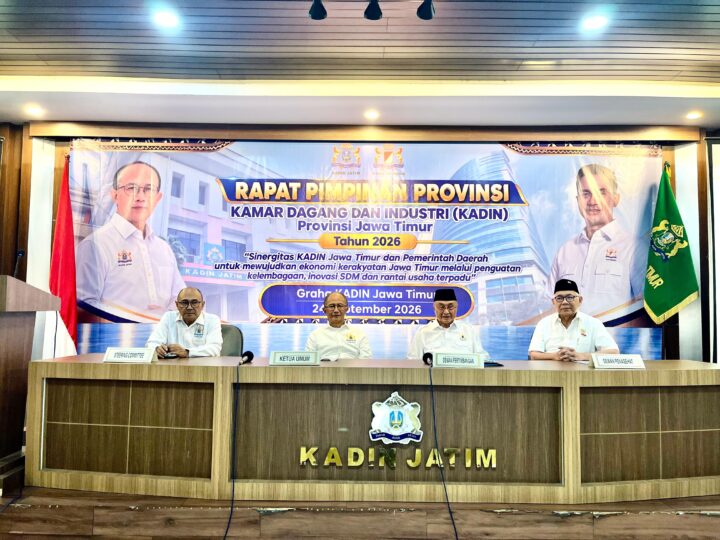
“Micro and small businesses should not become parties that continue to depend on assistance. MSME players must have the courage to continue growing and fight to compete,” Tommy said during a dialogue titled “Synergy between East Java Kadin and Local Governments to Realize a People-Based Economy in East Java through Institutional Strengthening, Human Resources Innovation, and an Integrated Business Chain” held as part of the 2026 East Java Kadin Provincial Leadership Meeting (Rapimprov) at Graha Kadin Jatim, Surabaya, on Thursday (Sept. 24, 2026).
He said developing the mindset of MSME players is one of the keys to strengthening the sector. Some MSMEs, he noted, have become too accustomed to receiving assistance, limiting their drive to develop their businesses independently and take advantage of new opportunities.
Therefore, assistance for MSMEs needs to be accompanied by stronger business capacity. MSME players need to be able to manage their businesses, increase production, expand marketing, and build business networks. “The most important thing is to develop the mindset of MSME players,” he emphasized.
Tommy said institutional strengthening is also an important part of the process. Institutional development is not merely about establishing organizations, but about building business systems that enable MSMEs to grow independently, covering areas ranging from legal compliance, management, and financing to production capacity and marketing.
The government, he added, has a strong interest in strengthening MSMEs because the sector is directly linked to job creation and reducing unemployment. Therefore, the relationship between the government and MSMEs should be positioned as a partnership.
“The government provides support and opens access, while MSMEs must also strengthen their institutional capacity so they can grow and compete,” he said.
The challenge becomes greater as MSMEs seek to enter export markets. Tommy said current global market conditions remain challenging, while many MSMEs continue to face limitations in production capacity, product quality, management, and the confidence to enter broader markets.
MSME competitiveness is also closely linked to the quality of human resources (HR). Deputy Chairman of East Java Kadin for Human Resources and Director of Kadin Institute, Nurul Indah Susanti, said the gap between workforce competencies and industry requirements is one of the issues affecting MSME productivity.
“The main issue is the gap in human resources and workforce quality. Skilled workers are not yet aligned with industry needs. Low MSME productivity is related to human resources,” she said.
According to Nurul, workforce competencies need to be aligned with industry requirements to make production processes more effective and efficient.
“If they do not meet industry needs, productivity will certainly decline. The key to productivity is increased production and efficiency,” she said.
Therefore, efforts to improve HR competencies need to be carried out through training and certification, while also being strengthened by upskilling and reskilling programs so that workers can adapt to changing industry requirements.
Meanwhile, Deputy Chairman of East Java Kadin for Islamic Banking, Zaki Basalamah, highlighted challenges facing East Java from a trade perspective. He said East Java's exports declined by 5.33 percent in January-July 2026, while imports increased by around 16.56 percent.
According to Zaki, the increase in imports needs to be examined further based on the composition of imported goods. Imports of capital goods and raw materials can support production activities, while imports of consumer goods have a different multiplier effect on the economy.
“What if these imports are consumer goods rather than capital goods? When imports consist of consumer goods, there is no multiplier effect. This is the issue we are facing,” he said.
He said East Java's challenge is not merely to maintain economic growth above five percent, but also to translate that growth into greater productivity, competitiveness, quality employment, and equitable economic development.
At the same time, MSME development must be connected to broader business chains. Deputy Chairman of East Java Kadin for Agriculture, Edi Purwanto, said partnerships between large companies and MSMEs are important to provide small businesses with market access and opportunities to enter supply chains.
According to Edi, Kadin has a role to play as a bridge and orchestrator of government programs, including by connecting MSMEs with large companies, markets, and financing institutions.
“Since the focus is on the MSME sector, partnerships are very important. There needs to be an equitable distribution of opportunities from large companies, including how they can bring strong partners together with these MSMEs,” he said.
Strengthening business chains is also linked to food security. Edi said East Java holds a strategic position as one of Indonesia's national food-producing regions. However, food security cannot be achieved simply by increasing production. Distribution, food reserves, market access, and supply chains must also be strengthened. He said the lack of an integrated supply chain remains both a challenge and an opportunity for the business community.
“The supply chain business has not been well integrated so far. This is a challenge: how can we maintain food security when the supply chain can operate much more effectively?” he said.
In this context, East Java Kadin, together with Kadin organizations at the regency and city levels, is expected to play a greater role in connecting the government, business community, MSMEs, and the banking sector.
Ultimately, strengthening MSMEs cannot rely solely on assistance. Policy support, financing, and market access need to go hand in hand with a shift in mindset, improvements in human resource quality, and stronger institutions to enable MSMEs to grow and enhance their competitiveness.