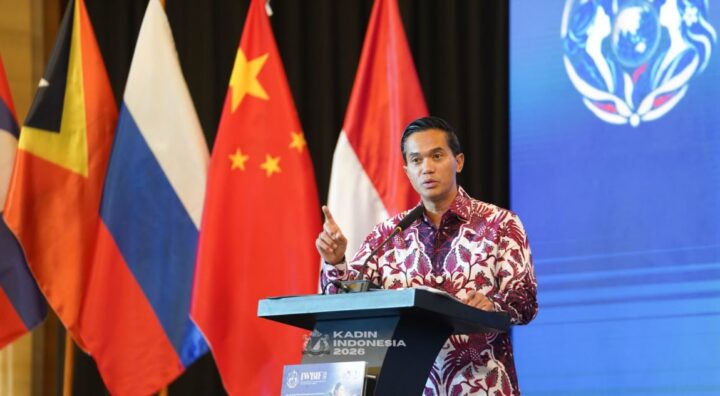
Jakarta – Chairman of the Indonesian Chamber of Commerce and Industry (Kadin Indonesia) Anindya Novyan Bakrie has urged MSCI to assess Indonesia’s capital market objectively, transparently, and proportionately, taking into account overall market conditions and the progress of ongoing reforms. The proposed reclassification of Indonesia from Emerging Market to Standalone Market carries significant implications for investor confidence, business financing, and the interests of public shareholders.
Anindya, commonly known as Anin, emphasized that Kadin respects MSCI’s independence as a global index provider. However, this independence should be accompanied by transparency regarding the basis of its assessments, consistency in the evaluation process, and fair recognition of improvements that have already been made.
“We respect MSCI as an independent institution that plays an important role in the global investment ecosystem. At the same time, we urge MSCI to assess Indonesia comprehensively, based on evidence and in a proportionate manner. Shortcomings must be addressed, but the progress already achieved must also be fairly recognized,” Anin said.
Kadin has raised concerns about the timing of the reclassification consultation, which was opened on October 15, 2026, New York time, or October 16, 2026, Indonesian time. MSCI had previously stated that if sufficient progress was not evident by its November 2026 index review, it would consider launching a consultation on changing Indonesia’s market classification. Therefore, opening the consultation in mid-October warrants an explanation of the considerations and evidence underlying the move.
“The public and the business community are entitled to an explanation: why was the reclassification consultation opened before the November evaluation deadline that had previously served as the reference point? What new findings prompted this move, and how has Indonesia’s reform progress been taken into account? Clarity on these matters is essential to maintaining confidence in the objectivity of the assessment process,” Anin said.
Kadin recognizes that regular index reviews and market classification consultations are separate processes. Therefore, the issue requiring clarification is not simply the difference in timing, but the consistency between previous communications, the opportunity to demonstrate reform outcomes, and the rationale for opening the consultation earlier than expected.
Although no final decision has been made, the proposed status change poses a serious risk to Indonesia’s capital market. If implemented, the Standalone Market classification would place Indonesia outside MSCI’s Emerging Markets index group. The consequences could include portfolio adjustments by global investors, a narrower investor base, and increased pressure on stock valuations and companies’ access to financing.
Market pressure was already evident in trading on Friday, October 16, 2026. Amid concerns over MSCI’s proposal, the Jakarta Composite Index (JCI) closed down 11.57% at 5,185.10. This movement highlights the market’s sensitivity to communications concerning a potential change in classification.
“The impact extends to companies that need capital to expand, create jobs, and drive economic activity. Millions of investors and public shareholders also have a stake in a healthy market and balanced assessments. Therefore, communications that could trigger significant market disruption must be accompanied by a clear rationale,” Anin said.
According to Kadin, reclassifying Indonesia as a Standalone Market would be disproportionate if it failed to fully consider the number, diversity, and quality of listed companies; market capitalization; trading frequency and value; market infrastructure; and governance improvements. Indonesia’s market size and its role in financing the economy must form part of a comprehensive evaluation.
At the same time, Kadin acknowledges that market size alone does not determine investment eligibility. Ownership transparency, the quality of shares genuinely available to the public, or free float, investor accessibility, and the integrity of price formation remain essential requirements. Therefore, efforts to defend Indonesia’s capital market must go hand in hand with demonstrable improvements.
“We believe Indonesia’s capital market deserves to retain its Emerging Market classification. Issues involving specific stocks or parties must be addressed firmly and in a measured manner. Assessments of the overall market must also take into account issuers that operate sound businesses and comply with governance requirements,” Anin stressed.
Kadin supports the implementation of the Eight Capital Market Reform Programs by the Financial Services Authority (OJK), self-regulatory organizations (SROs), and industry participants. The agenda includes raising the minimum free float requirement to 15%, with transitional provisions for existing listed companies; strengthening transparency regarding ultimate beneficial owners (UBOs); and improving the quality and granularity of share ownership data.
Other measures include preparing for stock exchange demutualization to strengthen governance and reduce conflicts of interest; consistently enforcing regulations and sanctions; improving corporate governance among listed companies; deepening the market through an integrated approach; and strengthening collaboration among the government, regulators, SROs, and industry participants.
Measures reported by OJK, including the disclosure of shareholdings above 1%, more detailed investor classifications, the disclosure of high concentrations of share ownership, and the policy to raise the minimum free float requirement, represent tangible progress that should be taken into account. However, these policies must also be assessed to determine their effectiveness in improving transparency and ensuring fair trading.
“Reforms are already underway and have produced concrete measures. We ask MSCI to assess this progress fairly while specifying which areas remain below its standards and what evidence of improvement is required. This would ensure that the consultation process provides a clear direction for further reforms,” Anin said.
Despite its objections to MSCI’s proposal, Kadin stressed that the situation should serve as a wake-up call for OJK, SROs, the government, capital market participants, and listed companies to accelerate improvements. Law enforcement against market manipulation, concealment of ownership, and the dissemination of misleading information must be consistent and transparent, with penalties strong enough to deter violations.
Kadin also urges listed companies to improve disclosure of affiliated relationships and ultimate beneficial owners, ensure the quality of their free float, and uphold fair treatment of public shareholders. The government and regulators should strengthen policy certainty and communicate measurable reform outcomes to domestic and international investors.
“We must use MSCI’s assessment as a wake-up call to improve. External criticism must be addressed with data, action, and verifiable results. Protecting public investors, enforcing the rules, and building a transparent market are in Indonesia’s own interests,” Anin said.
Kadin Indonesia stands ready to support constructive dialogue among the business community, capital market authorities, MSCI, and global investors. Such dialogue should focus on building a shared understanding of market conditions, establishing indicators of successful reform, and identifying concrete steps to restore confidence.
“We urge MSCI to act objectively and proportionately. We also call on all stakeholders in Indonesia to intensify their efforts. Trust must be built through a capital market that is transparent, fair, and credible, and that can effectively finance economic growth,” Anin concluded.