

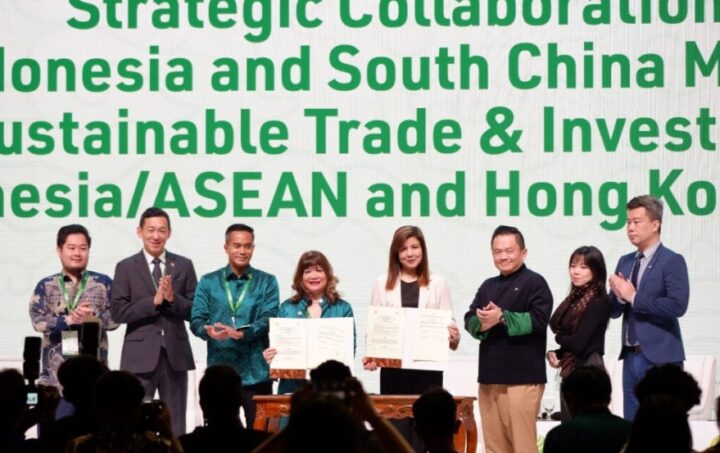

Jakarta, October 11, 2025 – The Indonesia International Sustainability Forum (ISF) 2025 officially concluded with significant outcomes, including the signing of 13 Memorandums of Understanding (MoUs) and the launch or declaration of three strategic initiatives, reflecting a strong multi-stakeholder commitment to advancing sustainable investment. The MoUs, ranging from research collaboration to concrete investment commitments, represent a total pledged value of IDR 278 trillion (approx. USD 17.6 billion), covering sectors such as clean energy, marine economy, carbon markets, forestry, and green infrastructure.
The forum marked a clear shift from dialogue to action, as both domestic and global stakeholders came together to accelerate Indonesia’s transition toward a green economy. The commitments were made not only by national and international corporations but also by financial institutions, development partners, and both central and regional governments.
"The signing of these 13 MoUs at ISF 2025 is expected to directly contribute to Indonesia’s clean energy transition and low-carbon economic agenda. These collaborations show that Indonesia is no longer in a wait-and-see position—we are taking the lead, bridging our national development priorities with global sustainability goals. ISF has now become a cross-sector platform that transforms ambition into concrete action," said Rachmat Kaimuddin, Deputy for Basic Infrastructure Coordination at the Coordinating Ministry for Infrastructure and Regional Development.
Echoing this, Nurul Ichwan, Deputy for Investment Promotion at the Ministry of Investment/BKPM, noted that the MoUs signed during ISF 2025 cover a wide range of collaborations—from strategic partnerships and grants to new investment commitments. He emphasized the critical importance of the investment aspect, as it represents a tangible commitment from the business sector to support sustainable development.
"Beyond the MoU values themselves, there are accompanying investment commitments—Minister Rosan has highlighted that over IDR 200 trillion worth of investments can already be committed. This doesn’t mean the entire amount will be disbursed this year, but it demonstrates clear intent. These commitments can be seen as key outcomes of ISF 2025," Nurul added.
ISF 2025 has gone beyond being just a discussion forum—it has elevated Indonesia’s role as a developing country willing to lead through concrete initiatives. These include projects such as floating solar power plants, heavy industry decarbonization, sustainable coastal development, and the promotion of a blue economy through seaweed-based industries.
"The MoUs we signed today are proof that Indonesian businesses are ready to be at the forefront of the green transition. Green investment not only strengthens economic growth but also creates opportunities for MSMEs, job creation, and a resilient, sustainable industrial transformation. ISF is a platform for strategic collaboration—and Kadin is committed to ensuring its benefits reach the grassroots level," said Shinta W. Kamdani, Vice Chair for Human Capital, Culture, and Sustainable Development at the Indonesian Chamber of Commerce and Industry (Kadin).
With a strong emphasis on cross-sector collaboration between government, business, financial institutions, and development partners, ISF 2025 strengthens its position as a new model for strategic partnerships in achieving the Sustainable Development Goals (SDGs), and reinforces Indonesia’s leadership in the global green economy.
Infrastructure Project Facilitation Office (IPFO)
Signatories: Coordinating Ministry for Infrastructure, ADB, KIAT
Purpose: Establishment of a strategic infrastructure facilitation office with international technical and financial support.
Investment potential: USD 11 billion.
Indonesia Incorporated on Seaweed – Advancing a Sustainable Blue Economy
Signatories: Conservation International, Konservasi Indonesia, APINDO, Standard Chartered
Focus: Sustainable seaweed industry development supporting blue economy, ocean restoration, and coastal inclusion.
Standby Trade & Loan Facility for Dieng 2 Geothermal Plant
Signatories: PT Bank Negara Indonesia (BNI), PT Geo Dipa Energi
Focus: Financing support for national clean energy acceleration.
Net Zero Advisory & Solutions Strategic Collaboration
Signatories: BESTARI, Utomodeck Group
Focus: Decarbonization strategy consulting and solutions for manufacturing and construction sectors.
Maritime Infrastructure Partnership for Clean Mobility
Signatories: PT Utomo Mobilitas Bersih Indonesia, Pyxis Maritime Pte. Ltd
Focus: Development of low-emission port and vessel infrastructure.
Indonesia–Germany Cooperation for Sustainable Development
Signatories: GIZ (Germany), Kadin Indonesia
Focus: Strengthening private sector capacity for resilient and carbon-neutral development.
Sustainable Forestry Policy and Investment Program
Signatories: Kadin Indonesia, Ministry of Environment and Forestry
Focus: Trial of multi-product sustainable forestry business models.
Carbon Markets Capacity Building
Signatories: Ministry of Environment and Forestry, IETA (International Emissions Trading Association)
Focus: Building credible and transparent carbon market systems in Indonesia.
Sustainable Paper & Packaging Innovation
Signatories: Asia Pulp & Paper (APP), Lubrizol
Focus: Development of bio-based, compostable food packaging to reduce plastic waste.
Strategic Alliance for Industrial Decarbonization
Signatories: Pupuk Indonesia, ACWA Power
Focus: Transitioning fertilizer production assets to low-carbon operations.
Investment potential: Up to USD 250 million.
Green Hydrogen for Maritime Transport in Small Islands
Signatories: GIZ, HDF Energy, Neuman & Esser
Focus: Exploring green hydrogen for maritime decarbonization in Indonesia’s remote islands.
Sustainable Used Cooking Oil Collection & Initiatives
Signatories: PT Noovoleum Indonesia Investama, PT Artotel Group Indonesia
Focus: Sustainable UCO collection and other green initiatives.
Sustainable Trade & Investment Corridors with Greater China
Signatories: Kadin Indonesia, South China Morning Post (SCMP)
Focus: Strengthening trade and investment corridors between Indonesia/Southeast Asia and Hong Kong/Greater China.
In addition to the MoUs, three strategic declarations and initiative launches were also announced on ISF 2025’s second day:
Launch of the Indonesia Transition Factbook
By: BloombergNEF & Kadin Indonesia
A comprehensive overview of Indonesia’s sustainability transition pathways.
CCS/CCUS Roadmap at Arun Block
By: PT Energi Mega Persada (EMP) & PEMA
Strategic collaboration on carbon capture, utilization, and storage for low-carbon industrial future.
Inauguration of the Indonesian Association of EV Charging Owners (ASPELUSI)
A national platform to support EV infrastructure development and green mobility adoption.
With these MoUs and multi-sectoral collaborations, ISF 2025 has proven itself to be more than a dialogue platform—it is now a practical implementation hub bridging global vision with local needs. The real commitments made by government, business, and international partners reinforce that the green transition is no longer optional—it is now Indonesia’s main development pathway.
ISF is expected to continue accelerating inclusive green policy, innovation, and investment. With a collaborative, stakeholder-driven approach, Indonesia is asserting itself as a key player in the regional sustainability ecosystem and a trusted partner in building a resilient, just, and sustainable future.
The Indonesia International Sustainability Forum (ISF) is an annual forum established in 2023 (initially launched as the Indonesia Sustainability Forum). It serves as a collaborative platform to promote investment, innovation, and concrete implementation of sustainable development in Indonesia.
Since its inception, ISF has achieved significant milestones. In 2023, the forum launched as a country-led initiative, bringing together stakeholders from across sectors. Last year, it hosted over 11,000 registered participants from 53 countries, making it the second-largest climate action forum in Asia-Pacific after COP. ISF 2023 facilitated 12 MoUs in the energy transition and decarbonization sectors and successfully connected strategic projects with new sources of sustainable financing.