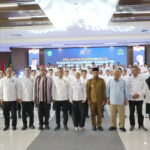





6 February 2026 – JAKARTA – The Asia Pacific Foundation of Canada (APF Canada) today convened policymakers, business leaders, and regional stakeholders at a high-level public–private workshop titled “Connecting Policy, Business & People: Digital Finance and Market Readiness for Inclusive MSMEs,” held on the sidelines of the APEC Business Advisory Council (ABAC) I meeting in Jakarta.
Held at the Shangri-La Hotel Jakarta, the workshop brought together ABAC members, senior government officials, representatives of the Embassy of Canada to Indonesia and Timor-Leste, the Ministry of Cooperatives and SMEs of the Republic of Indonesia, MSME support organizations, and invited participants from across the APEC region to strengthen dialogue on inclusive and gender-responsive MSME policymaking.
APEC Executive Director Eduardo Pedrosa, speaking at the opening session of the ABAC–SOM Dialogue, stated that the event highlighted key issues related to MSMEs and digitalization. He described the workshop as a strong example of effective public–private engagement in advancing policy reforms to support MSME development across the APEC region.
The event forms part of Phase Two of the APEC-Canada Growing Business Partnership (ACGBP)—a five-year, CAD 2.5 million initiative funded by the Government of Canada and implemented by APF Canada in Indonesia, Malaysia, the Philippines, Thailand, and Vietnam. The program aims to promote inclusive economic growth for micro, small, and medium enterprises (MSMEs), with a particular focus on women and young women entrepreneurs.
“Women-led MSMEs are a vital driver of innovation, productivity, and resilience across APEC economies,” said Jeff Nankivell, President and CEO of APF Canada.
“This workshop reflects our commitment to connecting policy, business, and people to ensure that digital finance and market access can be leveraged by those who have too often been left behind.”
Advancing Digital Financial Inclusion
The workshop opened with a panel discussion titled “Strengthening Digital Financial Inclusion for Women Entrepreneurs,” featuring ministry representatives and ABAC members involved in MSME development. Panelists discussed how digital payments, e-wallets, and online marketplaces can help women-led MSMEs improve efficiency, reduce risks, and expand access to domestic and regional markets, while addressing challenges such as digital literacy gaps, data privacy concerns, and financial products that do not yet fully meet the needs of women entrepreneurs.
Drawing on Indonesia’s experience, the discussion also explored opportunities for APEC and ABAC collaboration in developing interoperable payment systems, harmonizing Know-Your-Customer (KYC) standards, and enabling credit data portability to support women entrepreneurs’ participation in the digital economy. Deputy Minister for Entrepreneurship of the Ministry of Cooperatives and SMEs of the Republic of Indonesia, Siti Azizah, highlighted the continuing gaps in financial and digital literacy, noting that 74 percent of transactions are still conducted in cash. She emphasized that expanding access and opportunities in this area is crucial for MSME development in Indonesia, particularly for women-led enterprises.
Strengthening Women-Led MSMEs in Regional Value Chains
Following the panel session, a closed-door roundtable brought together ABAC members and senior government officials to discuss practical strategies to increase the participation of women-led MSMEs in domestic and regional value chains. Discussions highlighted digital adoption, business formalization, intellectual property ownership, certification and standards, export readiness, and the use of free trade agreements to open new market opportunities.
The session emphasized the importance of simplifying regulatory compliance, expanding access to digital tools and market intelligence, and strengthening APEC cooperation in standards harmonization, paperless trade, and inclusive procurement frameworks.
Chair of ABAC Indonesia Anindya Novyan Bakrie expressed appreciation for Canada’s longstanding commitment to MSME development and women’s empowerment, noting that the focus is highly relevant to Indonesia, which has around 60 million MSMEs, more than half of which are led by women.
“I would like to note that Indonesia has around 60 million MSMEs, and more than half are led by women,” he said.
Anindya also stressed the importance of improving market access, liquidity support, and more adaptive business models to enable women entrepreneurs to grow more rapidly.
“To support women entrepreneurs, we need better market access, stronger liquidity support, and business models that are truly easy for them to adopt,” he added.
Supporting APEC’s Inclusive Growth Agenda
The workshop directly supports APEC’s commitments to gender equality and inclusive growth under the La Serena Roadmap for Women and Inclusive Growth (2019), particularly in expanding women entrepreneurs’ access to finance and markets, strengthening MSME leadership, and promoting evidence-based policymaking.
“By grounding policy dialogue in business realities, we can generate more effective and gender-responsive MSME solutions,” added Vina Nadjibulla, Vice President of APF Canada.
Through continued collaboration with ABAC Canada, ABAC Indonesia, and regional partners, APF Canada aims to translate the outcomes of this workshop into concrete policy recommendations to expand digital financing access and supply-chain participation for women-led MSMEs in Indonesia and across the APEC region.
On the sidelines of the workshop, APF Canada and the Indonesian Chamber of Commerce and Industry (Kadin) Indonesia also signed a new Memorandum of Understanding (MoU) reflecting the strengthening Canada–Indonesia partnership at the intersection of policy, research, and business engagement. The MoU, signed in Jakarta by Jeff Nankivell, President and CEO of APF Canada, and Anindya Novyan Bakrie, Chairman of Kadin Indonesia, establishes a framework for closer collaboration in foreign policy analysis, trade and commercial strategy, and applied research in areas of mutual interest.
Through this partnership, the two organizations will collaborate on knowledge exchange, joint research initiatives, and policy dialogues on issues such as critical minerals, food and energy security, and the effective implementation of Canada–Indonesia economic agreements, supporting evidence-based policymaking while strengthening bilateral and regional cooperation.
— END —
About the Asia Pacific Foundation of Canada (APF Canada)
The Asia Pacific Foundation of Canada (APF Canada) is an independent, not-for-profit public institution dedicated to strengthening Canada’s engagement with Asia and deepening Asia’s engagement with Canada. Headquartered in Vancouver, Canada, with an Asia Regional Office in Singapore, APF Canada serves as a bridge between government, business, and academic institutions in Canada and Asia, promoting inclusive growth, resilient partnerships, and innovation across the Indo-Pacific region. Through advanced policy research, strategic forums, and targeted programs in trade, sustainability, security, climate action, education, and regional cooperation, APF Canada aims to strengthen economic ties and people-to-people connections between Asia and Canada.
For more information, visit www.asiapacific.ca.
About the Indonesian Chamber of Commerce and Industry (Kadin) Indonesia
Kadin Indonesia is the umbrella organization for chambers of commerce and business associations across Indonesia, covering all sectors of trade, industry, and services. It is strongly committed to leveraging national economic potential and synergy as a strategic forum for Indonesian CEOs. Privately funded, Kadin serves as an independent voice of the business community and is the only national business organization mandated under Law No. 1 of 1987 to represent the private sector. With a network of 34 provincial chambers and 514 municipal and regency branches, Kadin Indonesia maintains nationwide coverage across all economic sectors.