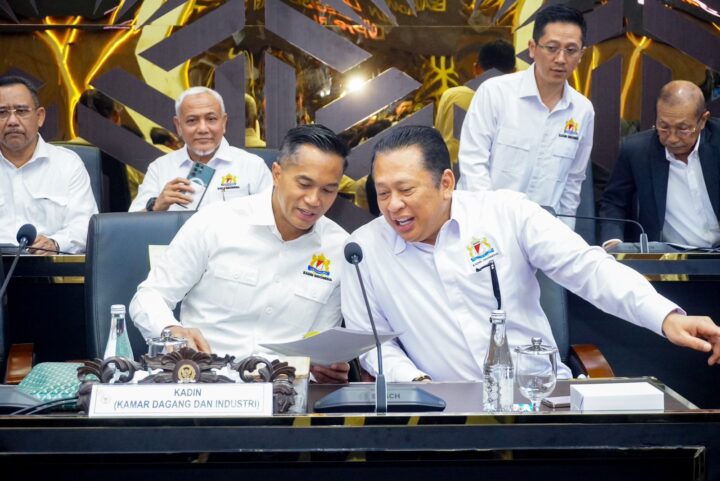
Jakarta – Member of the House of Representatives (DPR RI), the 15th Speaker of the People's Consultative Assembly (MPR RI), and Coordinating Vice Chairman for Politics and Security of the Indonesian Chamber of Commerce and Industry (Kadin), Bambang Soesatyo (Bamsoet), emphasized that revising Law No. 1 of 1987 on the Chamber of Commerce and Industry (Kadin) has become an urgent necessity to address increasingly complex national economic challenges.
Kadin’s position as the representative of the business community needs to be strengthened through a more robust legal foundation so that it can optimally serve as a strategic partner of the government in promoting economic growth, investment, job creation, and enhancing Indonesia’s global competitiveness.
For more than four decades, Kadin has served as a bridge between the government and the business sector. However, changes in the economic structure, advances in digital technology, industrial transformation, and intensifying global competition have made it necessary to strengthen Kadin institutionally through regulatory reforms that are more relevant to contemporary needs. The revision of the Kadin Law aims to provide a strong legal basis for all business actors, ranging from digital startups to small-scale traders, enabling them to connect directly with national policymaking channels.
“Indonesia’s economy today faces challenges that are vastly different from those that existed when the Kadin Law was drafted decades ago. The business community requires certainty, strong coordination, and a clear partnership mechanism between the state and the private sector. Revising the Kadin Law is an essential prerequisite for meeting those needs,” Bamsoet said during a Public Hearing Meeting (RDPU) between the Legislative Body (Baleg) of the House of Representatives and Kadin Indonesia at the Parliament Complex in Jakarta on Wednesday (June 17, 2026).
The hearing was attended by Legislative Body leaders, including Chairman Bob Hasan and Deputy Chairmen Martin Manurung, Iman Sukri, and Sturman Panjaitan. Representing Kadin Indonesia were Chairman Anindya Novyan Bakrie, Coordinating Vice Chairmen James Riady, Azis Syamsuddin, Mulyadi Jayabaya, Bobby Gafur Umar, Erwin Aksa, Nita Yudi, Carmelita Hartoto, Firman Soebagyo, and Taufan Rotorasiko, among others.
The 20th Speaker of the House of Representatives and the 7th Chairman of Commission III explained that the revision of the Kadin Law should transform Kadin into a modern institution capable of consolidating the entire strength of Indonesia’s business community. One of the key proposals is to strengthen Kadin’s status by granting it a position equivalent to a ministry or non-ministerial government institution (sui generis) while maintaining its non-budgetary status. Such legal reinforcement is important because Kadin performs functions that differ from those of mass organizations and professional associations. Kadin carries a public mandate directly linked to national economic development.
The proposed revision also seeks to strengthen Kadin’s position as the sole representative of the business community at the national, provincial, and municipal/regency levels. Bamsoet believes that legal certainty regarding a single business representation body would prevent overlapping authority, leadership disputes, and improve the effectiveness of communication between the government and business actors.
“The government needs one official partner with strong legitimacy to convey the aspirations of the business community. At the same time, business actors require institutional certainty so that their voices can be effectively represented in the policymaking process,” Bamsoet said.
The Vice Chairman of the Golkar Party and Vice Chairman/Head of the FKPPI National Defense Agency explained that the revised Kadin Law would also regulate Kadin’s public function as an institution carrying out quasi-state functions or serving as an institutional mirror. Under this concept, Kadin would be given a role in three key clusters: economic policymaking, business development, and business assistance. Similar practices are commonly found in many developed countries.
The strengthening of Kadin’s role would also be reflected through its direct involvement in formulating strategic policies. The government is expected to involve Kadin in the preparation of the National Medium-Term Development Plan (RPJMN), Regional Medium-Term Development Plans (RPJMD), Development Planning Deliberations (Musrenbang), as well as discussions on draft laws and government regulations that impact the business sector.
“Kadin should also be involved in providing input on the formulation of the State Budget (APBN) and Regional Budgets (APBD). Contributions from the business community are crucial, considering that the private sector remains the primary driver of investment and job creation,” Bamsoet explained.
The Chairman of ARDIN Indonesia and Vice Chairman of Pemuda Pancasila further noted that the Draft Kadin Law proposes granting Kadin authority to issue various international trade recommendation documents, register certification bodies, strengthen training systems, and enforce business ethics through a graduated sanctions mechanism. Strong business standards are essential for improving Indonesia’s competitiveness in the global marketplace.
The revision also proposes a more integrated membership system linked to the national business licensing ecosystem. Kadin membership would become one of the administrative requirements for obtaining a Business Identification Number (NIB), covering national companies, state-owned enterprises (SOEs), regionally owned enterprises (ROEs), cooperatives, and foreign investment companies.
“Another aspect considered highly important is the strengthening of Kadin’s organizational structure from the national to regional levels, as well as the establishment of an internal dispute resolution mechanism through an Ethics Committee whose decisions are final and binding. Such arrangements are expected to provide legal certainty and prevent prolonged conflicts that could potentially disrupt the business climate,” Bamsoet concluded.