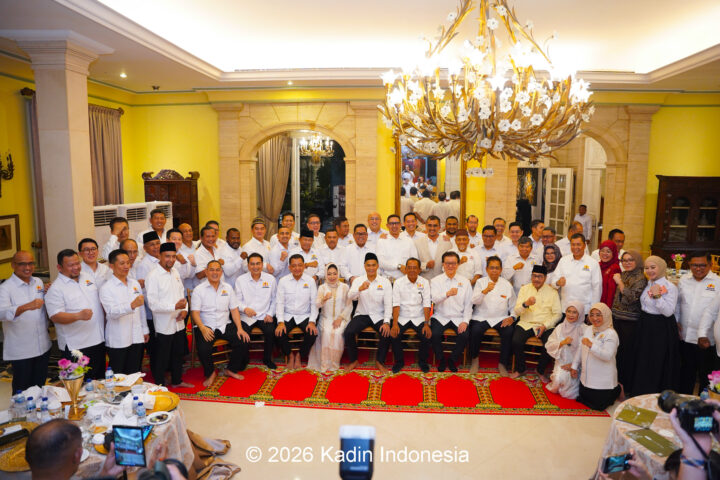
Jakarta – Chairman of the Indonesian Chamber of Commerce and Industry (Kadin) Anindya Novyan Bakrie held a gathering and iftar event with Coordinating Vice Chairpersons of Kadin Indonesia and Chairpersons of Kadin Provincial Chapters from across Indonesia in Menteng, Central Jakarta, on Friday (27/02/2026).
Anindya, who is commonly known as Anin, said that the month of Ramadan provides a timely momentum to strengthen ties while aligning perspectives in encouraging economic growth down to the regional level.
“We invited all Chairpersons of Kadin Provincial Chapters to attend, to see how we can further stimulate economic activity in the regions,” said Anin.
Anin emphasized that the target of national economic growth must be maintained not only at the central level but also across provinces, regencies, and municipalities.
“In the Gross Domestic Product (GDP), aside from government spending—which we must collectively assess in terms of how far it has been implemented—there is also domestic consumption. We also need to examine the state of trade and economic activity in the regions, including exports and imports,” Anin said.
In addition, Anin presented the results of Kadin’s recent international diplomacy efforts, particularly in relation to investment.
“The last aspect is investment. We want to work together to ensure that investment truly enters the country, creates more jobs, and generates new entrepreneurs,” Anin added.
During the event, Kadin also reviewed several of the government’s priority programs, including the Free Nutritious Meals (MBG) program and the Red-and-White Village Cooperatives (KDMP) initiative.
“These priority government programs must be safeguarded and closely supported so they succeed. Regional leaders can provide on-the-ground insights and help ensure the programs are effectively implemented,” Anin explained.
Anin stressed that these programs are funded by the state budget (APBN), therefore it is essential to ensure they are well-targeted and produce economic multiplier effects.
“They must not only reach those in need but also generate downstream impacts. In the near future, Kadin will launch a study called MBGnomics,” said Anin.
He explained that MBGnomics will examine how the MBG program can support the next generation—including around 80 million children and breastfeeding mothers—while also creating new business opportunities in the regions.
“It will explore how regional stakeholders can become successful entrepreneurs in areas such as raw materials, supply chains, and ecosystem development. That is also one of the reasons why we held this gathering today,” Anin said.
Response to the 15 Percent US Import Tariff Issue
Responding to the issue of a 15 percent import tariff imposed by the United States, Anin emphasized the importance of the US as one of Indonesia’s key trading partners.
“When we talk about the United States, it should be noted that the US is our second-largest trading partner, with trade totaling around US$40 billion. This is particularly important for sectors such as garments, textiles, footwear, furniture, and electronics,” Anin said.
Anin noted that there are more than 1,000 types of products that receive tariff incentives of up to 0 percent for exports to the US, including commodities such as cocoa, coffee, and crude palm oil (CPO).
“The objective is to ensure that Indonesian products can enter the United States with moderate tariffs, or even at zero percent,” Anin explained.
Regarding the decision by the US Supreme Court, Anin said the outcome had already been anticipated and would not worsen Indonesia’s position.
“The most important thing is that goodwill between the two countries has already been established. With that decision, the United States will of course need to complete its domestic regulatory adjustments. But I believe Indonesia’s position will not be worse than before,” Anin said.
Anin remains optimistic that Indonesia–US trade will continue to yield positive outcomes. Moreover, several commodities imported from the US—such as soybeans, cotton, and wheat—are indeed required by domestic industries.
“What matters for us is that the prices remain affordable. If the tariff is zero percent, it means it will ultimately be cheaper for our consumers,” Anin said.
Furthermore, responding to changes in US tariff policies, Anin stated that national businesses should increase their production capacity to seize export opportunities.
“Indonesia must prepare to expand its production capacity. If markets are opening in the United States, as well as in Europe and Canada—and generally they are discussing similar product categories—we need to increase our production capacity so we can generate more exports and foreign exchange,” Anin stressed.
According to Anin, the business community should start thinking more offensively, in the sense of expanding production, creating jobs, and attracting new investment.
“We should not only be defensive in terms of survival, but once opportunities open up, we must also be more offensive by expanding production. That of course means job creation and investment. These are things that must be carefully considered,” Anin concluded.
Among the Kadin Indonesia leaders present at the event were Coordinating Vice Chairman for Foreign Affairs James Riady, Coordinating Vice Chairman for Economic Affairs Franky O. Widjaja, Coordinating Vice Chairman for Food Affairs Mulyadi Jayabaya, Coordinating Vice Chairman for Investment, Downstream Industry, Energy and Environment Bobby Gafur Umar, Coordinating Vice Chairman for Social Affairs Nita Yudi, Coordinating Vice Chairman for Human Development, Culture and Sustainable Development Shinta W. Kamdani, Coordinating Vice Chairman for Law, Human Rights and Infrastructure Azis Syamsuddin, and Coordinating Vice Chairman for Export Development Juan Permata Adoe.
Chairpersons of several Kadin Provincial Chapters who attended included Iqbal Piyeung (Aceh), Firsal Ferial Mutyara (North Sumatra), Buchari Bachter (West Sumatra), Affandi Udji (South Sumatra), Muhammad Kadafi (Lampung), Ritchie Glen Yapranad (Bangka Belitung Islands), and Mustava (Riau Islands).
Also present were Harry Nuryanto (Central Java), Adik Dwi Putranto (East Java), Shinta Laksmi Dewi (South Kalimantan), Putri Amanda Nurramadhani (East Kalimantan), Kilit Laing (North Kalimantan), I Made Ariandi (Bali), Faurani (West Nusa Tenggara), Bobby Lianto (East Nusa Tenggara), Nur DG. Rahmatu (Central Sulawesi), Anton Timbang (Southeast Sulawesi), Muhammad Armin Syarif Latuconsina (Maluku), Alexander Gobai (Central Papua), and Ronald Antonio (Papua).