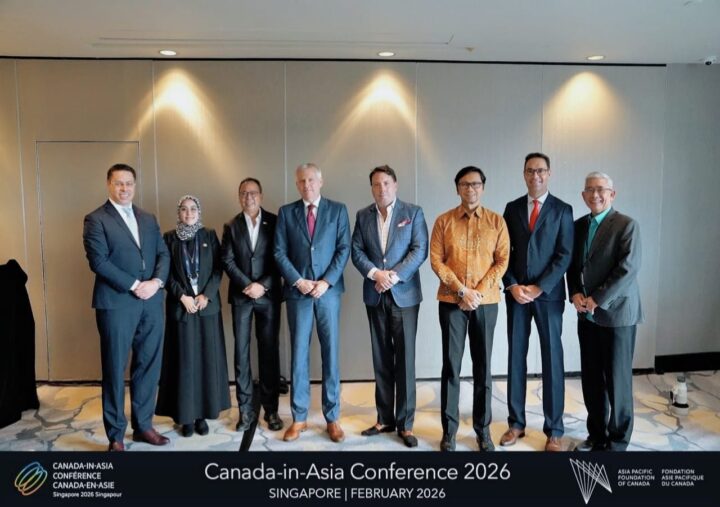
Singapore — Food security is no longer understood merely as an issue of agricultural production; it has evolved into a strategic economic agenda that affects national productivity, supply-chain resilience, investment flows, and long-term economic stability. This was conveyed by Vice Chair for Agriculture of the Kamar Dagang dan Industri (Kadin) Indonesia, Devi Erna Rachmawati, during the panel discussion “Advancing Trade and Investment through the Indonesia–Canada Comprehensive Economic Partnership Agreement (CEPA)” at the Canada in Asia Conference held at the Swissôtel Raffles City Convention Centre, Singapore, Monday (10 February 2026).
“This discussion is highly relevant and timely. Food security is no longer solely about production; it has become a strategic economic foundation for both Indonesia and Canada,” Devi said before business leaders and stakeholders from the two countries.
Representing Kadin Indonesia Chairman Anindya Novyan Bakrie, Devi explained that modern food security encompasses much broader dimensions: supply-chain reliability, price affordability, nutritional quality and safety, environmental sustainability, and the ability to withstand various shocks—from climate change to geopolitical uncertainty.
For Indonesia, with a population of more than 280 million and a rapidly expanding middle class, food security directly influences inflation control, social stability, and economic competitiveness. Food price volatility, she noted, remains a sensitive factor in macroeconomic stability.
For Canada, meanwhile, as one of the global leaders in agricultural production and food-system innovation, food security represents both a source of trade strength and a foundation for long-term international cooperation. “Therefore, food security becomes a natural pillar of the Indonesia–Canada economic partnership,” she emphasized.
Indonesia, Devi continued, approaches the issue through the Indonesia Incorporated framework. Under this model, central and regional governments provide policy direction, incentives, and regulatory certainty; businesses and investors drive efficiency and production scale; while talent, research institutions, and young entrepreneurs act as engines of innovation.
Within this framework, international trade and foreign direct investment are no longer viewed as optional add-ons, but as necessities for strengthening the domestic food system. Cooperation with Canada is considered well aligned with this approach, particularly in terms of access to technology, high-quality agricultural inputs, and food-safety systems.
Complementary Indonesia–Canada Trade Relations
Data for 2024 show that total bilateral trade between Indonesia and Canada reached approximately US$6.7 billion, with Indonesia’s exports to Canada amounting to US$3.5 billion and Canada’s exports to Indonesia about US$3.2 billion.
In the food and agriculture sector, Canada serves as an important supplier to Indonesia, particularly for commodities not produced domestically. Canada’s key exports to Indonesia include cereals—especially wheat—valued at around US$888.6 million, fertilizers at US$366.8 million, oilseeds such as canola and soybeans at US$138 million, pulp and wood products at US$284.7 million, and fish and aquatic products at US$18.6 million. Canada’s total goods exports to Indonesia in 2024 exceeded US$2.14 billion, making Indonesia Canada’s largest agri-food market in ASEAN.
Conversely, Indonesia exports tropical and value-added agricultural products to Canada, including rubber and its derivatives (US$185.9 million), cocoa and processed cocoa products (US$58.2 million), fisheries products (US$54.7 million), coffee (US$29.5 million), and pineapples and other tropical fruits (US$5.8 million). Palm oil and its derivatives also remain strategic commodities, with Indonesia currently the second-largest supplier to Canada and targeting the top position.
Indonesia’s total agricultural exports to Canada exceeded US$220 million in 2024, with strong potential for expansion into value-added and sustainability-certified products.
“This relationship is not one-way. Canada provides key inputs for the food system—from wheat to fertilizers—while Indonesia complements the Canadian market with tropical commodities that cannot be produced locally,” Devi noted.
Productivity and Investment Agenda
Devi also stressed that food security cannot be separated from the productivity and investment agenda. In 2024, Indonesia’s total agri-food and seafood imports reached approximately US$39 billion, reflecting rising demand for quality food, urbanization, lifestyle changes, and growth in the food-processing and food-service industries.
From a business perspective, efficient supply chains help stabilize prices and control inflation. Reliable imports reduce supply volatility caused by climate risks, while downstream processing creates jobs and domestic value addition.
At the same time, exports to Canada encourage higher standards in sustainability, traceability, and food safety, opening opportunities for MSMEs, processing industries, and agricultural and fisheries communities in rural and coastal areas.
According to Devi, the success of food-system integration largely depends on the quality of human resources. Indonesia possesses a significant demographic dividend but still faces productivity gaps, particularly in agriculture and food-sector MSMEs. Indonesia–Canada cooperation could include talent exchange and applied research collaboration, MSME training to meet international food-safety and ESG standards, and the development of youth- and women-led agri-food startups.
“Food security must be understood as productive infrastructure—on par with energy, logistics, and digital systems,” she said.
Long-Term Integration Platform
Institutionally, the Indonesia–Canada Comprehensive Economic Partnership Agreement (CEPA) serves as a strategic platform to deepen the partnership. CEPA will gradually eliminate tariffs on more than 95% of Canada’s exports to Indonesia, expand market access for Indonesian food and agricultural products, and strengthen regulatory cooperation, investment protection, and supply-chain integration.
For the food systems of both countries, CEPA will create more predictable and affordable trade opportunities, generate joint investment incentives, and deepen the integration of Indonesia–Canada agri-food value chains.
Concluding her remarks, Devi emphasized that food security represents one of the most strategic and mutually beneficial pillars of Indonesia–Canada relations.
“By strengthening trade, investment, innovation, and human-capital development, both countries have the opportunity to build resilient and diversified food supply chains, create quality jobs, support sustainable and climate-resilient food systems, and contribute to regional and global food security. With the Indonesia Incorporated approach and trusted partners such as Canada, we have a real opportunity to move from simple trade flows toward a long-term strategic partnership in food security,” she concluded.