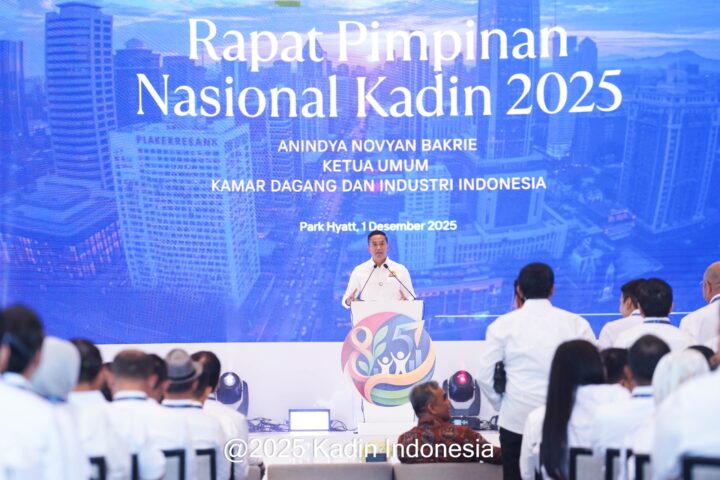
Jakarta – Over two days, Monday (01/12/2025) to Tuesday (02/12/2025), the Indonesian Chamber of Commerce and Industry (Kadin Indonesia) convened the Second Kadin National Leadership Meeting (Rapimnas II), attended by 1,653 members, including representatives from the central Kadin board, association leaders, as well as provincial and regional Kadin chairpersons and executives. The Rapimnas produced a set of policy recommendations that will be incorporated into a policy paper to be submitted to the President.
This reflects Kadin’s contribution as a strategic partner to the government, working together to accelerate inclusive economic growth toward 8%, eliminate extreme poverty, and support the realization of Indonesia’s Golden Generation 2045.
Rapimnas Kadin II 2025 carried the theme “Kadin Working Together to Expand Employment Opportunities for Indonesia’s Welfare and Self-Reliance”, with the subtheme “Strengthening Innovation, Productivity, Investment, Industry, and Trade for Golden Indonesia 2045.”
The meeting produced several key points and recommendations.
First, Kadin is optimistic that Indonesia’s economic conditions in 2026 and the years ahead will continue to improve. The country enters 2026 with a higher level of confidence as government programs rolled out earlier in the year begin to show impact. Next year, economic growth is projected to exceed 5.5%.
With ongoing improvements, government programs are expected to deliver significant impact on economic growth and job creation. The Seventeen Programs and Eight Priority Agendas have begun to generate optimism about the future of the national economy. Kadin identified six of the Eight Priority Agendas as quick wins: the MBG program, deployment of migrant workers, construction and improvement of 3 million homes, free health checkups, paid internships, and the “Merah Putih” cooperatives.
Second, Rapimnas placed strong emphasis on job creation. In collaboration with the government and financial institutions under the spirit of “Indonesia Incorporated,” Kadin is committed to expanding employment opportunities. Various government programs are contributing significantly to job expansion.
Third, to expand employment opportunities, investment across sectors must be further facilitated. Indonesia needs investment in areas ranging from agriculture, industry, energy, trade and services, the creative economy, tourism, and even Artificial Intelligence (AI). Investment is viewed as a game changer, especially now when household purchasing power is under pressure. The Ministry of Finance has already injected Rp276 trillion in liquidity, and Bank Indonesia’s monetary policy has begun to ease. Liquidity is no longer an issue the challenge lies on the demand side. This underscores the importance of easing investment, both domestic and foreign.
Kadin will take an active role in increasing investment’s contribution to GDP, currently at 29%. This contribution will be gradually raised to over 40%. To this end, Kadin supports government efforts to debottleneck investment barriers, provide incentives for businesses, revise various regulatory frameworks that hinder investment, and reduce high economic costs that drive up the ICOR.
To smoothen investment, Kadin highlights the importance of establishing an industrial/land dispute clearing house, providing inclusive tax holidays for medium-sized domestic investors, ensuring regulatory certainty for environmental impact assessments (AMDAL), and strengthening the government’s role in strategic industries. Kadin also recommends synchronizing the OSS system, developing a supply chain roadmap, and promoting the development of Special Economic Zones (KEK) and industrial estates outside Java through PPP schemes. A closed-loop transmigration model connected to industries and Kadin offtakers is also encouraged.
Fourth, Kadin supports government efforts to accelerate downstreaming and industrialization across sectors. In the short term, labor-intensive industries should be further encouraged while strengthening basic industries, capital goods industries, and the adoption of digitalization and AI.
Fifth, productivity must be enhanced through education and skills training. Productivity is not only influenced by technical skills addressed through vocational programs and apprenticeships—but also by work ethic, supported through integrity education.
Sixth, innovation must be strengthened through R&D incentives, technology adoption, redefining waste to support the circular economy, and fostering applied research collaboration between BRIN and industry players. The LPDP scholarship program should be better aligned with national industry needs. University–industry partnerships must also be strengthened.
Seventh, trade performance can be boosted through:
-
Strengthening trade remedies, improving import governance, and simplifying export–import licensing.
-
Supporting MSMEs to utilize FTAs, reformulating the Sea Toll Program into an efficient hub-and-spoke system, advancing offensive–defensive trade diplomacy with Kadin’s involvement, and launching nationwide and global campaigns for Proudly Made in Indonesia.
Eighth, MSMEs must be mobilized by involving them in economic activities across sectors and government programs, such as MBG, 3 million homes, food, and energy initiatives. As MSMEs absorb 98% of the workforce and contribute 60% to GDP, they require incentives and support to improve product and service quality.
Ninth, Kadin supports sustainable development by participating in the development of renewable energy, including hydro energy, geothermal, solar panels, and hydropower, while strengthening energy resilience initiatives. Kadin is also involved in 5R (reduce, recycle, reuse, replant, replace) sustainability projects.
Tenth, Kadin contributes to helping children in remote areas who must cross rivers to reach school by supporting the construction of bridges funded through CSR programs. For years, many have had to wear makeshift plastic bag clothing to protect their uniforms. Approximately 300,000 bridges need to be built, costing between Rp200 million and Rp800 million each.
“The policy paper derived from the input of Kadin members is being finalized and will be submitted to the President,” Anin concluded.
Jakarta, 2 December 2025
Chairman of Kadin Indonesia
Anindya Novyan Bakrie