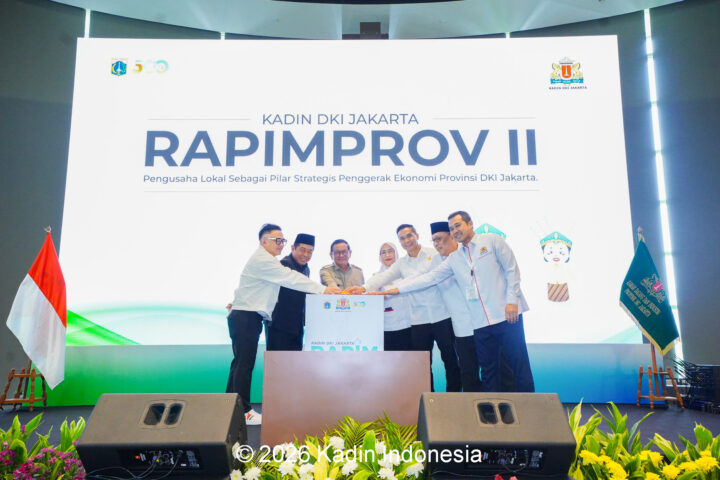
Jakarta – The Jakarta Chapter of the Indonesian Chamber of Commerce and Industry (Kadin DKI Jakarta) held its 2nd Provincial Leadership Meeting (Rapimprov II) under the theme “Local Entrepreneurs as Strategic Pillars Driving the Economy of Jakarta Province” at Park Hyatt Jakarta, Monday (March 9, 2026).
In his opening remarks, Kadin Indonesia Chairman Anindya Novyan Bakrie said that the business community is currently facing increasingly complex global challenges, ranging from geopolitical conflicts to international economic pressures.
Bakrie, commonly known as Anin, said the uncertain global situation, including the conflict in the Middle East, could have significant implications for the national economy.
“We see that the world today is full of challenges. Last year we talked about trade wars and tariffs with the United States. Now we are witnessing physical war in the Middle East. The impact of this conflict will certainly be very significant for all of us,” Anin said.
Anin highlighted three key aspects that Indonesia must closely monitor: energy security, food security, and national stability. In terms of energy, he warned that rising global oil prices could put pressure on the State Budget (APBN).
“If oil prices continue to rise and even surpass US$100 per barrel, it will place considerable pressure on our state budget. Currently, our state budget deficit is around Rp600 trillion as projected, and the figure could increase by as much as 40–50 percent,” Anin explained.
Nevertheless, Anin said that energy resilience in Jakarta remains relatively secure, particularly in terms of gas and fuel supply that are essential for economic activities, including the fisheries sector.
In addition to energy, he emphasized the importance of food security to maintain price stability, particularly ahead of the Eid al-Fitr holiday.
“The Chairwoman of Kadin Jakarta, Diana Dewi, mentioned initiatives such as affordable market programs to help control inflation. This is very important because we are beginning to see inflation gradually creeping up, especially ahead of the Eid holiday period,” Anin said.
The third aspect, he continued, is national stability, including the stability of Jakarta as Indonesia’s economic hub.
“Kadin Jakarta is not only an engine of economic growth but also a guardian of national stability,” he said.
Anin further noted that Jakarta plays a significant role in the national economy, contributing 16.8 percent to Indonesia’s Gross Domestic Product (GDP) and recording economic growth of 5.21 percent, which is above the national average.
“And this is despite the fact that Jakarta is no longer the capital city. In fact, we are seeing its transformation into a strong service industry hub,” Anin added.
He also expressed appreciation for Kadin Jakarta’s efforts to support small and medium industries (SMIs) and MSMEs, particularly through certification programs and vocational training aimed at improving productivity and innovation.
“After all, one of the key ways to strengthen the economy is by increasing productivity. And improvements in productivity and innovation are closely linked to training programs such as these,” Anin said.
Anin also proposed four strategic pillars to strengthen Jakarta’s economy.
“First, how Kadin Jakarta can continue to pursue self-sufficiency, and hopefully even help other provinces. Second, economic growth. Third, ensuring Jakarta remains an inclusive province. And lastly, sustainability,” he said.
Meanwhile, Chairwoman of Kadin DKI Jakarta Diana Dewi emphasized that strengthening local entrepreneurs would have a significant impact on the regional economy.
According to her, when local businesses grow, the benefits extend beyond corporate expansion to include job creation, stronger regional economic circulation, and increased tax revenue.
“When local entrepreneurs grow, what develops is not only their businesses but also employment opportunities, economic circulation, and a multiplier effect for society. As the Governor once said, people should shop more in Jakarta rather than abroad. The statement may sound simple, but its meaning is profound. Every rupiah spent in Jakarta will continue to circulate within Jakarta,” Diana said.
She also praised business actors who apply affirmative policies by giving greater opportunities and priority to local entrepreneurs in various development projects in Jakarta, while still maintaining fair competition.
“We hope Jakarta can also consider policies that provide space and priority for local entrepreneurs in regional development. In this way, collaboration between the local government and the business community will become stronger in maintaining economic stability while creating new growth opportunities for Jakarta,” Diana said.
Furthermore, Jakarta Governor Pramono Anung encouraged Kadin to play an active role in accelerating the city’s development. The Jakarta administration, he said, is committed to simplifying bureaucratic processes to create broader opportunities for business growth.
As a result, entrepreneurs in Jakarta will be able to expand their businesses with greater certainty regarding legal protection.
“Entrepreneurs should not be afraid to stand on their own. The Jakarta Provincial Government will open the widest possible opportunities for business actors to grow. Legal certainty in doing business in Jakarta must become an example in realizing Jakarta as a global city,” Pramono concluded.
Also present at the event was Kadin Indonesia Vice Chairman for Membership Affairs Widiyanto Saputro.