

Jakarta – Indonesia needs to strengthen its Comprehensive Economic Partnership Agreements (CEPAs) to advance cooperation with various countries, particularly within the ASEAN region. This step is considered urgent as the world is entering an increasingly harsh era, marked by tariff wars, intensifying global warming, and geopolitical conflicts over energy and critical mineral resources.
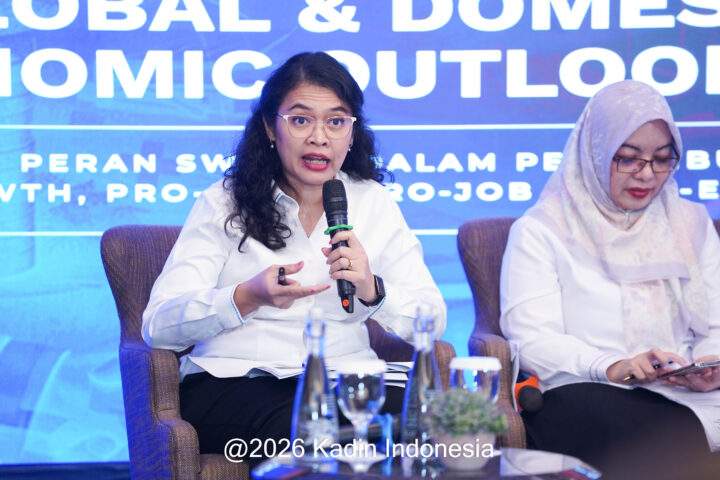
“I agree with multilateralism, but we need to focus on finding new formats, especially within ASEAN. I see that intra-ASEAN trade and investment growth has actually been quite strong,” said Dinna Prapto Raharja, an international relations practitioner and lecturer, during the seminar “Global and Domestic Economic Outlook 2026: Strengthening the Role of the Private Sector in Economic Growth: Pro-Growth, Pro-Poor, Pro-Job, and Pro-Environment” hosted by Kadin Indonesia on Thursday (15/1/2026).
Dinna described the evolving global situation as entering what she termed a “violent” era—one that is increasingly unforgiving. According to her, efforts by major powers to halt the rise of the rest and maintain global dominance have created significant pressure on developing countries, emerging economies, and middle powers, including equatorial nations such as Indonesia.
She outlined her analysis within three broad frameworks: what is almost certain to occur in 2026, what Indonesia needs to anticipate, and the policy recommendations that should be prepared. One factor that is almost certain, she said, is the escalation of global warming, which has the potential to erode economic growth achievements.
Global warming in 2026 is projected to exceed 1.28 degrees Celsius, bringing it increasingly close to the 1.5-degree Celsius threshold long regarded as a critical limit, beyond which the risk of global disasters rises sharply. The impacts include longer rainy seasons, stronger winds such as cyclones and monsoons, and an increased frequency of flash floods, landslides, and other geological disruptions, particularly across Asia.
Dinna emphasized that the future economic burden of the climate crisis will not only involve loss of life, but also infrastructure damage, job displacement, degradation of agricultural land, and disruptions to commodity-based resources that have long underpinned export performance. She also highlighted a less anticipated issue: population displacement, irregular migration, and the rise of illegal activities in areas with limited government reach.
On the geopolitical front, Dinna assessed that global tensions will continue to escalate. The unresolved conflict in Ukraine, developments in Venezuela, and discourse surrounding U.S. pressure in the Arctic and Greenland are all seen as exacerbating global instability. For equatorial countries, this translates into facing a combination of rising temperatures, extreme rainfall, and sea-level rise simultaneously.
She warned that Indonesia could potentially face a triple planetary crisis: climate change, biodiversity loss, and waste and pollution challenges. Referring to various studies, Dinna cautioned that trends in natural resource extraction, including minerals, have accelerated deforestation and environmental degradation, in line with intensifying geopolitical competition over strategic resources.
According to Dinna, protectionism in advanced economies no longer manifests solely through tariffs, but also through the push for large-scale resource exploitation. At the same time, she observed that the global multilateral order is weakening. Institutions such as the G20, the UN Security Council, and the World Trade Organization (WTO) are, in her view, increasingly ineffective due to conflicting interests among key actors.
“We are witnessing global institutions that are supposed to support international cooperation becoming paralyzed. Developing countries are ultimately forced to search for their own identity and new cooperation formats,” she said.
In the context of U.S.–China rivalry, Dinna argued that Indonesia will face mounting pressure to take a position. The United States, through alliances such as the Mineral Security Partnership—often referred to as Paksilika—is accelerating efforts to secure control over critical mineral supply chains, including lithium and copper. Meanwhile, China continues to dominate critical mineral refining processes and ownership in the sector.
Dinna noted that Indonesia’s extensive cooperation with China in mineral exploration has led to perceptions of Indonesia as part of a China-centric mineral hub. This situation could place Indonesia in a strategic dilemma amid rivalry between the world’s two major powers.
Amid such global uncertainty, Dinna emphasized that Indonesia must strengthen the cooperation instruments it already possesses. CEPA is viewed as a far more strategic framework than a conventional Free Trade Agreement, as it enables deeper, more flexible, and more structured cooperation among economic actors.
“CEPAs are highly beneficial for Indonesia. It is time for the business community, including Kadin, to focus on exploring and optimizing every CEPA we have. The challenges within RCEP are also more similar to CEPA than to a conventional FTA,” she said.
Beyond strengthening CEPAs and intra-ASEAN trade, Dinna recommended improving the quality of human resources so that Indonesia can better integrate into global value chains. She stressed that investment in human capital should be an integral part of international cooperation negotiations.
She also highlighted the importance of developing the recycling industry as a new business value chain with relatively few players, as well as the need for greater attention to sectors most affected by climate change, such as agriculture, forestry, and fisheries.
“The dominance of certain countries in the energy and mineral sectors will determine the strength of other nations. That is why we must be clear about which sectors we want to strengthen, while simultaneously expanding intra-ASEAN trade that has yet to be fully optimized,” Dinna concluded.