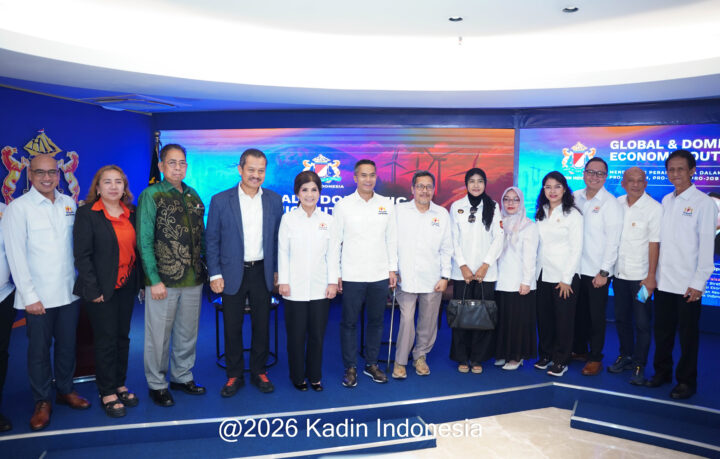
Jakarta – The Indonesian Chamber of Commerce and Industry (Kadin Indonesia) held the Global & Domestic Economic Outlook 2026 discussion forum themed “Strengthening the Role of the Private Sector in Economic Growth: Pro-Growth, Pro-Poor, Pro-Job, and Pro-Environment” at the Kadin Indonesia Tower, Jakarta, on Thursday (15/01/2026).
Chairman of Kadin Indonesia, Anindya Novyan Bakrie, stated that the forum marked Kadin’s initial step in developing the Kadin Trust Index, a data-driven index designed to measure business confidence and sentiment.
“This time, we are talking about data. This is the foundation of the Kadin Trust Index. We are starting by collecting data from industries, consumers, and vendors to assess their enthusiasm for doing business, both in the production and services sectors,” said Anindya, commonly known as Anin.
Anin emphasized Kadin’s optimism regarding the government’s efforts to drive national economic growth, as reflected in the four core principles being promoted: pro-growth, pro-poor, pro-job, and pro-environment.
He explained that the pro-poor principle is essential to lifting communities out of unfavorable economic conditions, while the pro-job approach is particularly crucial given that unemployment—especially among young people—remains at around 4.85 percent.
From a pro-growth perspective, Kadin is targeting national economic growth in the range of 5.4–5.5 percent, with prospects for further improvement in the future. Meanwhile, the pro-environment principle serves as a key foundation to ensure sustainable development.
Anin also highlighted the challenging global economic environment, with global growth projected at around 3 percent. Despite this, Indonesia continues to demonstrate a strong level of confidence, supported by economic growth exceeding 5 percent.
“That indicates confidence, especially as this confidence is supported by continued trade growth through the third and fourth quarters of last year,” Anin said.
In addition, Anin touched on Indonesia’s trajectory toward stronger energy resilience amid rising global energy demand, including for the development of data centers and artificial intelligence (AI) technologies.
Meanwhile, Kadin Indonesia Vice Chairman for Macro and Microeconomic Policy Analysis, Aviliani, underscored the importance of greater attention to regional economies, which she noted have not been sufficiently examined in depth. She highlighted the need to evaluate policies related to reductions in regional transfers, as they could potentially affect regional economic growth.
“We encourage future evaluations of reductions in regional transfers. The central government also needs to involve regional governments so that they continue to benefit from the policymaking process,” she said.
At the same forum, Secretary General of the International Economic Association, Lili Yan Ing, explained that the main challenge facing Indonesia and the ASEAN region is enhancing investment attractiveness.
According to Lili, Indonesia still lags behind in terms of the ratio of foreign direct investment (FDI) to GDP, which currently stands at around 1.2 percent—the lowest among ASEAN countries. By comparison, Singapore records an FDI-to-GDP ratio of 27 percent, Vietnam 4.2 percent, while China, during the early stages of its economic growth, recorded a ratio of around 6 percent.
“This condition highlights the need for significant structural reforms and business climate reforms to enhance Indonesia’s competitiveness in attracting investment,” she concluded.
Furthermore, Director of Economic Stabilization Strategy at the Ministry of Finance, Noor Faisal Achmad, representing Minister of Finance Purbaya Yudhi Sadewa, stated that the government continues to maintain fiscal discipline as a key pillar for long-term fiscal sustainability.
He explained that the state budget deficit has been kept below 3 percent, in line with statutory requirements, after widening to 6.14 percent in 2020 due to the pandemic. In 2025, the deficit was reduced to 2.92 percent, with the debt-to-GDP ratio maintained at around 40 percent.
“With fiscal discipline well maintained, the state budget can continue to serve as a credible instrument to support development and safeguard economic stability,” he said.
The event also featured the launch of Kadin Business Pulse, a data-driven survey and insight platform for Indonesian businesses.
Chairman of the Kadin Indonesia Institute Management Board, Mulya Amri, stated that Kadin Business Pulse is the first quarterly survey measuring rapid business sentiment across Indonesia.
“This survey complements macroeconomic data such as GDP growth and inflation, while also reflecting the real-time sentiment of business players on the ground,” he concluded.
The forum was attended by members of the Kadin Indonesia leadership, including Coordinating Vice Chairman for Export Development Juan Permata Adoe; Coordinating Vice Chairman for Law and Human Rights as well as Infrastructure M. Aziz Syamsuddin; Vice Chairman for Agriculture Devi Eka Rachmawati; Vice Chairman for Strategic Infrastructure Development, Rural Development, and Transmigration Thomas Djusman; Vice Chairman for Agrarian Affairs, Spatial Planning, and Economic Zoning Sanny Iskandar; Vice Chairman for Creative Industries Gilang Widya Pramana; Vice Chairman for MICE Budiarto Linggowiyono; Vice Chairman for Marketing, Promotion, Innovation, and MSME Product Development Rifda Ammarina; and Head of the Kadin Communications Office, Primus Dorimulu.
Also in attendance were Chairman of Kadin West Sumatra Province Buchari Bucher and Chairman of Kadin West Nusa Tenggara Province, Faurani.