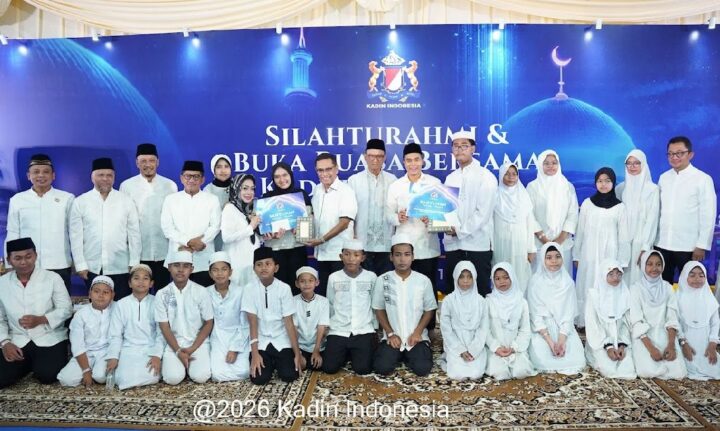
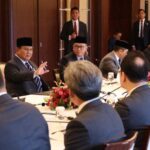
Jakarta – The Indonesian Chamber of Commerce and Industry (Kadin) held a gathering and communal iftar event titled “Strengthening Indonesia’s Resilience Amid Global Dynamics: Reinforcing Solidarity, Empowering the People’s Economy” at Istiqlal Mosque, Central Jakarta, on Friday (March 13, 2026).
The event, held during the last ten days of Ramadan, was organized to enliven the holy month of Ramadan 1447 Hijri while strengthening ties and fostering unity within the broader Kadin Indonesia community.
Chairman of Kadin Indonesia, Anindya Novyan Bakrie, said the event was part of an effort to balance economic strength with spiritual values.
“Kadin held this iftar gathering today at Istiqlal because this is the time for the business community not only to strengthen its physical and economic capacity, but also to reinforce its spiritual foundation,” said Anindya, who is widely known as Anin.
Beyond serving as a networking occasion, Anin also invited all attendees to pray for peace in the Middle East, which is currently experiencing escalating tensions. He expressed hope that the conflict would soon end for humanitarian reasons.
“First, the Middle East is currently experiencing extraordinary dynamics. We should pray that our brothers and sisters there will see their suffering reduced, or even end altogether, with the war stopping as soon as possible,” Anin said.
Anin acknowledged that the conflict in the Middle East has systemic implications for Indonesia’s economy, particularly related to fluctuations in global energy prices and monetary stability.
“Secondly, we hope that the impact on Indonesia—whether from rising oil prices, the weakening rupiah exchange rate, or the potential increase in interest rates—can be managed well, just as we have overcome previous crises,” he explained.
Despite the challenges, Anin emphasized that Kadin remains united in responding to global uncertainty. He expressed confidence that Indonesia has the experience to navigate various crises.
“It is important to say here that Kadin stands united and remains determined to respond to these challenges. It will not be easy, but this is a challenge faced by countries around the world,” Anin stressed.
As part of the event, Kadin also demonstrated its social commitment by providing assistance to 5,700 orphans, in line with the organization’s 57th anniversary. The donations were symbolically presented to 20 orphan representatives who attended the gathering.
“Earlier we also distributed assistance to 5,700 orphans as part of Kadin’s 57th anniversary this year,” Anin added.
Anin further underscored the importance of collaboration between the business community and religious institutions in empowering society.
“We need to see how the business sector and mosque management can work together, so that mosques become not only places of worship but also centers for community empowerment, both locally and nationally,” he said.
He also highlighted concerns over global oil price movements triggered by tensions in the Middle East.
“First, of course, is the issue of oil. Any price above US$60—the assumption used in the state budget—will certainly have an impact. We need to observe developments over the next one to two months. At one point prices were above US$100, now they are below that level, so we must see where they eventually stabilize,” he noted.
Anin also warned about potential disruptions in global supply chains that could trigger inflation in Indonesia.
“Then there are also concerns related to the rupiah exchange rate, interest rates, and inflation due to supply chain disruptions. All of these factors must be carefully calculated. But inevitably, businesses must pursue efficiency because there are costs beyond their control,” he explained.
On the other hand, Anin emphasized two key sectors that must be safeguarded to maintain national stability amid geopolitical tensions.
“We must strengthen food security and energy security. These two are crucial, both for industry and for maintaining national stability,” he said.
Meanwhile, Indonesia’s Minister of Religious Affairs, Nasaruddin Umar, highlighted in his remarks the importance of integrating religious values with national economic development. According to him, the prosperity of a nation’s economy depends greatly on its alignment with religious principles.
“An economy that is distant from religion will not bring blessings. Just remember that,” Nasaruddin said.
He also addressed moral challenges in contemporary economic practices, noting that social conflicts often arise from consumption or income derived from unlawful sources. As a solution, the government is working to strengthen a clean and equitable economic system.
“We are trying to build an economic system with zero exploitation of human beings. We have begun moving in that direction,” he said.
On the same occasion, Nasaruddin also expressed positive views regarding the fundamental vision of President Prabowo Subianto. According to him, the President’s core ideas represent a transformative approach that could bring significant change to the nation if implemented consistently.
“Believe that, God willing, through collaboration we will see a new face of our national economy in the future,” he concluded.
Also attending the event were several Kadin Indonesia vice chairpersons, including Erwin Aksa, James T. Riady, Carmelita Hartoto, Nita Yudi, Shinta W. Kamdani, and Bobby Gafur Umar, along with other Kadin executives.
A number of provincial Kadin chairpersons were also present, including representatives from North Sumatra, West Sumatra, Lampung, Riau Islands, West Nusa Tenggara, East Nusa Tenggara, Southeast Sulawesi, Central Sulawesi, and Papua.