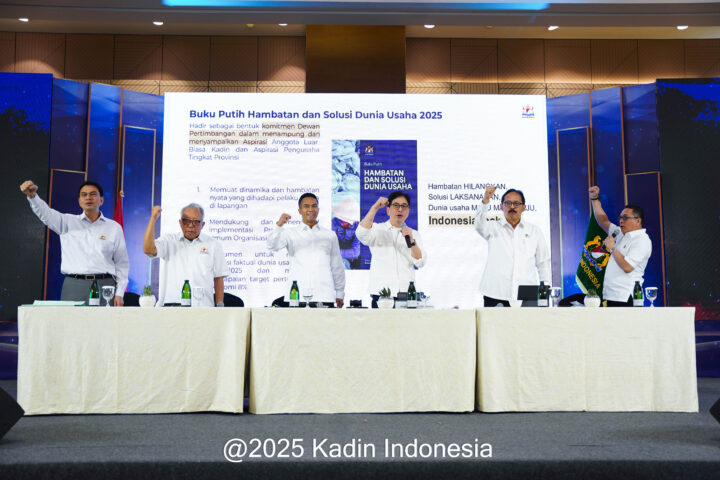
Jakarta - The Indonesian Chamber of Commerce and Industry (Kadin) reaffirmed its readiness to strengthen cooperation with the government in driving job creation and national economic growth.
This commitment was conveyed by Kadin Indonesia Chairman Anindya Novyan Bakrie during the Extraordinary Members Communication Forum (ALB) ahead of the 2025 National Leadership Meeting (Rapimnas), held at Mangkuhulur Artotel Hotel, Central Jakarta, on Friday (28/11/2025).
“The focus of Kadin Indonesia’s 2025 Rapimnas is working with the government to build or create jobs. That is the key focus,” said Anin, as he is familiarly known.
Anin explained that job creation directly correlates with improved public welfare.
“When job opportunities grow, people’s welfare grows, and we build self-reliance,” he added.
He stated that Kadin will work closely with its leadership across 38 provinces and hundreds of industry associations to develop sector-based job creation strategies. Kadin will also assess investment potential and identify obstacles that need to be addressed.
“The second point is how much investment can come in and what the barriers are. This will enable us to provide input to the government on what can be improved,” Anin noted.
Furthermore, Anin emphasized that nurturing new entrepreneurs remains a key agenda. Increasing the number of entrepreneurs, he said, will help drive the economy and reflect unity within the business community.
“This is something very important. And it demonstrates the enduring unity within Kadin for Indonesia,” he said.
Anin also expressed optimism that Indonesia can achieve economic growth of up to 8 percent. He said this projection is supported by his observations of global opportunities, while stressing that improving the business climate remains crucial.
“We must join hands with the government to ensure that ease of doing business remains strong. This will keep our ICOR (Incremental Capital Output Ratio) healthy, logistics efficient, and costs affordable,” he explained.
“And finally, it will ensure that job opportunities—especially for young people (Gen Z)—can be realized,” Anin concluded.
Meanwhile, Chairman of the Kadin Indonesia Advisory Council, Arsjad Rasjid, emphasized that the business sector must serve as a partner to the government in implementing national priorities.
“The essence is how the business community can support the government, particularly the vision and mission of President Prabowo Subianto,” he said.
“We want to work together, offering input that, God willing, can help provide solutions. Our aim here is not to complain, but to find solutions so that the 8 percent growth target can be achieved,” he added.
The event was also attended by Kadin leaders including M. Azis Syamsuddin, Deputy Chair for Legal and Human Rights Affairs and Infrastructure; Benny Soetrisno, Deputy Chair for Association and Extraordinary Members Development; Saleh Husin, Deputy Chair for Industrial Affairs; Aviliani, Deputy Chair for Macro-Micro Economic Policy Analysis; and Tatyana Sentani Sutara, Deputy Chair for Women and Child Empowerment.