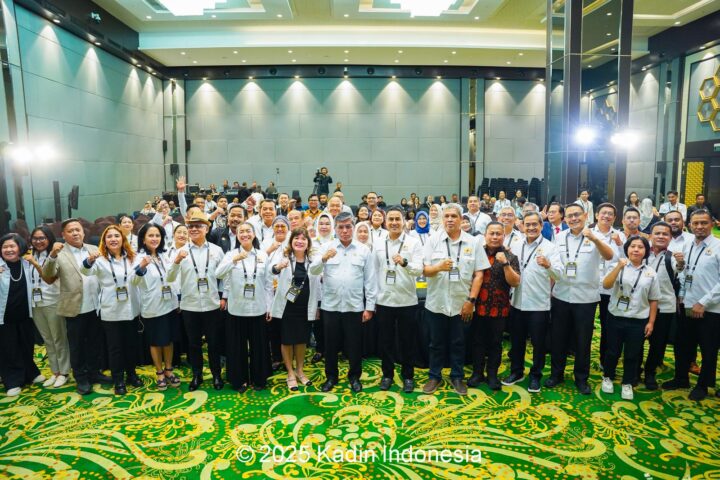
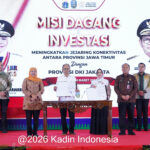
Jakarta – The Indonesian Chamber of Commerce and Industry (Kadin) Human Development, Culture, and Sustainable Development Sector held the National Coordination Meeting (Rakornas) themed “Productive, Innovative, and Sustainable Development Towards an Advanced Indonesia” at Plaza BPJamsostek, South Jakarta, on Thursday (13/11/2025).
Chairman of Kadin Indonesia, Anindya Novyan Bakrie, emphasized the importance of cross-sector collaboration in driving national economic growth.
"We must all collaborate in a national orchestration to achieve 8% economic growth and reduce extreme poverty to 0%. In this spirit, Kadin acts as a strategic partner of the government, ensuring that national policies and business capacities are aligned, mutually reinforcing, and have a tangible impact on the people," said Anindya, or Anin as he is commonly known.
Meanwhile, Deputy Chair for Human Development, Culture, and Sustainable Development of Kadin Indonesia, Shinta W. Kamdani, highlighted that Indonesia is currently at a crucial point toward the vision of Indonesia Maju 2045.
"The 2025-2029 National Medium-Term Development Plan (RPJMN) prioritizes improving human resource quality. However, employment challenges remain complex, with skill mismatches between graduates and industry needs," said Shinta. She emphasized the urgency of strengthening vocational training and enhancing human resource capacity to optimize the demographic bonus.
Shinta stressed that Indonesia is entering an era of knowledge-based and sustainable economy, driven by rapid technological change and green growth, noting that Rakornas 2025 serves as an important forum to align business efforts with the national strategy for human resource development, innovation, and sustainability.
Meanwhile, Coordinating Minister for Human Development and Culture, Pratikno, emphasized the importance of concrete steps to ensure alignment between vocational education and industry needs.
"Through this collaboration, we are establishing a joint task force and a joint dashboard. We aim to better align education in vocational institutions with labor market demands. This will reduce the risk of skill mismatch," said Pratikno.
Furthermore, Minister of Health, Budi Gunadi Sadikin, highlighted the critical role of the health sector in supporting national economic growth. He noted the sector has significant potential to drive domestic economic growth.
"The health sector, in particular, has historically grown above 8%. Now, we want to ensure that it can translate into domestic gross growth," Budi said.
He explained that the government is analyzing health expenditure patterns, which have grown by approximately 90%, to map the potential for domestic products.
"We are working with Kadin to see if they (Kadin) can invest using their own funds without relying on the state budget, to build domestic health industries. This could be in pharmaceuticals, medical devices, hospitals, or clinics. In doing so, it will drive domestic gross growth," Budi concluded.
Additionally, Minister of Manpower, Yassierli, noted that Indonesian labor productivity still lags behind other ASEAN countries. To address this, the government is developing a vocational training ecosystem through the Vocational and Productivity Training Center (BPVP), supported by digital technology and collaborative approaches.
Enhancing productivity is not only crucial for domestic workers but also has a direct impact on Indonesian Migrant Workers (PMI). With higher skills and productivity, PMI will have stronger competitiveness in the global market and gain better employment opportunities. This aligns with the Rakornas’s Focus Group Discussion (FGD) themed “Synergy in the Governance of Indonesian Migrant Worker Recruitment and Protection.”
The Kadin Indonesia National Coordination Meeting on Human Development, Culture, and Sustainable Development produced three strategic outcomes:
1. Signing of the Kadin-Kemenko PMK MoU
The MoU underscores the commitment to strategic collaboration between the business sector and government in strengthening human resource development, vocational education, industry-based curricula, cultural enhancement, and innovation research.
2. Launch of the 2045 Industrial Vocational Roadmap
This roadmap serves as a guide for integrating vocational education with future industry needs, ensuring young generations have competent skills and are prepared to face global economic challenges.
3. Launch of the Health White Paper
This strategic document provides policy recommendations to strengthen the national health sector, from improving services to fostering industrial innovation, supporting the enhancement of public health in Indonesia.
Shinta hopes that this partnership will accelerate the implementation of link-and-match vocational policies, expand access to quality education, strengthen the health sector, and enhance the empowerment of cultural communities.
"Let us maintain this spirit of mutual cooperation moving forward so that today’s investments truly benefit all of us," concluded Shinta.
The Rakornas on Human Development, Culture, and Sustainable Development by Kadin Indonesia was sponsored by BPJS Ketenagakerjaan, Astra, Paragon Corp, and TUV Rheinland.