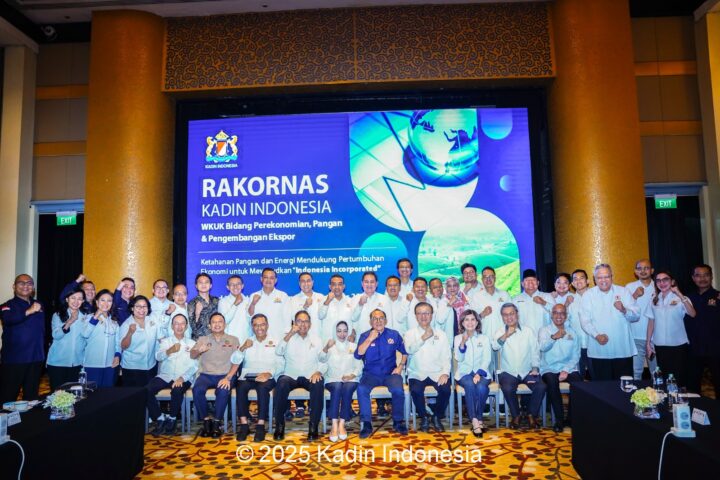
Jakarta - The Indonesian Chamber of Commerce and Industry (Kadin) through its Division for Economy, Food, and Export Development held the National Coordination Meeting (Rakornas) under the theme “Food and Energy Resilience to Support Economic Growth for a Strong Indonesia Incorporated” at the Grand Hyatt Hotel, Central Jakarta, on Friday (November 7, 2025).
The Rakornas was attended by Kadin Indonesia executives, including Coordinating Vice Chairman for Economy Franky O. Widjaja, Coordinating Vice Chairman for Food Mulyadi Jayabaya, Coordinating Vice Chairman for Export Development Juan Permata Adoe, Coordinating Vice Chairman for Social Affairs Nita Yudi, and Member of Commission IV of the Indonesian House of Representatives (DPR RI) Arif Rahman.
Kadin Indonesia Chairman Anindya Novyan Bakrie, who delivered his remarks via recorded video, emphasized the importance of cross-sector collaboration in strengthening Indonesia’s economic foundation amid ongoing global uncertainty.
Anindya, familiarly known as Anin, stated that despite global economic turbulence, Indonesia’s economy has remained robust maintaining growth above 5 percent throughout 2025 and projected to stay stable until the end of the year.
However, challenges such as high logistics costs and suboptimal industrial productivity remain major issues that need immediate resolution.
“Our logistics costs are still at 17 percent higher than the Asian average. Our industrial productivity has yet to reach the next level. These are big homework items for all of us. To leap forward, we can’t just walk we must jump,” said Anin.
He explained that the food sector must strengthen supply chains and productivity to not only support national resilience but also improve public welfare. The economic sector, he continued, should serve as a policy hub to lower the cost of doing business and strengthen real-sector investment.
Meanwhile, the export development division aims to transition from being an exporter of raw materials to an exporter of innovation, with a target of increasing non-commodity exports by USD 5 billion within the next two years.
Anin also revealed that Kadin is working with the Ministry of Forestry to promote multi-business forestry—an integrated system combining forest products, environmental services, food, and energy.
“The potential is tremendous. Over 30 million hectares of land are available across Indonesia. Non-timber forest products already reach 872,000 tons, but that’s only 20 percent of their potential. If the value increases by just 10–20 percent, it could add IDR 100–300 billion per province annually,” he said.
He further added that environmental and carbon service potentials could generate IDR 25–100 billion per province per year, while the agroforestry, food, and bioenergy sectors have potential economic values reaching IDR 1–2 trillion annually.
“Yet all of this can only be achieved if we move together. Kadin is the big house of Indonesian business—where the strong lift the weak, and the large guide the small. That is the spirit of Kadin Gotong Royong,” Anin emphasized.
“The Kadin of the future must be 30 percent human-led, 70 percent tech-enabled, and 100 percent nation-driven. We lead with heart, strengthen with data, and fight for the nation,” he concluded.
Meanwhile, Kadin Indonesia Coordinating Vice Chairman for Food Mulyadi Jayabaya stressed the importance of strengthening the national food sector through improved agricultural productivity, availability of quality seeds, and sufficient fertilizer supplies.
Mulyadi explained that Indonesia has around 10 million hectares of rice fields, with an average yield of 5.2 tons per hectare, according to the Minister of Agriculture. Based on that figure, Indonesia could potentially achieve a surplus of 50 million tons of rice per harvest season, while national consumption stands at around 30 million tons.
“If we calculate it properly, we should have a surplus and not need to import. But the problem lies in the lack of quality seeds and fertilizer, which hampers optimal yields,” he said.
He identified two main challenges in the food sector limited availability of superior seeds and fertilizer shortages—and expressed hope that these could be resolved through government policy, particularly under the upcoming administration of President-elect Prabowo Subianto, who prioritizes working capital support for farmers.
“If seed and fertilizer needs are met, and farmers receive working capital, food resilience can be achieved. Rice prices are currently good reaching IDR 7,000 per kilogram,” Mulyadi noted.
In his remarks, Kadin Indonesia Coordinating Vice Chairman for Export Development Juan Permata Adoe underlined that exports remain a key pillar in driving national economic growth.
Juan explained that Kadin Indonesia is preparing various strategic measures to broaden stakeholder participation in the export ecosystem, including enhancing cooperation with the Ministry of Trade.
“We have a plan to involve multiple stakeholders more actively. Our cooperation with the Ministry of Trade must also be strengthened to achieve export growth and increase state revenue,” Juan said.
He also emphasized the importance of human capital development and policy refinement as the foundation for improving the competitiveness of Indonesian businesses in global markets.
“We have established key pillars in education, training, and policy enhancement so that entrepreneurs across sectors can enter export activities with stronger competitiveness,” he added.
Meanwhile, Kadin Indonesia Coordinating Vice Chairman for Economy Franky O. Widjaja highlighted the importance of strengthening cross-sectoral coordination to achieve national food and energy resilience.
Franky stated that Kadin has formulated concrete strategies to replicate the success of the inclusive closed-loop partnership model previously implemented in the palm oil sector across other commodities.
“Our focus is on food and energy resilience. We have developed a roadmap to ensure this can be effectively realized,” Franky said.
The inclusive closed-loop model, he explained, is a partnership framework between companies, cooperatives, and communities, designed to ensure equitable and sustainable economic benefits for all participants.
“In this model, companies collaborate directly with cooperatives and local communities. They receive the same high-quality seeds, follow the same production standards, and gain access to financing with guarantees from core companies. The products can then enter export markets at competitive and uniform prices,” Franky elaborated.
He concluded that the model’s success in the palm oil industry could serve as a blueprint for other food sectors, helping boost national productivity and expand export opportunities.
“If we can replicate this model for other commodities, productivity will rise not only to meet domestic needs but also to strengthen our export capacity,” Franky concluded