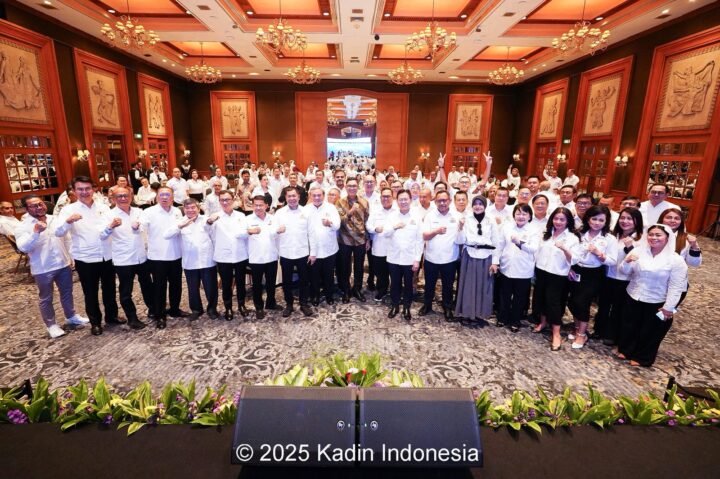
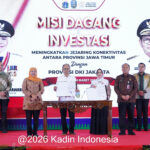
Jakarta - The Indonesian Chamber of Commerce and Industry (Kadin Indonesia), through its Foreign Affairs Division, held the National Coordination Meeting (Rakornas) themed “Indonesia’s Global Presence: Partnerships, Investment, and Sustainable Growth” at the Aryaduta Hotel on Friday (November 14, 2025).
In his remarks delivered via video conference, Kadin Indonesia Chairman Anindya Novyan Bakrie highlighted Indonesia’s increasingly strong position in the global economic landscape. Over the past few years, Anindya commonly known as Anin said Indonesia’s role has gained greater respect through various international collaborations involving both the private sector and the government.
"Kadin, together with the Coordinating Vice Chair for Foreign Affairs and all Vice Chairs, has been at the forefront of strengthening global strategic partnerships, including negotiations for the Indonesia–European Union Comprehensive Economic Partnership Agreement (I-EU CEPA), the Indonesia–Canada CEPA, and active participation in New York Climate Week and the Australia–Indonesia Investor Dialogue," Anin said.
He also stressed that each partnership must generate tangible benefits for Indonesia and its international partners. Therefore, starting this year, Kadin along with all coordinating and sectoral vice chairs, bilateral committees, and global partners will conduct a joint review of its existing international cooperation initiatives.
"This step aims to ensure continuity, optimize benefits, and formulate follow-up actions that are inclusive and mutually advantageous," he added.
Looking ahead, Anin stated that Kadin will focus on three main agendas: expanding ethical and sovereign global partnerships, promoting high-quality investment driven by technology and innovation, and strengthening green economic diplomacy, energy transition, and sustainable economic development.
"This is the spirit of Indonesia Incorporated, where the government, business community, and society move in harmony to build strong and globally competitive economic sovereignty," Anin concluded.
Meanwhile, James T. Riady, Kadin Indonesia’s Coordinating Vice Chair for Foreign Affairs, emphasized that the global economic landscape is undergoing major shifts. Global challenges from weakening multilateralism and geopolitical rivalry to tariff wars demand a more adaptive economic diplomacy strategy.
"Over the past year, we have worked to build strategic partnerships, attract high-quality investment, and open new export opportunities. But more importantly, we have learned that in a world filled with tension, trust and integrity are the most valuable currencies," James said.
He noted that as global institutions become less effective, ASEAN, the East Asia Economic Community, and bilateral relations are becoming increasingly strategic arenas that must be strengthened. In this context, the role of Kadin’s Standing Committees and Bilateral Committees is essential.
"They are the spearhead of Kadin Indonesia’s representation across regions of the world. Indonesian businesses are present not only as economic actors but also as ambassadors of peace and civilized cooperation," he remarked.
James also highlighted the major shifts in global supply chains. Supply chain realignment, he explained, opens significant opportunities for Indonesia as a stable and competitive new hub. However, these opportunities can only be maximized with stronger national coordination and a more robust economic information ecosystem.
"With its international network, Kadin must be the navigator not merely a passenger in the new map of the global economy," James asserted.
Furthermore, Indonesia’s Vice Minister of Foreign Affairs, Arif Havas Oegroseno, stated that Kadin holds a strategic role as a government partner in strengthening Indonesia’s position on the global stage, particularly through economic diplomacy that directly contributes to boosting investment, trade, and innovation.
"Kadin’s efforts to strengthen international partnerships are part of Indonesia’s collective strategy to ensure that foreign policy also delivers concrete economic benefits for the people," Arif concluded.