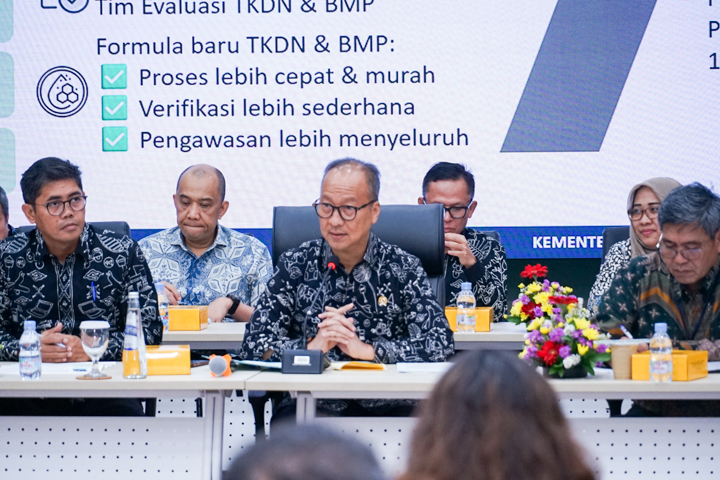
Jakarta - Minister of Industry Agus Gumiwang Kartasasmita has officially launched a new policy on Domestic Component Level (TKDN) through the issuance of Minister of Industry Regulation Number 35 of 2025 concerning the Provisions and Procedures for TKDN Certification and Corporate Benefit Weight (BMP). This reform is considered a major step toward establishing a system that is more affordable, simple, fast, transparent, and accountable thereby further encouraging investment and strengthening the competitiveness of the national industry.
“This reform is built on four main pillars: incentives, simplification, ease, and speed. These four pillars give birth to 13 fundamental and significant changes,” said the Minister of Industry to reporters in Jakarta, Thursday (11/9).
Under the incentive pillar, changes are made by rewarding industrial players who carry out research and development (R&D) activities. Previously, R&D activities did not receive additional value, but now the reform allows an additional TKDN value of up to 20 percent.
Furthermore, companies that invest domestically will receive an incentive in the form of a minimum TKDN value of 25 percent. Meanwhile, the Corporate Benefit Weight (BMP), which previously had a maximum value of only 15 percent and was difficult to achieve, has now become more accessible with 15 component options to form the BMP value.
The second pillar is simplification. Previously, TKDN calculations for goods were cost-based and required complex conditions. Now, this approach has been simplified there is no longer a need to calculate total costs, except for industrial services.
Materials are now assessed directly based on their TKDN value at the second level, and if not available, are evaluated based on the origin of the product. The validity period of TKDN and BMP certificates, which used to be only three years, has now been extended to five years, supported by a more structured supervision system.
Third, the pillar of ease. This reform introduces breakthroughs for small industries. Previously, their TKDN value was capped at a maximum of 40 percent and the certificate was valid for only three years. Now, through the self-declaration method, small industries can obtain TKDN values exceeding 40 percent, with certificates valid for up to five years.
Changes also occur in how the TKDN value is displayed. In the past, consumers had to look up certified product inventory lists to find TKDN values. Now, the TKDN value is printed directly on the label and product packaging.
R&D calculations, which were previously cost-based, are now simplified through intellectual aspects. Even TKDN certification for industrial services which previously had no clear procedures can now be applied for by calculating the cost components of labor, equipment, and general services.
The final pillar is speed. The time required for TKDN certification has also been significantly reduced. Certification through Independent Verification Institutions (LVI), which used to take 22 working days, can now be completed in just 10 working days.
Meanwhile, for small industries, which previously took five working days after documents were completed, the process now only takes three working days. The calculation of direct labor content and indirect factory costs, which used to require complex cost composition analysis, is now simplified through checklists of component elements.
TKDN calculation is no longer required to reach the third layer of production but is sufficient at the first layer, by referring to the existing TKDN certificates and domestic content from the next level suppliers.
In addition to reforms in incentives, simplification, ease, and speed, the government has also strengthened supervision and sanctions. Non-compliant practices such as TKDN washing, submission of false documents, breach of commitment, and certificate forgery will be dealt with firmly.
Sanctions may include Revocation of TKDN certificates, Revocation of verification institution accreditations, and Sanction recommendations for procurement officials in ministries, institutions, SOEs, and regional-owned enterprises.
“TKDN reform is the answer to the needs of the business world as well as a real form of the government's support for the domestic industry. We want to ensure that Indonesian industry not only survives but also leaps forward and provides real benefits to the nation and the people,” emphasized Agus.
The Ministry of Industry recorded that as of September 11, 2025, a total of 88,218 industrial products have been TKDN-certified, involving more than 15,000 industrial companies across various sectors. This achievement has had a significant impact, including maintaining production continuity, absorbing labor, increasing tax revenue, and supporting national economic growth.
TKDN Certificate for iPhone 17
In line with the TKDN reform, the Ministry of Industry also announced the issuance of four TKDN certificates for iPhone 17 products submitted by PT Apple Indonesia. These certificates were issued on September 11, 2025, after the products were confirmed to meet the requirements stipulated in Ministerial Regulation No. 29 of 2017 regarding the Provisions and Procedures for Calculating TKDN Values.
Agus emphasized that the issuance of these certificates not only shows Apple’s commitment to complying with national regulations but also reinforces Apple's strategic investment in Indonesia, beyond the TKDN scheme including the development of the Apple Developer Academy and digital talent ecosystem programs.
“Apple’s investment continues alongside the issuance of the TKDN certificates for iPhone 17. This proves that Indonesia remains a key partner for global companies in building innovation-based industrial value chains,” Agus stated.
The Minister of Industry concluded by affirming that the TKDN reforms and global investment commitments such as Apple’s will be the foundation for future growth of the national industry.
“Through TKDN reform, we aim to ensure that Indonesian industry not only survives but also leaps forward and delivers real benefits to the nation and its people,” he concluded.