Jakarta – As 2026 approaches, business players are buoyed by positive sentiment. The inaugural Kadin Business Pulse survey conducted by the Kadin Indonesia Institute (KII) shows that positive sentiment among businesses stands at 40%, higher than negative sentiment at 35%. Meanwhile, 25% of respondents assessed business conditions as neutral.
The main drivers of positive sentiment are market improvement or expansion (38%), followed by a more conducive competitive environment (24%) and improving regulations (23%).
Responding to the launch of the first Kadin Business Pulse, Chairman of Kadin Indonesia Anindya Novyan Bakrie expressed his appreciation.
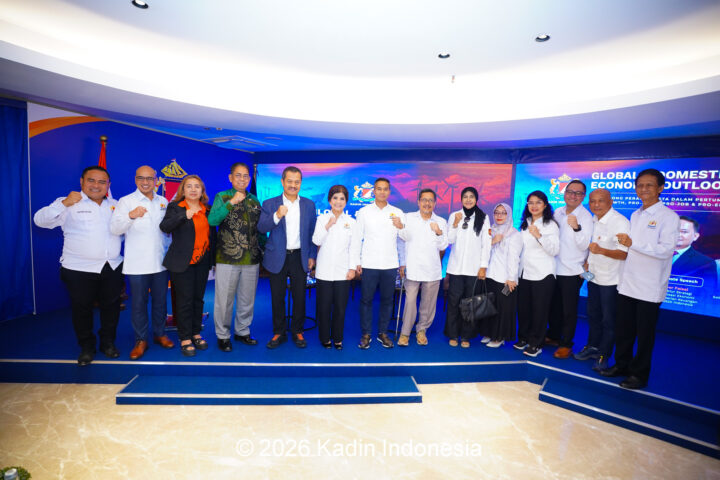
“Going forward, Kadin, as a strategic partner of the government, will speak based on up-to-date data produced independently—by the Kadin Indonesia Institute,” said Anindya, commonly known as Anin, at the launch of the Kadin Business Pulse on the sidelines of the Global & Domestic Economic Outlook 2026 forum themed Encouraging the Role of the Private Sector in Economic Growth: Pro-Growth, Pro-Poor, Pro-Job, and Pro-Environment at the Kadin Indonesia Tower, Jakarta, on Thursday (15/01/2026).
Meanwhile, Chairman of the Board of Kadin Indonesia Institute Mulya Amri said the results presented represent the inaugural or pilot edition of the Kadin Business Pulse for Q4 2025.
“This is a business sentiment survey designed as a rapid and periodic monitoring instrument for business conditions and the national economy,” Mulya said.
Like an oximeter used to measure the human pulse, KII—through the Kadin Business Pulse—measures developments in the business sector by surveying Kadin members across Indonesia. The inaugural survey was conducted from 1–23 December 2025, involving 155 respondents who are Kadin Indonesia members from various regions, sectors, and business scales.
KII explained that the initiative was introduced to meet the need for more concise and responsive economic monitoring, in line with the national targets of 8% economic growth and the elimination of extreme poverty to 0%.
Based on the survey results, positive sentiment among businesses reached 40%, exceeding negative sentiment at 35%. The main drivers of positive sentiment were market improvement or expansion (38%), a more conducive competitive environment (24%), and improving regulations (23%). These findings indicate business optimism heading into 2026.
To maintain this positive sentiment, Mulya noted that several areas require attention and improvement. The top priority is improving government policies and regulations (20%), followed by access to financing (17%), demand (13%), and labor (9%).
“These findings show that business challenges are still dominated by structural issues, particularly related to regulations as well as the availability and ease of financing, amid demand that needs to be strengthened,” Mulya explained at the Kadin Tower in Jakarta.
From a sectoral perspective, the Kadin Business Pulse Q4 2025 survey shows that the sector with the highest positive sentiment is financial services and insurance. KII views this signal as important for reading the direction of business optimism, including investment plans and expectations for improved business conditions in 2026.
To date, Mulya continued, formal economic data such as Gross Domestic Product (GDP) are published quarterly by Statistics Indonesia (BPS). Meanwhile, regular information on business sentiment remains limited and does not fully represent national business conditions. Therefore, the Kadin Business Pulse was initiated as a periodic survey to capture business sentiment and perceptions of economic, business, and investment conditions in Indonesia.
In his presentation, Mulya said the survey is intended to complement formal economic data such as GDP and the National Labor Force Survey (Sakernas) with a business-sector perspective, both retrospectively (the previous quarter) and prospectively (the upcoming quarter). The survey also aims to provide rapid, actionable insights for government policymaking and private-sector strategy, as well as to enhance understanding of on-the-ground business conditions and future economic prospects.
The objectives of the Kadin Business Pulse, Mulya added, include demonstrating Kadin Indonesia’s capability to conduct, analyze, and publish high-quality and credible surveys. In addition, the survey aims to build a database of Kadin Indonesia members to support future Kadin programs and activities. The program is designed as a regular and consistent monitoring system for business sentiment, leveraging Kadin’s member network from MSMEs to large corporations.
In terms of methodology, respondents were selected using random sampling. The survey was conducted online via WhatsApp and an online survey form. The six main topics covered include perceptions of current business conditions compared to the previous quarter, perceptions of sectoral conditions, investment plans over the next six months, key business challenges, positive developments experienced by businesses, and confidence levels regarding improvements in business conditions and the economy in 2026.
Mulya expressed appreciation to Kadin executives and members who supported the implementation of this inaugural survey. KII also requested continued support for the next survey, Kadin Business Pulse Q1 2026, which is scheduled to be conducted in March 2026.