

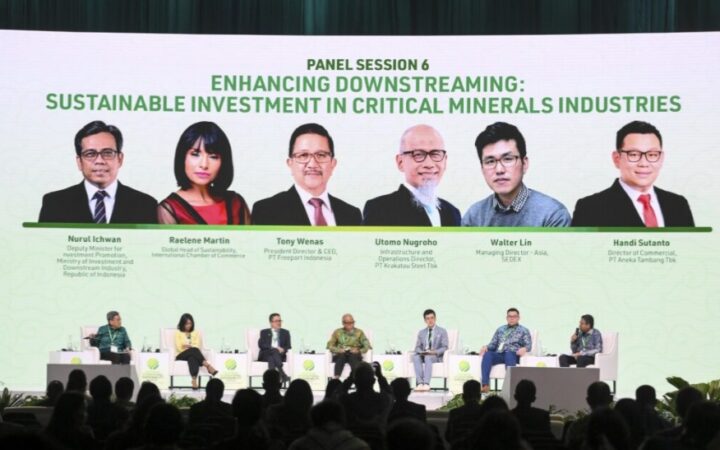

Jakarta, 11 October 2025 – As part of the Indonesia International Sustainability Forum (ISF) 2025, the panel session titled “Enhancing Downstreaming: Sustainable Investment in Critical Minerals Industries” emerged as one of the key discussions, highlighting Indonesia’s strategic role in strengthening the downstream sector of critical minerals to support a sustainable global energy transition.
This panel featured Nurul Ichwan, Deputy for Investment Promotion at the Ministry of Investment and Downstreaming (BKPM); Raelene Martin, Global Head of Sustainability at the International Chamber of Commerce; Tony Wenas, CEO of PT Freeport Indonesia; Utomo Nugroho, Director of Infrastructure and Operations at PT Krakatau Steel; and Walter Lin, Managing Director Asia at SEDEX. The discussion was moderated by Ashwin Balasubramanian from McKinsey & Company.
In his remarks, Nurul emphasized that mineral downstreaming is a core strategy for Indonesia to strengthen its national economic structure and accelerate the transition toward sustainable development. He stressed that the development of downstream industries must align with international regulations, including the EU Carbon Border Adjustment Mechanism (CBAM) and environmental and human-rights due diligence policies, to ensure Indonesia’s industries remain competitive in the global market.
“The government is targeting more than IDR 3,800 trillion in investment over the next five years to develop downstream industries for 15 priority commodities, including nickel, copper, bauxite, and steel. Downstreaming is not just about industrialization; it is about creating sustainable economic value, supporting the energy transition, and strengthening Indonesia’s position in the global supply chain,” said Nurul Ichwan.
He added that critical minerals are now strategic assets in international economic diplomacy, where national policies must bridge the interests of resource-rich countries and those with capital and advanced technologies. The government also encourages that the downstreaming process is carried out in line with good mining practices and the use of clean energy to ensure a balance between economic growth and environmental sustainability.
This panel discussed the dynamics and vast opportunities Indonesia holds in expanding its critical mineral downstream capacity—particularly for nickel, copper, bauxite, and rare earth metals—which are key to developing electric vehicle (EV) ecosystems and renewable energy technologies.
Speakers highlighted the importance of policy consistency amid shifting global trends, especially with the growing use of lithium iron phosphate (LFP) battery technology that could affect the competitiveness of nickel. On the other hand, the strategic collaboration between Freeport Indonesia and Antam to supply 30–50 tons of gold per year to the domestic market was recognized as a concrete step to strengthen local supply chains and domestic value creation.
The panel also highlighted the need for data interoperability and supply chain traceability, as promoted by the International Chamber of Commerce (ICC), to improve transparency, build trust, and attract sustainable investment. Meanwhile, Krakatau Steel emphasized the major role of the steel sector in the national economy, noting that every dollar of investment can generate 2.5 times added value in the supply chain and 13 times in related sectors, while also creating significant employment opportunities—aligned with its environmental roadmap.
Through green-oriented downstreaming, the government aims to achieve inclusive national economic growth of up to 8 percent, while positioning Indonesia as a sustainable investment hub both regionally and globally.
Cross-sector collaboration between the government, businesses, and global partners is expected to increase the added value of Indonesia’s mineral resources, ensure responsible governance, and establish the country as a key hub in the global green economy in this era of energy transition. (*)