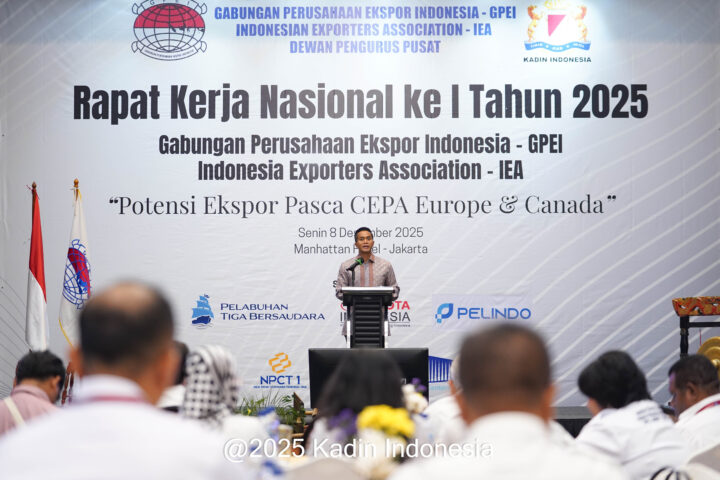
Jakarta - Chairman of the Indonesian Chamber of Commerce and Industry (Kadin) Anindya Novyan Bakrie underscored the importance of strengthening national export performance amid global geopolitical dynamics. Anindya, commonly known as Anin, delivered the message during the 2025 National Working Meeting (Rakernas) I of the Indonesian Exporters Association (GPEI), themed “Post-CEPA Export Potential: Europe & Canada”, held at the Manhattan Hotel, South Jakarta, on Monday (08/12/2025).
In his remarks, Anin highlighted Indonesia’s strong export performance, which has consistently shown positive growth. He noted that national exports have recorded 66 consecutive months of positive growth, reaching US$38 billion as of October 2025.
“I consider this an achievement that deserves pride and gratitude, especially given the intense geopolitical dynamism we see today,” Anin said.
Anin emphasized that exports must remain a primary driver in strengthening national economic growth. He explained that Kadin has been developing its industrial planning by “working backwards from exports”—identifying what the global market demands, and then fostering industries aligned with those needs.
“Exports are cross-sectoral. It’s not just about industry and jobs; ultimately, exports increase our foreign exchange earnings,” Anin said.
To achieve this, Anin called on Kadin and GPEI to work more closely in expanding industrial capacity, increasing the number of business actors, and involving MSMEs in export-oriented activities. He also stressed the importance of modernizing data systems—building intelligence-driven, predictive, and scenario-based data analysis capabilities.
Anin illustrated the state of the business sector with a familiar analogy: if businesses were chickens, they must be kept from becoming stressed in order to continue laying eggs—representing the generation of economic activity and job creation.
He added that Kadin’s two pillars—sectoral associations and provincial Kadin chapters—play a critical role in maintaining business stability and productivity. Collaboration with the government, law enforcement agencies, and fiscal authorities is also essential to ensure both certainty and comfort for businesses.
“This ‘chicken’ must not be stressed; if it is, it won’t lay eggs. Economic players need not only certainty but also comfort. Of course, laws and taxes must be enforced, but our partners in the business community also need a conducive environment,” Anin said.
While acknowledging Indonesia’s many challenges, Anin stressed that other countries face similar or even more complex issues. For this reason, he urged all business players to stay optimistic and continue collaborative efforts to help Indonesia achieve economic growth above 5 percent, moving toward 6–8 percent over the long term.
“We are on the right track. There are many challenges, but as history shows, the long-term trend is always upward. I’m confident that with the support of all GPEI members, we can reach growth above 5 percent, then 6, 7, 8 percent, and ultimately create more jobs and shared prosperity,” Anin concluded.