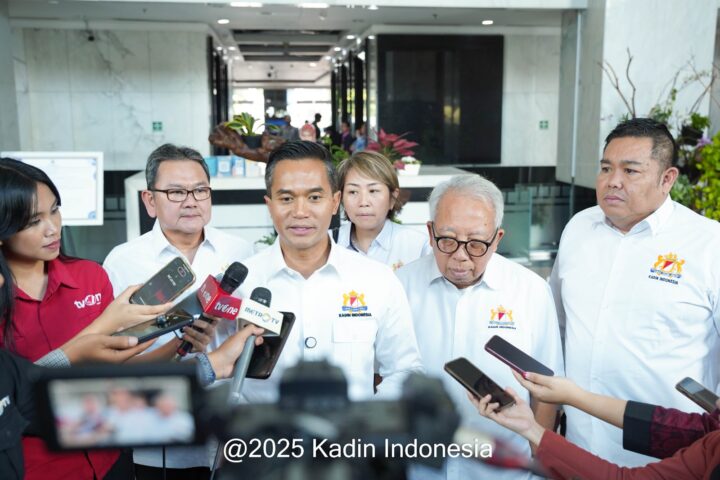
Jakarta – Chairman of the Indonesian Chamber of Commerce and Industry (Kadin Indonesia), Anindya Novyan Bakrie, together with members of the executive board, held an audience with Indonesia’s Minister of Finance Purbaya Yudhi Sadewa at the Ministry of Finance Office, Central Jakarta, on Thursday afternoon (December 11, 2025). The meeting discussed various strategic issues currently facing the industrial sector, particularly the steel, footwear, and textile and textile products (TPT) industries.
Anindya, who is familiarly known as Anin, explained that Kadin attended the meeting alongside industry associations and business players from the three key sectors, representing both upstream and downstream segments.
“We came together with associations and business actors from three sectors. First, steel, both upstream and downstream. Second, footwear. And third, textiles and garments, which also have upstream and downstream components,” Anin said.
Anin revealed that one of the main issues raised was imports, especially in the steel sector.
“Many of our members emphasized that imports need to be carefully monitored. If they are legal, that is fine. But what about illegal imports? Even for legal imports, domestic production capacity must be taken into account,” he explained.
Beyond steel, the footwear sector was also highlighted, given its significant contribution to exports to the United States, Canada, and the European Union. According to Anin, key issues such as wage structures and environmental aspects were also discussed.
In the textile and textile products (TPT) sector, the discussion focused on strengthening industrial competitiveness, which has been perceived as declining in recent years.“We also discussed how imports can be properly supervised so that the industry remains competitive. It was even emphasized that the textile and garment industry is not a sunset industry, but one that can be revitalized,” Anin said.
In addition to internal industry issues, the meeting also addressed regulatory consistency in port areas, including customs and import supervision, which are seen as affecting the performance of the steel, footwear, and TPT sectors.
According to Anin, positive signals emerged from discussions regarding plans to establish task forces on deregulation and incentives, initiated by the Minister of Finance.
“This appears to be the initial stage of what the Minister of Finance discussed—namely, a deregulation task force and an incentives task force. We also conveyed several inputs,” Anin noted.
Anin assessed that communication between Kadin Indonesia and the Ministry of Finance has been very constructive and was positively received by the industry representatives present.
“Our colleagues from the steel, footwear, and textile sectors were very pleased. Perhaps in the next one or two weeks, we will return with representatives from other sectors,” he added.
Responding to questions regarding the possibility of fiscal supervision for each sector, Anin stressed that policy decisions rest entirely with the government. However, Kadin’s position remains firm in advocating for the competitiveness of national industries.
“Ultimately, Kadin’s focus is competitiveness. Without competitiveness, we cannot increase investment and exports,” Anin emphasized.
He added that job creation is also a key priority, in line with the government’s target of boosting economic growth to 8 percent.
“If employment grows, purchasing power increases. Many say these industries are already in decline, but if they can be revitalized, this represents our opportunity to achieve growth of 6, 7, or even 8 percent in the future,” Anin concluded.
The audience was attended by members of the Kadin Indonesia executive board, including Coordinating Vice Chairwoman for Human Development, Culture, and Sustainable Development Shinta W. Kamdani; Vice Chairman for Organization Taufan Eko Nugroho; Vice Chairman for Association Development and Extraordinary Members Benny Soetrisno; Vice Chairman for Industry Saleh Husin; Vice Chairwoman for Macro–Micro Economic Policy Analysis Aviliani; Chairman of the Kadin Indonesia Institute Mulya Amri; and Head of Communications of Kadin Indonesia, Primus Dorimulu.
Also present were industry association leaders, including Akbar Djohan, Chairman of the Indonesia Iron Steel Association (IISA); Leslie Soemedi, Chairman of The Indonesian Iron & Steel Industry Association (IISIA); Budi Harta Winata, Chairman of the Indonesian Society of Steel Construction (ISSC); Yoseph Billie Dosiwoda, Executive Director of the Indonesian Footwear Association (Aprisindo); Jemmy Kartiwa Sastraatmaja, Chairman of the Indonesian Textile Association (API); and Anne Patricia Sutanto, Chairwoman of the Indonesian Garment and Textile Association (AGTI).