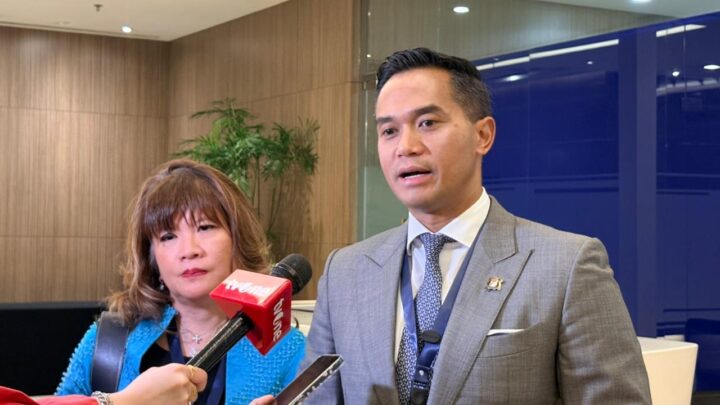
JAKARTA — Chairman of Kadin Indonesia, Anindya Bakrie, attended the Indonesia Economic Outlook 2026 event led directly by President Prabowo Subianto at the Danantara Indonesia Auditorium, Friday (13/02/2026).
In his opening remarks, President Prabowo expressed appreciation for the hard work of his administration during its first year in office. He stated that numerous achievements over the past year represent accomplishments worthy of national pride.
“All of our achievements, which we should be proud of, are the result of the hard work of the entire team that I lead. So, ladies and gentlemen, before all of Indonesia, I say that my team, in my opinion and conviction—because I am the one who works closely with them—truly represents the best sons and daughters of Indonesia,” President Prabowo said, as quoted from the official website of the State Secretariat.
Following the event, Anindya—commonly known as Anin—affirmed that Indonesia’s economic fundamentals remain solid amid global dynamics, as various priority government programs begin to deliver tangible results.
Anin highlighted several initiatives, including the Free Nutritious Meals (MBG) program, the Fishermen’s Village program, and the Red-and-White Village Cooperatives, which he said have begun to show positive impacts, including multiplier effects on the broader economy.
“Indonesia’s economic fundamentals are solid. These government programs have demonstrated results, especially MBG and its downstream effects. Significant budget efficiencies have also been achieved,” Anin said.
According to him, bureaucratic efficiency has created broader fiscal space to fund priority development programs.
“For us in the business community, it is encouraging to see bureaucratic efficiency because the savings can be redirected to other productive purposes,” he added.
Anin further emphasized that consistent law enforcement, alongside the provision of space for businesses to operate and grow, is crucial to maintaining national growth momentum—especially amid global uncertainty.
“When Indonesia has this momentum—as the second-fastest growing economy in the G20—we must seize it,” Anin stressed.
He noted that agriculture and labor-intensive industries play strategic roles due to their capacity to absorb large numbers of workers. Sectors such as footwear, garments, textiles, furniture, and electronics have strong export potential while also serving as engines for job creation.
Therefore, Anin underscored the importance of reindustrialization to maintain high employment absorption while increasing the industrial sector’s contribution to gross domestic product (GDP).
He also pointed to the government’s efforts to expand international market access—including to the European Union, Canada, the Eurasian region, and the United States—as a positive step toward broadening export opportunities.
“Our economy is growing, but it is taking a path that is not easy—yet it is the right path. That requires time, and it also requires time to communicate clearly to the public,” he said.
Anin stressed that the concept of Indonesia Incorporated is essential to strengthening collaboration among national economic stakeholders.
“It is very important. The spirit is mutual cooperation—progressing together, not individually. Those who are capable help those who are less capable. Large businesses support medium-sized ones, and so on,” he concluded.
Meanwhile, Chairwoman of the Indonesian Employers Association (Apindo) and Coordinating Vice Chair for Human Development, Culture, and Sustainable Development at Kadin Indonesia, Shinta W. Kamdani, emphasized the importance of sustained support for labor-intensive industries as key sources of formal employment.
“Labor-intensive industries are a major source of formal job creation. We must continue to support their growth,” Shinta said.
She noted that manufacturing’s contribution to GDP currently stands at around 19 percent, down from approximately 23 percent in previous years. Strengthening industrialization remains essential, including the development of upstream industries to reduce dependence on imported raw materials.
“About 70 percent of our raw and supporting materials are still imported. The government is expected to facilitate upstream industrial development so that we reduce dependence on imports from other countries,” she explained.
Shinta also highlighted the need to protect domestic industries—particularly textiles and garments—from import pressures, while improving the quality and competitiveness of the informal sector, including MSMEs and gig economy workers.
“We must support gig workers so they can grow, improve in quality, and contribute to job creation as well,” she concluded.