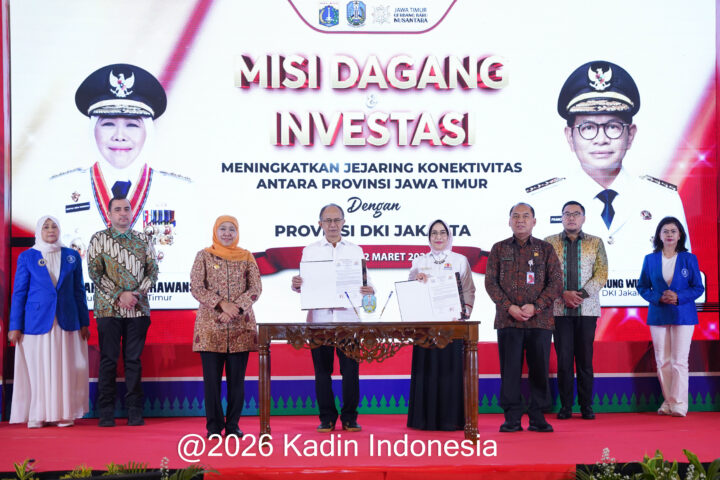
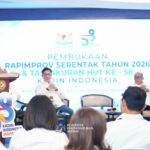
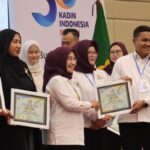
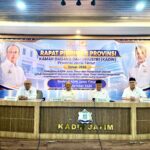
Jakarta - The Provincial Government of DKI Jakarta and the Provincial Government of East Java held a Trade and Investment Mission: Strengthening Connectivity Networks between East Java Province and DKI Jakarta Province at Menara Peninsula Hotel, Jakarta, on Monday (March 2, 2026).
The event was organized as an effort to strengthen interregional economic connectivity while encouraging economic growth through increased trade and investment cooperation.
On the occasion, a memorandum of understanding (MoU) was also signed between the East Java Chamber of Commerce and Industry (Kadin East Java) and the Jakarta Chamber of Commerce and Industry (Kadin DKI Jakarta), covering cooperation in trade and human resource development.
The agreement was signed by Chairman of Kadin East Java Adik Dwi Putranto and Chairwoman of Kadin DKI Jakarta Diana Dewi.
Chairman of Kadin East Java Adik Dwi Putranto stated that interprovincial trade missions represent a strategic step to strengthen the domestic market through the utilization of locally produced goods.
“This initiative aims to strengthen the domestic market with domestic products. It turns out that there are still many opportunities, very significant ones, both for entrepreneurs outside East Java Province and those within East Java itself,” Adik said after the event.
He explained that the cooperation between Kadin East Java and Kadin DKI Jakarta is expected to open wider market opportunities for businesses, particularly from East Java, to meet various demands in the capital.
“With this cooperation, we can identify what kinds of needs exist in DKI Jakarta. It turns out there are still many demands that can be supplied by East Java. Our hope is that entrepreneurs from East Java can support these needs,” Adik said.
Adik also expressed hope that similar cooperation models could be implemented by other provinces so that the domestic market can increasingly be dominated by local products.
“We hope this can be replicated by all provinces so that the domestic market can truly be supplied by products made within the country,” he added.
In addition to trade cooperation, the MoU also includes human resource development programs, including training for micro, small, and medium enterprises (MSMEs). According to Adik, the quality of human resources is a key factor in driving economic growth.
“In our view, around 60–70 percent of economic growth is determined by human resources. Therefore, it must continue to be strengthened through training and capacity building,” Adik explained.
Meanwhile, East Java Governor Khofifah Indar Parawansa emphasized that the trade mission is not solely focused on commodity transactions. She noted that the initiative is also part of efforts to build a resilient and efficient supply chain ecosystem.
“We want to ensure that what is produced by farmers, livestock breeders, and MSME players in East Java can be optimally absorbed by the Jakarta market with stable prices and maintained quality. This is a joint effort to control inflation and maintain people’s purchasing power,” she said.
Meanwhile, Jakarta Regional Secretary Uus Kuswanto, who attended the event representing Jakarta Governor Pramono Anung, stated that for Jakarta, trade missions are an important instrument to strengthen domestic market integration. In addition to shortening supply chains, such collaboration is also seen as a way to enhance national economic resilience through interregional synergy.
“For DKI Jakarta, trade missions are a strategic instrument to strengthen domestic market integration, shorten supply chains, and enhance national economic resilience based on interregional collaboration,” he concluded.
According to the official website of the East Java Provincial Community and Village Empowerment Office, the total transaction commitment from the East Java–Jakarta Trade and Investment Mission reached Rp5.744 trillion, surpassing the East Java–Jakarta Trade Mission achievement in 2021, which recorded Rp750.44 billion.
Of the total, East Java’s sales to DKI Jakarta reached Rp5.615 trillion, while East Java’s purchases from DKI Jakarta amounted to Rp129.6 billion, mainly in beef commodities.
Leading commodities from East Java traded in the mission include poultry meat, day-old chicks, poultry livestock, coffee beans, dory fillets, various processed seafood and meat products, milk, chicken eggs, white crystal sugar, fish feed, pillows and bolsters, cigarettes, fashion and textile products, sauces, soy sauce, spices, hand-drawn batik, sawn timber, ornamental fish such as koi and goldfish, cigars, and sheep.