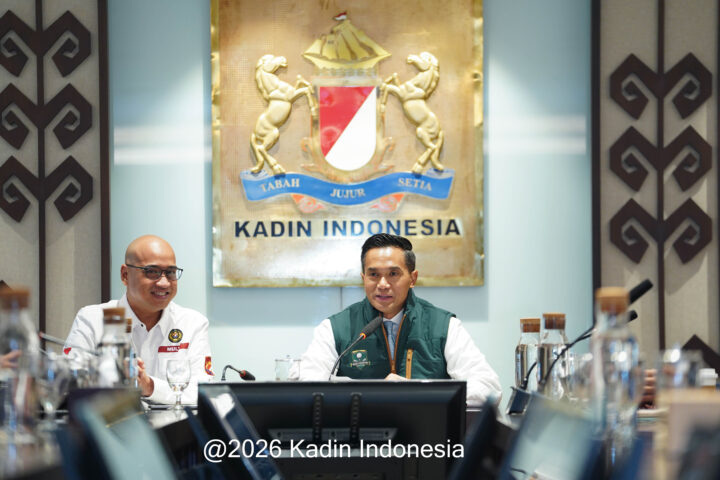
Jakarta – The Indonesian Chamber of Commerce and Industry (Kadin) Institute (KII) officially launched the Kadin AI Academy during a seminar titled “AI and the Future of Human Capital” held at Menara Kadin Indonesia in Jakarta on Wednesday (20/05/2026).
The launch marks a strategic step by Kadin Indonesia to bridge the skills gap while promoting the inclusive adoption of artificial intelligence (AI) among businesses, workers, and MSMEs across various regions in Indonesia.
Chairman of Kadin Indonesia, Anindya Novyan Bakrie, stated that the momentum of AI adoption among Indonesian businesses is becoming increasingly evident and is beginning to shape new expectations for the future of the national business landscape.
Anin, as he is commonly known, revealed that based on the Kadin Indonesia Business Pulse Q1-2026 survey, there has been a significant surge in positive business perceptions toward technological developments, particularly AI.
“In the fourth quarter of 2025, only a very small number of surveyed business players viewed technological development as a positive driver for their businesses. However, just three months later, in Q1-2026, the figure jumped to 22 percent. There are now 22 percent of business actors who see technological advancements, especially AI, as a source of optimism for the business sector,” said Anin.
According to Anin, the increase is not merely a statistical figure, but a strong signal that the benefits of AI are beginning to be tangibly felt by Indonesian businesses.
“The question is, how do we ensure this 22 percent continues to grow, and how do we extend it beyond Jakarta to Kadin members across the regions, to MSMEs, and to workers who are most at risk of being left behind by this wave? This is the question that the Kadin AI Academy seeks to answer,” Anin explained.
Anin emphasized that AI is now impacting all segments of the business ecosystem, ranging from large industries, students and job seekers, to MSMEs and entrepreneurs seeking to restructure their companies’ workflows.
On the occasion, Anin also outlined three key principles that he believes should guide AI adoption in Indonesia.
First, according to Anin, AI must be inclusive and should not widen the gap between those who are already advanced and those who are left behind. He stressed that AI must reach the groups most vulnerable to disruption, including workers, MSMEs, and regions outside major economic centers.
Second, Anin stated that AI must be positioned as a productive rather than substitutive technology. He emphasized that AI should serve as a strategic “partner” that strengthens human capabilities rather than replacing them.
“AI must help Indonesians work smarter, faster, and more effectively,” said Anin.
Third, Anin noted that AI must become an accelerator of national economic growth.
“The 8 percent economic growth target set by President Prabowo Subianto requires substantial productivity improvements, and AI is one of the most concrete levers currently available,” Anin explained.
Meanwhile, Executive Director of KII Mulya Amri said that the Kadin AI Academy was established to help MSMEs utilize AI technology, which is now becoming increasingly accessible on a massive scale.
“How can MSMEs make use of the various technologies that are now widely available, including numerous AI-powered applications? How can they become active users of these technologies to enhance their business capabilities?” said Mulya.
He explained that through AI, MSME players can learn various aspects of business management, such as preparing financial reports, managing human resources, drafting business plans, and applying for financing.
“All of these can be learned through AI, and users can receive answers tailored to their specific business needs based on the information they provide to the AI,” Mulya concluded.