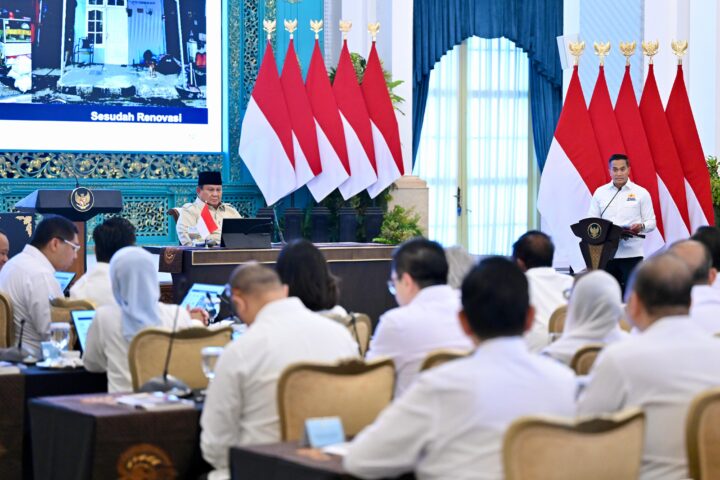
Jakarta – The General Chair of the Indonesian Chamber of Commerce and Industry (Kadin), Anindya Novyan Bakrie, alongside members of the executive board and provincial Kadin chairpersons, attended a meeting with President Prabowo Subianto. The agenda, titled "Meeting of the President of the Republic of Indonesia with Central and Regional Business Leaders of Kadin from Across Indonesia," took place at the State Palace, Central Jakarta, on Friday (31/07/2026).
In his address, the President expressed his appreciation for the attendance of business leaders representing various regions across Indonesia. The Head of State noted that the meeting with Kadin was crucial for strengthening synergy between the government and business actors in driving national development.
“I would also like to express my gratitude for your presence here. When it was reported to me that Kadin wished to meet, I said this was very important and prioritized receiving all of you,” the President stated.
Furthermore, the President explained that national development spans multiple sectors. Therefore, all elements of the nation must be mobilized and united so that Indonesia’s resources can be utilized optimally for the benefit of the people.
“Nation-building is a cross-sectoral effort. Thus, it requires the collective strength of the nation to be mobilized and unified so that we can leverage all available national resources,” the President added.
Meanwhile, Kadin Indonesia General Chair Anindya Novyan Bakrie reported on various strategic initiatives undertaken by Kadin to support the government's priority programs. These range from the Free Nutritious Meals (MBG) program, Free Health Screenings (PKG), upgrading the skills and protection of Indonesian Migrant Workers (PMI), to renovating unfit housing (RTLH). Anin also reiterated the business community’s commitment to supporting Indonesia’s economic growth target of reaching 8 percent.
Addressing President Prabowo, Anin—as he is affectionately called—stated that Kadin has consistently chosen to remain optimistic in the face of global economic dynamics by offering practical solutions for the business sector.
“Wherever we go, every country faces similar challenges. In fact, Indonesia is in a relatively better position given its 5 percent economic growth over the last 20 years and well-controlled inflation,” Anin said.
According to Anin, current global economic conditions represent a new normal that must be navigated through close collaboration between the government and the business sector.
“With your permission, Mr. President, we have traveled extensively across the regions to observe the cooperation between local governments and regional Kadin chapters, as we see a very positive correlation,” he noted.
Anin shared that observations from his regional visits demonstrate how strong synergy between local governments and Kadin can drive higher economic growth.
“When we visited places like North Maluku, North Kalimantan, Central Kalimantan, or West Nusa Tenggara, where there is close, strategic partnership, economic growth has been remarkably robust. Interestingly, this growth is driven not only by the national and regional budgets (APBN/APBD), but also by the collective creativity of local stakeholders,” Anin remarked.
On that occasion, Anin also presented the progress of Kadin’s four quick-win programs launched in early 2025, serving as concrete support for the government’s development agenda and the Prabowo-Gibran administration's Asta Cita initiatives.
The first program is the Free Nutritious Meal (MBG) Gotong Royong Task Force. To date, Kadin has contributed through 866 Nutrition Fulfillment Service Units (SPPG), including 128 units located in underdeveloped, frontier, and outermost (3T) regions.
“We are focusing heavily on this because UNICEF research indicates that every $1 spent yields a multiplier effect of $3 to $15,” Anin explained.
The second initiative is the Free Health Screening (PKG) Task Force. To support this program, Kadin launched a white paper titled Health is the New Wealth, which highlights the massive economic potential of the health sector.
“We identified that the healthcare sector accounts for IDR 670 trillion, where every IDR 1 spent can generate IDR 2 to IDR 3 in economic value,” Anin noted.
Additionally, Kadin is implementing a program to protect and upskill Indonesian migrant workers through certification and training for approximately 208,000 workers.
“This is crucial because foreign exchange remittances from migrant workers rank fourth, contributing USD 17.1 billion—right behind iron and steel, coal, and palm oil,” Anin stated.
The next quick-win program involves renovating unfit housing (RTLH) in support of the government's Three Million Houses Program.
“We initiated this early on because such transformations create a massive impact, generating up to 19 million jobs. That is why we supported the Three Million Houses Program from the very beginning,” Anin detailed.
Furthermore, Anin expressed his appreciation to President Prabowo and the cabinet ministers for the continuous synergy built with Kadin, particularly in strengthening Indonesia's economic diplomacy globally. According to Anin, Kadin is routinely involved in overseas missions to unlock opportunities for trade, investment, and industrialization.
“Mr. President, we are grateful for the opportunity to join overseas diplomatic trips aimed at finding counterpart partners—partners for trade, investment, and industrial development,” Anin said.
Anin added that national investment realization in the first half of 2026 demonstrated a positive trend. Out of the IDR 2,041 trillion investment target for this year, roughly half has been realized, creating nearly 1.5 million new jobs. To ensure these international cooperation opportunities are fully leveraged by domestic businesses, Kadin established the Kadin Global Engagement Office (GEO).
“The objective is to serve as project management to ensure that trade agreements secured by the government, whether Free Trade Agreements (FTAs) or Comprehensive Economic Partnership Agreements (CEPAs), are fully maximized,” Anin said.
Moreover, Anin stated that Kadin regularly hosts economic diplomacy forums with foreign ambassadors to strengthen Indonesia’s trade relations across the globe.
“Every second Friday of the month, we host a diplomacy event with all ambassadors and rotate visits among ministries to ensure seamless coordination between overseas partners, regional Kadin chapters, and trade associations,” Anin explained.
During the meeting, Anin also introduced the We Buy From Indonesia initiative, a trade and technology platform showcasing Indonesian products that have integrated into global supply chains.
“We would like to present an initiative entitled We Buy From Indonesia. This initiative is more than just a catalog; it is a trade and technology platform demonstrating how numerous global and Indonesian products are produced in Indonesia and have become part of global supply chains,” Anin said.
Anin clarified that the platform features not only national products like Pindad and Kopiko, but also highlights Indonesian industrial participation in the supply chains of various global brands.
“It includes not only local brands like Pindad, On Cloud footwear, and Kopiko, but also components utilized by global brands such as Tesla, Airbus, Kia, IKEA, and many others,” Anin added.
Anin noted that the platform was developed to offer a comprehensive view of Indonesia's export potential while boosting the capacity of local manufacturers to integrate further into global supply chains. The We Buy From Indonesia platform is available in three languages—Indonesian, English, and Mandarin—and was co-developed with key stakeholders, including the Ministry of Trade, to serve as a reliable reference for Indonesian export data.
Closing his report to the President, Anin emphasized that Indonesia needs to gradually accelerate its economic growth toward 8 percent to successfully escape the middle-income trap. He reaffirmed Kadin’s readiness to remain a strategic partner to the government in driving national economic development.
“Moving forward, we hope Kadin can work hand in hand with the government. May the President remain in good health to lead us not only out of these challenges, but forward toward achieving 8 percent growth,” Anin concluded.
The event was attended by members of Kadin Indonesia's executive board, including Coordinating Vice General Chair (WKUK) for Organization, Communication, and Regional Empowerment Erwin Aksa; WKUK for Food Mulyadi Jayabaya; WKUK for Foreign Affairs James T. Riady; WKUK for Infrastructure and Regional Development Carmelita Hartoto; WKUK for Investment, Downstreaming, Energy, and Environment Bobby Gafur Umar; WKUK for Social Affairs Nita Yudi; WKUK for Human Development, Culture, and Sustainable Development Shinta W. Kamdani; WKUK for Politics and Security Bambang Soesatyo; WKUK for Law, Human Rights, and Infrastructure M. Azis Syamsuddin; and WKUK for Export Development Juan Permata Adoe.
Also in attendance were Provincial Kadin Chairpersons, including West Sumatra Kadin Chair Buchari Bachter, South Sumatra Kadin Chair Affandi Udji, Jambi Kadin Chair Usman, Bangka Belitung Kadin Chair Ritchie Glen Yapranadi, West Java Kadin Chair Almer Faiq Rusydi, East Java Kadin Chair Adik Dwi Putranto, West Kalimantan Kadin Chair Arya Rizqi Darsono, Central Kalimantan Kadin Chair Rahmat Nasution Hamka, East Kalimantan Kadin Chair Putri Amanda Nurramadhani, North Kalimantan Kadin Chair Kilit Laing, North Maluku Kadin Chair Muksin Thalib, West Sulawesi Kadin Chair Zaneth Raodathul Djannah, South Sulawesi Kadin Chair Andi Iwan Darmawan Aras, Southeast Sulawesi Kadin Chair Anton Timbang, Central Sulawesi Kadin Chair Gufran Ahmad, East Nusa Tenggara Kadin Chair Bobby Lianto, Papua Kadin Chair Jacleana Joku, and West Papua Kadin Chair Suriyati Faisal.