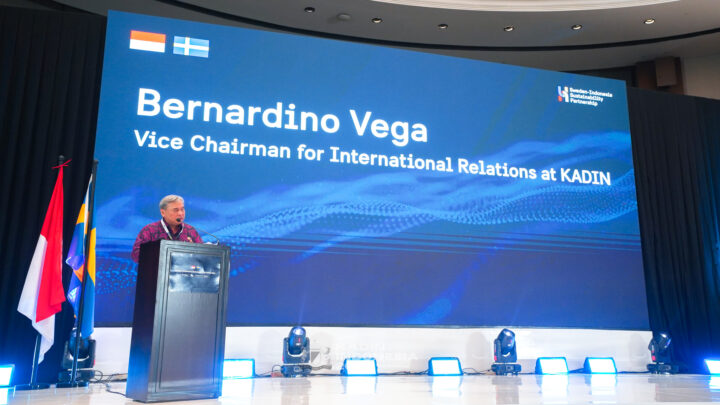
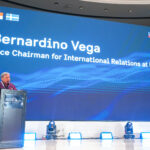
Jakarta – Deputy Chairman for Foreign Relations of the Indonesian Chamber of Commerce and Industry (Kadin Indonesia) Bernardino M. Vega called for stronger economic ties between Indonesia and Sweden through enhanced cooperation in trade, investment, technology, and sustainable development. He made the statement at the Sweden-Indonesia Sustainability Partnership (SISP) 2026 Business Dinner held at the Park Hyatt Hotel in Central Jakarta on Tuesday evening (September 8, 2026).
Dino Vega, as Bernardino is widely known, said that relations between Indonesia and Sweden have a strong foundation, both diplomatically and economically. The two countries have maintained diplomatic relations since 1950, and over more than seven decades, those ties have expanded across various sectors, including energy, electric vehicles, sustainability, mining, healthcare, and forestry.
“Our relationship has depth, not just ceremony. The foundation of our economic relationship is getting stronger, and there is still significant room to grow. The challenge is how we elevate that partnership,” Dino Vega said.
Dino Vega added that around 80 Swedish companies are currently operating in Indonesia. Their presence has also helped build business ecosystems with Indonesian partners, including distributors, suppliers, and service providers.
Meanwhile, bilateral trade between Indonesia and Sweden is valued at around US$825 million. This figure remains relatively small compared with Indonesia’s total trade in goods with the European Union, which stands at approximately US$27 billion.
“This means that Sweden’s presence in Indonesia is already quite deep, but in terms of volume, there is still very significant room for growth,” he said.
Dino Vega said the prospects are becoming increasingly promising as Indonesia’s economy continues to grow. Indonesia’s economy grew by 5.11% in 2025 and is projected to expand by around 5.2% in 2026. With a population of approximately 283 million and its position as Southeast Asia’s largest economy, Indonesia is considered to have a large and relatively young market.
“Regardless of how each of us views the pace of that growth, the direction of capital formation in Indonesia is clearly increasing and is being carried out in a planned manner,” Dino Vega said.
Furthermore, Dino Vega highlighted two strategic opportunities that could further strengthen economic relations between Indonesia and Sweden. One of them is the Indonesia-European Union Comprehensive Economic Partnership Agreement (IEU-CEPA).
According to him, the IEU-CEPA will represent an important structural shift for the Indonesia-Europe market. The agreement includes the elimination of approximately 98.5% of Indonesia’s tariffs on goods from the European Union, expanded services market access in the computer and telecommunications sectors, simplified customs procedures, and stronger protection of intellectual property rights.
“This represents the biggest structural change in the market in the past decade, and its implementation is getting closer,” he said.
Dino Vega emphasized that a survey showed 66% of Swedish companies in Indonesia expect the CEPA to improve their business prospects. Meanwhile, 54% of companies expect lower import duties on raw materials and finished products from the European Union.
The second strategic opportunity is Indonesia’s accession process to the Organisation for Economic Co-operation and Development (OECD). Dino Vega said Sweden has experience and expertise that could help Indonesia meet various OECD standards.
Indonesia is the first Southeast Asian country to have applied for OECD membership. The comprehensive technical process began in July 2026, with 26 technical committees assessing Indonesia against OECD standards across various public policy areas, including trade, investment, governance, competition, and integrity.
“Kadin views OECD accession as a business project, not merely a diplomatic project,” Dino Vega said.
He added that Kadin Indonesia, together with the Coordinating Ministry for Economic Affairs of the Republic of Indonesia, launched the OECD Private Sector Playbook in April 2026 as a guide for the private sector in supporting Indonesia’s accession process.
In this context, Dino Vega invited Swedish companies, business organizations, and regulators to build cooperation with Kadin Indonesia, particularly through the exchange of knowledge and experience in regulatory impact assessment, competition policy, integrity, and anti-corruption compliance.
“Sweden knows what is required to meet OECD standards because Sweden has contributed to shaping those standards. We invite Swedish businesses, business organizations, and regulators to work with Kadin through structured exchanges of knowledge and experience,” he said.
According to Dino Vega, Sweden’s support for Indonesia’s OECD accession process would ultimately help create a more conducive business environment for Swedish companies operating in Indonesia.
Dino Vega also emphasized the importance of integrating economic growth with sustainability principles. He said Indonesia’s future competitiveness will increasingly be determined by the ability of businesses to meet global environmental standards.
In the energy sector, for example, Kadin Indonesia and BloombergNEF have estimated that around US$3.5 trillion in investment will be required for Indonesia to achieve its net-zero target by 2050.
For Indonesian exporters to Europe, meanwhile, the ability to reduce carbon intensity will become increasingly important in maintaining market access. In this regard, Swedish technology could help Indonesian companies not only meet compliance standards but also enhance their competitiveness.
“Swedish technology can not only help meet compliance standards, but also maintain companies’ competitiveness and ensure that market access remains open,” Dino Vega said.
Opportunities for cooperation are also open in the electric vehicle, mining, healthcare, food, and forestry sectors. The development of electric vehicle ecosystems and sustainable mineral supply chains is one area that could bring together Indonesia’s resource advantages with European technology and standards.
In the healthcare sector, Indonesia has embarked on a transformation agenda, including a target to sequence 400,000 genomes (genes and chromosomes) by 2030. Meanwhile, the Free Nutritious Meals Program opens opportunities for the development of cold-chain systems, packaging, and various supporting industries on a large scale. In the forestry sector, Bernardino welcomed cooperation initiatives that bring together Indonesia’s rich natural resources with Sweden’s experience in sustainable forest management.
Dino Vega emphasized that Indonesia and Sweden have complementary strengths. Indonesia offers market scale, resources, demographics, and a growing economy, while Sweden brings standards, technology, and institutional credibility.
“Neither of us will achieve the maximum results by going it alone. We have to do it together and through collaboration,” he said.
Also attending the event were Kadin Indonesia Deputy Chairman Coordinating for Legal and Human Rights, Facilities and Infrastructure M. Azis Syamsuddin; Deputy Chairman for Agriculture Devi Erna Rachmawati; Deputy Chairman for Strategic Infrastructure Development, Rural Development and Transmigration Thomas Djusman; and Deputy Chairman for Research and Technology Ilham Akbar Habibie.