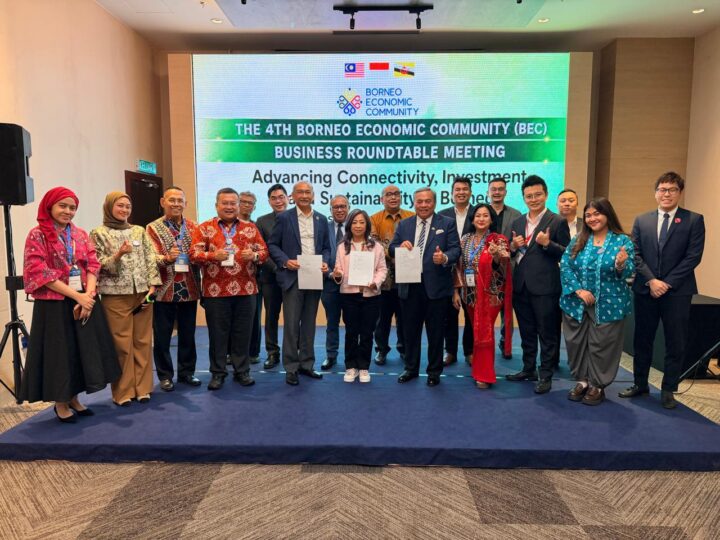
Kota Kinabalu, Malaysia - The Indonesian Chamber of Commerce and Industry (Kadin) Indonesia is pushing for stronger economic integration across Borneo through enhanced connectivity, expanded investment, and sustainable development. The initiative formed the central focus of The 4th Borneo Economic Community (BEC) Meeting - BEC Business Roundtable, themed "Advancing Connectivity, Investment, and Sustainability in Borneo," held at the Sabah International Convention Centre (SICC) in Kota Kinabalu, Malaysia. The strategic gathering brought together business leaders from Indonesia, Brunei Darussalam, and Malaysia (representing Sabah, Sarawak, and Labuan) to unlock cross-border commercial opportunities and reinforce the Borneo Economic Community (BEC) as the primary platform for private sector collaboration on the island.
The Kadin Indonesia delegation was led by Vice Chairman for Foreign Affairs and Alternate Chairman of the ASEAN Business Advisory Council (ASEAN-BAC), Bernardino Vega, who delivered a presentation titled "Building an Integrated Connectivity Vision for Borneo." Vega outlined a phased connectivity roadmap for the island, encompassing short-term enhancement of air connectivity, medium-term development of maritime networks integrated with Indonesia’s new capital city, Nusantara (IKN), and long-term establishment of a high-speed rail network. “Connectivity serves as the foundation for building Borneo into an increasingly integrated economic zone. We must connect not only people and goods, but also investments, industries, energy, and various economic growth centers across Borneo,” Bernardino stated.
He emphasized that developing connectivity requires a multimodal approach tailored to the distinct characteristics and needs of each region. Air connectivity serves as a critical first step to boost mobility for communities and business actors, while maritime and land links are necessary to bolster freight movement, supply chains, and cross-border trade. In this context, the development of IKN is slated to act as a catalyst for regional economic growth. The emerging economic hub in Kalimantan offers significant potential to drive trade, investment, and cross-border value chain development with Sabah, Sarawak, Labuan, and Brunei Darussalam.
As Asia’s largest island with a population of approximately 24 million, Borneo holds substantial economic potential, boasting a combined Gross Domestic Product (GDP) of US$165 billion. Investment momentum across the region continues to accelerate, with Indonesia recording US$107.1 billion in realized investments in 2025 and Malaysia approving US$104.2 billion during the same period. Meanwhile, investment in IKN reached roughly US$4 billion by May 2026 through dozens of commercial partnerships.
The BEC Business Roundtable addressed three core priorities for regional cooperation: connectivity, investment, and sustainability. Participating territories presented their strategies to foster a more interconnected economic ecosystem.
Sabah focused on expanding air and maritime routes while developing the eastern Borneo economic corridor through port optimization, enhanced shipping lines, increased flight frequencies, and the reinforcement of strategic hubs like Tawau to support economic ties with North and East Kalimantan. Meanwhile, Labuan is positioning itself as a regional maritime and financial gateway by leveraging its port infrastructure, cross-border financial services, and capital mobilization for regional projects.
Brunei Darussalam plays a strategic role in driving regional investment by leveraging its capital resources, energy assets, and economic diversification agenda. Key areas of cooperation include regional infrastructure, energy security, clean energy transition, the halal economy, sustainable tourism, and non-oil and gas industrial development.
For Indonesia, the development of IKN alongside Kalimantan’s vast resource base is expected to propel downstream industrialization and value-added regional supply chains. Collaborative opportunities span high-value mineral processing, green refining, agriculture, renewable energy, and the development of industrial parks linked with Sabah, Sarawak, and Brunei Darussalam. These efforts will be further supported by the ASEAN Alliance on Carbon Markets to develop interconnected carbon markets, mobilize green investment, and advance low-carbon industries across Borneo.
Bernardino stressed that economic development on the island must translate into concrete projects that yield tangible benefits for local businesses and communities. “What we need next is to convert this shared vision into actionable projects. We must identify priority connectivity routes, bankable investment opportunities, and key sectors to build shared value chains so that the benefits of Borneo’s growth are widely felt,” he remarked.
Highlighting the importance of regional synergy, Haji Musa bin Haji Adnin, Managing Director of Adinin Group of Companies, Brunei, noted ongoing efforts to enhance inter-island links, including direct flights connecting Sulawesi to Brunei to complement existing cooperation frameworks.
Supporting this vision, Datuk Susan Chang, Chairman of the Malaysian International Chamber of Commerce & Industry (MICCI) Sabah, affirmed that connectivity remains the single most critical infrastructure component for the BEC framework. Echoing these sentiments, Consul General of the Republic of Indonesia in Kota Kinabalu, Noorman Effendi, stated that the BEC serves as a strong complement to BIMP-EAGA by giving the private sector a stronger voice. He emphasized the need to pursue realistic "quick win" projects with high economic value to accelerate tangible economic integration.
Datuk Hajah Rosmawati from Sabah International Expo 2026 and Daniel Doughty from the Labuan Chamber of Commerce highlighted the critical need for regional synergy and positioned the BEC as a unified voice to address connectivity bottlenecks and environmental challenges across Borneo. Both emphasized collaborating across Indonesia, Malaysia, and Brunei to attract global investment, champion strategic projects like the trans-Borneo railway, and transform ecological challenges into sustainable business ventures, such as carbon credits. Aligning with these views, Azhar Othman from BEBC Labuan added that the BEC provides a more flexible, effective platform for business needs than formal government channels, particularly in advocating for technical customs and regulatory solutions at the national level.
On operational efficiency and supply chain integration, Simon Wong from Harrisons Sabah Sdn Bhd and Albert Wen Yau Hwong from Dynamik Technologies advocated for seamless internal economic integration free from inter-regional competition. Wong proposed positioning Tawau as a new logistics gateway for North Kalimantan while encouraging regional stakeholders to consolidate resources. To facilitate smooth cross-border operations, Hwong introduced the "Borneo on the Go" initiative—a digital system slated for launch in November 2026 to harmonize business indicators, streamline certification recognition, and facilitate professional talent mobility through a credential wallet within the BEC ecosystem.
The meeting concluded with delegates adopting the Joint Statement of the 4th Borneo Economic Community (BEC) Business Roundtable Meeting, establishing a framework for continued private sector collaboration. The joint statement was signed by Haji Musa bin Haji Adnin representing Brunei Darussalam, Bernardino M. Vega representing Indonesia, and Datuk Susan Chang Huan Soon representing Sabah, Malaysia. The signatories reaffirmed their commitment to strengthening the BEC as a platform for deeper trade, investment, and economic alignment. The day’s proceedings concluded with a networking dinner hosted by Kadin Indonesia.
Established on September 5, 2023, by members of ASEAN-BAC alongside chambers of commerce and business associations from across Borneo, the BEC was created to reinforce the BIMP-EAGA framework. Beyond driving internal integration, the BEC pledged its full support for the upcoming 4th BIMP-EAGA Trade, Investment and Halal Industry Conference, scheduled to take place in Jakarta, Indonesia, in October 2027.
The meeting was attended by key representatives from various regional institutions and business sectors, including Bernardino M. Vega; Haji Musa bin Haji Adnin; Datuk Susan Chang; Noorman Effendi; Hajah Rosmawati from Sabah International Expo 2026; Erich Nicholas and Daniel Doughty representing the Labuan Chamber of Commerce; Matthew Loh and Stella Liew representing MICCI Sabah; Simon Wong from Harrisons Sabah; Datuk Jade Koh from Jetsin; Fitriani Kuroda from PT MilangKori Persada; Albert Wen Yau Hwong from Dynamik Technologies; Ary Adiati representing the Indonesian Consulate General (KJRI) in Kota Kinabalu; as well as the Kadin Indonesia delegation, comprising Ira Kusumawardani and Rian Suarianto from IraRian Modest Halal Fashion, Ika Saraswati Sulandjari, Yahya Adi Dharma Prawiro, Hanadia Pasca Yurista, and Fairuz Andra Prastyanti. Through this reinforced collaboration, Borneo is expected to evolve into an integrated economic space that delivers sustainable benefits for all communities across the region.