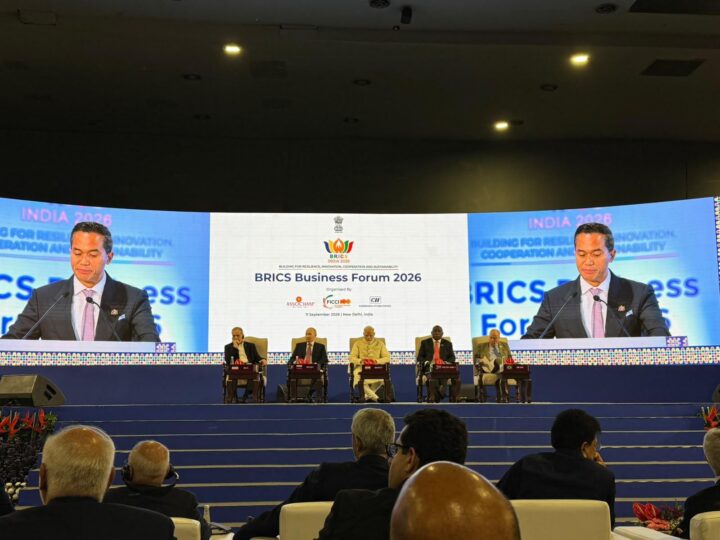
New Delhi, India – Chairman of the Indonesian Chamber of Commerce and Industry (Kadin Indonesia) Anindya Novyan Bakrie brought President Prabowo Subianto’s vision of downstreaming, human capital development, and economic self-reliance to the BRICS Business Forum in New Delhi, India. Speaking before Indian Prime Minister Narendra Modi, Russian President Vladimir Putin, South African President Cyril Ramaphosa, Iranian President Masoud Pezeshkian, and other world leaders, Anindya, widely known as Anin, emphasized that Indonesia does not want to merely become a new market, but also aims to help shape the direction of economic cooperation within BRICS.
In his speech on Friday (September 11, 2026), Anin expressed his pride in Indonesia becoming part of the BRICS family under President Prabowo’s leadership. Indonesia, he said, also now has an active chapter within the BRICS Business Council, enabling it to contribute to advancing trade, investment, industry, technology, and services among member countries.
“We are very glad and honored that Indonesia has joined the BRICS family thanks to President Prabowo. Indonesia now has a very active chapter in the BRICS Business Council,” Anin said.
The speech was delivered during a session on developing intra-BRICS trade and services. Anin noted that BRICS represents nearly half of the world’s population and around 40% of the global economy. According to Anin, this scale not only provides the capacity to shape the future of the global economy, but also creates a responsibility to ensure that more people can benefit from economic progress.
“When we speak about BRICS, we are speaking about nearly half of humanity and around 40% of the world economy. We have the economic power to shape the future, but also the responsibility to ensure that more people can take part in it,” Anin said.
Anin explained that discussions on trade and services should not stop at broad concepts. Cooperation must address practical challenges faced by businesses: whether companies can find partners in other member countries, enter BRICS markets, access the services they need, and receive payments quickly and securely.
According to Anin, the industrial and services sectors cannot be separated. A factory requires technology, financing, software, logistics, and skilled workers. Therefore, developing the services sector will strengthen industrialization, while industrial growth will create new demand for various services.
For Indonesia, such cooperation is aligned with President Prabowo’s priorities to accelerate downstreaming and strengthen the quality of human resources. Collaboration in the services sector can also expand public access to better education and healthcare services.
Anin then outlined three priorities to strengthen intra-BRICS trade and services.
First, BRICS should facilitate the mobility of companies and professionals across countries. The BRICS Business Council should identify concrete barriers faced by businesses and then submit specific solutions to the respective governments.
Mutual recognition of professional qualifications and easier business travel, Anin said, would accelerate transactions and investment. He proposed developing a BRICS Business Travel Card to support the mobility of businesspeople.
Second, BRICS needs to connect and strengthen cross-border payment systems, particularly digital payments. Anin said India, Brazil, and China have demonstrated the significant potential of real-time payments. The challenge now is to ensure that these systems can be connected and used efficiently for cross-border transactions.
BRICS, according to Anin, should also expand the use of local currencies for appropriate trade transactions while maintaining data security and financial system stability. “Financial sovereignty does not have to mean financial isolation,” Anin emphasized.
The proposal is in line with discussions at the BRICS Business Forum on payment system connectivity, increasing transactions using local currencies, and developing fast, affordable, and secure cross-border payment mechanisms.
Third, BRICS countries must increase investment in people and infrastructure that support trade in services. Businesses should be encouraged to train workers, establish partnerships with universities, and help companies—particularly micro, small, and medium-sized enterprises—make use of artificial intelligence.
Anin proposed that each BRICS Business Council chapter establish measurable annual targets for the number of workers trained. The New Development Bank could also play a role in financing digital networks, training programs, and supporting infrastructure.
According to Anin, new member countries such as Indonesia should help determine the BRICS agenda rather than merely become markets for products and companies from countries that joined earlier. Every partnership should build domestic capabilities so that people in all member countries can become both providers and users of services.
Anin described meaningful BRICS integration as an ecosystem in which micro and small businesses in Surabaya, São Paulo, Durban, and Alexandria can find customers, offer services, and receive payments through the BRICS economic network.
“That is the test of truly meaningful BRICS integration,” said Anin, who also serves as Chairman of the Indonesia Chapter of the BRICS Business Council.
Concluding his speech, Anin recalled the spirit of the 1955 Asian-African Conference in Bandung. According to Anin, BRICS cooperation should strengthen ties among developing countries while generating economic benefits that reach communities and small businesses.
“In the spirit of Bandung (the 1955 Asian-African Conference), stronger cooperation within BRICS must connect us with one another. Indonesia is ready to help build those connections. Let us make the future we see in BRICS a future that can be enjoyed and developed together,” Anin concluded.