


Jakarta - Chairman of the Indonesian Chamber of Commerce and Industry (Kadin Indonesia), Anindya Novyan Bakrie, emphasized that the vision of bringing Indonesia to the global stage must be anchored in the upgrading of Micro, Small, and Medium Enterprises (MSMEs), the creation of quality jobs, and the integration of grassroots businesses into industrial supply chains. Investment must flow down to the regions, stimulate production, and pave the way for Indonesian products to penetrate global markets.
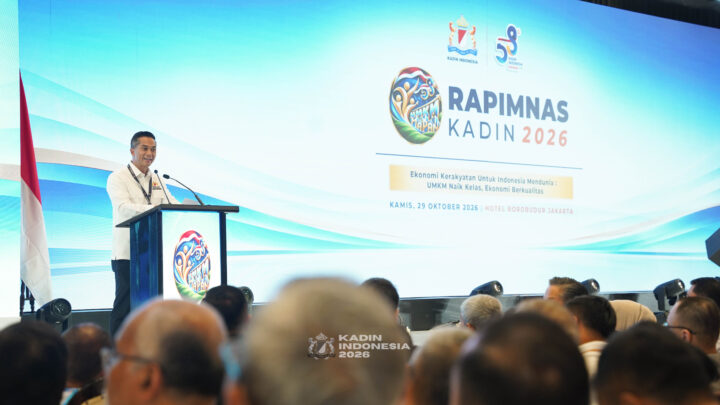
"It is impossible to achieve a people's economy and a global Indonesia without upgrading MSMEs and creating quality jobs," said Anin—Anindya's familiar nickname—at the opening of the Kadin Indonesia National Leadership Meeting (Rapimnas) at Hotel Borobudur, Jakarta, on Thursday (October 29, 2026).
Under the theme "The People's Economy for a Global Indonesia," Anin urged the business community and the government to forge stronger ties between capital inflows, industrial development, grassroots enterprise empowerment, and export growth. He summarized this strategic direction as a business development flow moving from villages to factories, and ultimately reaching world markets.
According to Anin, investments will yield broader benefits when grassroots businesses can participate in the value creation process. Business actors in rural areas must be given the opportunity to become raw material suppliers, production partners, service providers, or integral parts of industrial distribution networks. "From villages to factories to world markets," he said, describing the direction of the partnerships Kadin aims to strengthen.
Within this framework, Anin connected two major agendas: Buy Indonesia and Buy from Indonesia. The first agenda is directed toward attracting investments into Indonesia, both through the capital market and via direct investment. The second agenda aims to expand international market purchases of Indonesian products and services.
Both, according to Anin's presentation, are part of a single continuous economic cycle. Incoming capital must develop production capacity and broaden domestic supplier engagement. Increased production must then be paired with market access so that investments generate sustainable sales, revenues, and employment opportunities.
Anin stated that the Rapimnas serves as Kadin's primary channel to formulate the business community's aspirations and convey them to the government. The forum also functions as a space to unify input from regional business leaders, associations, and business federations into a shared agenda.
"There are many ways to convey aspirations to the government, and all of them are good. But within Kadin, the way to do so is by holding the Rapimnas," he stated.
The timing of the forum, which closely coincides with Youth Pledge Day (Sumpah Pemuda), provides momentum for strengthening the solidarity of the business community in facing national and global challenges, as reflected in his opening remarks.
Anin began his presentation by highlighting the growing global attention toward emergency preparedness. He cited efforts to build energy reserves and household preparedness as illustrations that global uncertainties must be met with tangible anticipatory measures.
For Indonesia, this situation reinforces the urgency of building food, water, and energy resilience. These three fundamental needs determine the ability of society and the business community to withstand supply disruptions and international shocks. "The resilience of food, water, and energy is part of Indonesia's sovereignty," Anin said.
He linked this agenda to the policy direction of President Prabowo Subianto and the ideals of economic independence championed by President Soekarno. National resilience, in his view, must be supported by the capacity to fulfill basic needs and develop independent production capabilities.
Amidst these uncertainties, Anin remains optimistic about Indonesia's economic resilience. He asserted that evaluations of economic conditions must consider overall fundamentals comprehensively, including growth, investment activity, corporate performance, and financing.
Responding to questions regarding whether Indonesia is on the verge of a crisis, Anin compared current conditions to the 1998 economic crisis and the 2020 Covid-19 pandemic. In his presentation, he noted an economic contraction of approximately 13% in 1998 and about 2.1% in 2020, whereas current economic growth remains positive at around 5.1%.
According to Anin, this difference indicates that economic activity must be assessed proportionally. While vigilance must be maintained regarding financial market volatility, the growth capacity of the real sector also deserves attention. "It is better to look at the fundamentals," he remarked.
Anin acknowledged the intense pressures facing the capital and financial markets. In his presentation, he noted capital outflows of roughly Rp124 trillion, a decline in the Jakarta Composite Index (IHSG) of about 40%, and an exchange rate reaching approximately Rp18,170 per US dollar. He did not specify the measurement periods for each figure during his address.
However, concurrently, he highlighted foreign direct investment, corporate earnings growth, foreign exchange reserves, and credit growth as indicators that must be factored in when assessing economic resilience.
Anin cited foreign direct investment realization of around Rp270 trillion, listed companies' net profit growth of approximately 16%, and year-on-year credit growth of about 13.3%. These figures were presented as part of his overview of economic fundamentals, without further elaboration on their specific periods and scopes.
"We are not saying that the challenges on the left do not exist; they do and must be watched closely. But let us return to the fundamentals," he said, contrasting financial market pressures with the underlying indicators supporting economic activity.
Nevertheless, Anin stressed that national economic resilience must be felt at the regional level. Feedback from regional Kadin leadership underscores the importance of maintaining local business activity, particularly amidst budget tightening and reduced government spending.
He pointed to reductions in transfer-to-regions and regional capital expenditures, which can impact local economic activity. According to Anin, these conditions require careful attention because regional enterprises depend on the continuity of infrastructure development, productive spending, and public demand.
Anin stated that the government has paid attention to these concerns. He understands initial tightening measures as an effort to improve efficiency, which must subsequently be followed by productivity enhancements.
In his view, Indonesia's existing resilience must be elevated into competitiveness. The ability to endure pressures must evolve into the capability to produce more competitive products, expand investments, and boost sales both domestically and internationally.
To showcase Indonesia's production capabilities, Anin introduced the book We Buy from Indonesia. He noted that the publication features testimonials and examples of Indonesia's integration into the production networks of global brands.
According to Anin, the book highlights 77 brands—including Airbus, Tesla, and Nike—demonstrating how Indonesian products and components link to international markets. He also mentioned Kopiko as an example of an Indonesian brand reaching global markets. "Our task is to elevate those components and boost their sales," he said.
The core message, according to Anin, is that Indonesia has already established a foothold in global supply chains. This foothold needs to be expanded by increasing the number of suppliers, production capacity, quality, and domestic value addition.
He also emphasized the importance of economic diplomacy and the expansion of trade access. Various international cooperation frameworks must be leveraged to unlock sales opportunities while attracting investments that strengthen domestic industries.
In this context, international economic relations must generate concrete business opportunities for Indonesian enterprises, including MSMEs integrated into the supply chains of large corporations.
Anin further highlighted the relationship between the capital market and the real sector. In his view, the composition of large corporations in the capital market does not yet fully reflect the diversity of Indonesia's economic activities.
He believes there is still ample room for more real sector companies to access the capital market. Such expansion would enrich investment choices while opening new financing sources for production activities.
Anin understands that capital market evaluations factor in growth prospects and future expectations. However, the broader the representation of the real sector, the greater the opportunity for the capital market to support business development across various fields.
To strengthen the relationship between large corporations and grassroots enterprises, Kadin has prepared several partnership models. Anin mentioned inclusive closed-loop systems, core-plasma patterns, production partnerships, industrial supplier development, supply chain financing, distribution and retail partnerships, and the involvement of local vendors in industrial estates.
Through these models, grassroots businesses are expected to gain better access to markets, financing, technology, and industrial production inputs. Partnerships must generate sustainable business relationships so that MSME capacity building is matched by tangible market demand.
Anin explained that the initial framework for the Rapimnas recommendations focuses on three needs: first, strengthening buffers to face crises; second, ensuring raw material support for grassroots production; and third, enhancing business certainty so that Indonesian companies can grow and compete internationally.
This framework will be discussed further with provincial Kadin boards, business associations, and federations. Consequently, the final recommendations are expected to accurately reflect the challenges faced by business actors on the ground.
Anin also underscored the importance of the "Indonesia Incorporated" concept, representing collaborative efforts between the government and the business community to strengthen the national economy. He touched upon fiscal discipline, deregulation, and the resolution of investment bottlenecks as part of this agenda.
Within this framework, Danantara is expected to act as an enabler, allowing the government and the private sector to jointly advance investment activities. Simultaneously, the business community must strengthen its involvement in uplifting grassroots enterprises.
To ensure the Rapimnas agenda yields actionable follow-ups, Anin announced the formation of eight working groups. The first group addresses the upgrading of business actors, including cooperatives and MSMEs. The second focuses on grassroots business value chains, infrastructure, and logistics. The third handles downstream processing, energy, and value addition.
The fourth group is tasked with human resource productivity and technology adoption. The fifth handles economic resilience and the defense industry. The sixth focuses on economic diplomacy and trade agreements. The seventh deals with strengthening Kadin's institutional capacity across regions, while the eighth oversees food sovereignty and resilience.
Anin emphasized that program implementation will be monitored every three months. This periodic monitoring is intended to evaluate progress and promptly address any implementation bottlenecks.
"So that we do not merely talk about these programs once a year," he stated.
According to Anin, the formulation of the Rapimnas agenda was preceded by consolidation with regional chapters and various organizational divisions. He noted the simultaneous holding of provincial leadership meetings across 38 provinces alongside 12 national coordination meetings.
Kadin has also convened meetings to respond to strategic developments and executed the quarterly Kadin Business Pulse. This feedback is utilized to gauge business conditions and formulate responses tailored to the needs of business actors.
Anin expressed hope that collaborative efforts among the government, large corporations, MSMEs, and regional entrepreneurs can translate Indonesia's potential into increased production and prosperity. Incoming investments must pave the way for grassroots enterprises to grow, while the expansion of global markets must deliver tangible benefits down to the village level.
Concluding his remarks, Anin quoted a saying frequently shared by President Prabowo: "One thousand friends too few, one enemy too many." He urged the business community to expand cooperation to safeguard national sovereignty while reinforcing Indonesia's standing in the global economy.
"Forward Indonesia, forward Kadin," he concluded.

National Economy
Regional Economy
National Economy
Regional Economy