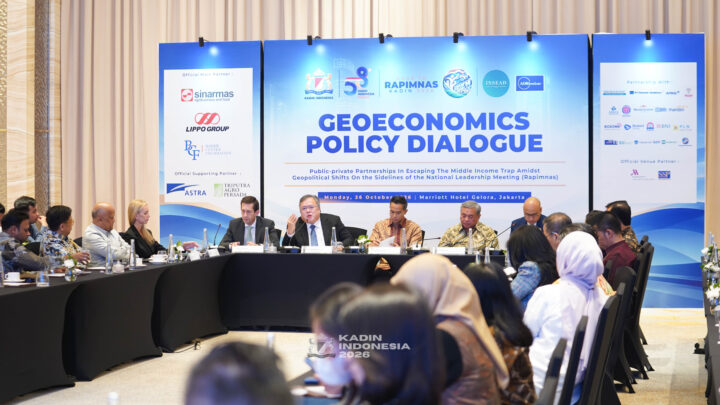
Jakarta – The Indonesian Chamber of Commerce and Industry (Kadin Indonesia) held a Geoeconomics Policy Dialogue themed “Public-Private Partnerships in Escaping the Middle-Income Trap Amidst Geopolitical Shifts” ahead of the 2026 Kadin National Leadership Meeting (Rapimnas). The event took place at the Marriott Hotel Gelora in West Jakarta on Monday (October 26, 2026).
The event featured several speakers, including Dean and CEO of the Asian Development Bank Institute (ADBI) Prof. Bambang Brodjonegoro, Dean of INSEAD Prof. Francisco Veloso, and Director of International Development at INSEAD Michaela Felber.
Kadin Indonesia Chairman Anindya Novyan Bakrie emphasized that the private sector plays a crucial role in driving Indonesia’s economic growth and helping the country escape the middle-income trap.
Anindya, popularly known as Anin, noted that 92% of Indonesia’s gross domestic product (GDP) comes from sources outside government spending, namely investment, exports, and domestic consumption.
“Kadin is the independent voice of the business community, mandated by law, and we clearly understand that 92% of our GDP comes from outside government spending, namely investment, exports, and domestic consumption,” Anin said.
Anin also highlighted the importance of industrialization in boosting productivity and creating jobs. He noted that Indonesia’s manufacturing index had declined from 32% in 2002 to approximately 19% today.
“To grow, we need to industrialize. Our manufacturing index has declined from 32% in 2002 to around 19% today,” Anin said.
According to Anin, improving productivity through the adoption of technology is essential to creating better jobs and fostering equitable, sustainable, and inclusive economic growth.
He also stressed that Indonesia must capitalize on its demographic dividend to accelerate economic growth and escape the middle-income trap.
“Our President has set an 8% growth target for a clear reason: to strive to escape the middle-income trap, as other countries have done before us,” Anin explained.
Meanwhile, Dean and CEO of the Asian Development Bank Institute (ADBI) Prof. Bambang Brodjonegoro said Indonesia should learn from Japan and South Korea, which developed their manufacturing industries to become high-income economies.
“This is dangerous and could happen in many Southeast Asian countries. They engage in manufacturing and export their products, but they do not advance their technology. This means their competitiveness will decline over time,” Bambang said.
He explained that industrial development requires more than manufacturing and assembly activities. Companies must adopt technology, strengthen their engineering capabilities, and develop innovations.
Bambang cited South Korean companies as examples of businesses that evolved from different initial industries before expanding into technology and manufacturing. In the 1960s, Samsung, for instance, was involved in the sugar trading business. LG began in cosmetics, Hyundai in construction, SK in textiles, and Daewoo in trading.
These companies subsequently expanded into various industrial sectors. Samsung developed into an electronics company, Hyundai established itself in the automotive industry, while SK expanded into telecommunications.
“The government must encourage the private sector to work together to help the country escape the middle-income trap,” Bambang said.
Dean of INSEAD Prof. Francisco Veloso said global changes present both challenges and opportunities for Indonesia. He highlighted the importance of developing relevant skills to navigate the artificial intelligence (AI) revolution and the changing demands of the future workforce.
“The world is in a period of transition. There are many challenges, but also many opportunities. The intelligence revolution is changing the way we move forward. Therefore, developing the right skills for the future will become increasingly important,” Veloso said.
He expressed hope that the dialogue would strengthen collaboration in support of Indonesia’s development, in line with the vision of Golden Indonesia 2045. Veloso also highlighted the role of family businesses in Indonesia’s economy, an area in which INSEAD has significant expertise.
“We focus, in particular, on the role family businesses have played in Indonesia and the role they can play in the future. INSEAD has considerable expertise in this area. We hope this forum will provide a productive platform for us to continue collaborating in the years ahead,” he said.
As part of the event, Kadin Indonesia Chairman Anindya Novyan Bakrie and ADBI Dean and CEO Prof. Bambang Brodjonegoro signed a Memorandum of Understanding (MoU). On the same occasion, Kadin Indonesia and ADBI officially launched a joint working paper examining the role of the private sector in development financing.
The program continued with the signing of an MoU between Kadin Indonesia and INSEAD. This collaboration forms part of Kadin Indonesia’s efforts to strengthen partnerships with academic institutions and international development organizations in support of Indonesia’s economic development.
Also in attendance were Kadin Indonesia Deputy Chairman for Membership Widiyanto Saputro; Deputy Chairman for Events and Chair of the 2026 Kadin National Leadership Meeting Organizing Committee Ria Yusnita; Deputy Chairman for Foreign Relations Bernardino M. Vega; Deputy Chairman for Research and Technology Ilham Akbar Habibie; and Chair of the Kadin Indonesia Russia-Belarus Bilateral Committee Didit Ratam.
The event was part of the series of activities leading up to the 2026 Kadin National Leadership Meeting and was sponsored by Sinarmas Agribusiness and Food, PT Triputra Agro Persada Tbk, PT Astra International Tbk, PT Riau Andalan Pulp and Paper, PT Freeport Indonesia, Tempo Scan Pacific Tbk, Wiraraja Madura Industrial Estate III, PT Anindya Wiraputra Konsult, PT Bank Rakyat Indonesia (Persero), Amazon Web Services Indonesia/PT Mastersystem Infotama Tbk, PT Indocement Tunggal Prakarsa Tbk, PT Bank Mandiri, the Association of Ceramic Industries (ASAKI), PT Bank Negara Indonesia (Persero), Syam & Syam Law Office, PLN Icon Plus, PT Bosowa, Dayak Nusantara Bersatu, PT Chandra Asri Pacific Tbk, PT Bank Tabungan Negara (Persero), and PT Bank Syariah Indonesia.