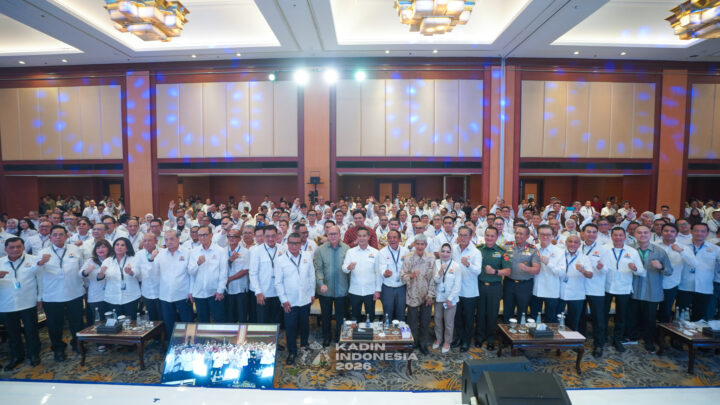
Jakarta - The 2026 National Leadership Meeting (Rapimnas) of the Indonesian Chamber of Commerce and Industry (Kadin Indonesia), themed "The Role of Kadin in the People's Economy for a Global Indonesia" with the sub-theme "Empowering MSMEs, Building a Quality Indonesian Economy," has officially opened. The event takes place from October 29–30, 2026, at Hotel Borobudur, Central Jakarta.
The opening ceremony of the 2026 Rapimnas was symbolically inaugurated by the General Chairperson of Kadin Indonesia, Anindya Novyan Bakrie, alongside the Minister of Investment and Downstreaming / Head of the Investment Coordinating Board (BKPM), Rosan P. Roeslani; the Vice Chairperson Coordinator (WKUK) for Organization, Communication, and Regional Empowerment of Kadin Indonesia and Chair of the 2026 Rapimnas Organizing Committee, Erwin Aksa; the WKUK for Law, Human Rights, and Infrastructure/Facilities of Kadin Indonesia and Chair of the 2026 Rapimnas Steering Committee, M. Azis Syamsuddin; and the Vice Chairperson for Event Management of Kadin Indonesia and Chair of the 2026 Rapimnas Operating Committee, Ria Yusnita.
In his remarks, Kadin Indonesia General Chairperson Anindya Novyan Bakrie stated that the Rapimnas serves as one of Kadin Indonesia's primary mechanisms to voice the business community's aspirations to the government while formulating strategic steps to address global economic challenges.
Anin, as he is familiarly known, highlighted the importance of strengthening national resilience amid global uncertainties, particularly within the food, water, and energy sectors. According to Anin, these three sectors constitute vital pillars of Indonesia's sovereignty.
"The resilience of food, water, and energy is a fundamental part of Indonesia's sovereignty. This has also been frequently voiced by President Prabowo and by President Soekarno through his Trisakti principles," Anin said.
Anin noted that amid global dynamics driving various nations to strengthen preparedness and strategic reserves, Indonesia must continue building national resilience while optimizing its potential.
Anin also emphasized that Indonesia's economic fundamentals continue to demonstrate resilience. He pointed to Indonesia's economic growth reaching 5.1 percent, compared to a contraction of 13 percent in 1998 and minus 2.1 percent during the Covid-19 pandemic in 2020.
"In our view, it is better to look at the fundamentals. We can see that in 1998 it was minus 13 percent, in 2020 during Covid it was minus 2.1 percent, whereas now it stands at plus 5.1 percent," Anin stated.
Nevertheless, Anin acknowledged that pressures in the capital and financial markets still warrant caution. He noted a capital outflow of Rp124 trillion from the capital market, a decline in the Jakarta Composite Index (IHSG) of around 40 percent, and an exchange rate reaching Rp18,170 per US dollar.
However, he pointed out that several other indicators still reflect economic resilience, including foreign direct investment (FDI) realization of Rp270 trillion, a net profit growth of listed companies of approximately 16 percent, foreign exchange reserves of US$146 billion, and a year-on-year credit growth of 13.3 percent.
"We are not saying that the challenges on the left do not exist; they do and must be watched closely. But returning to the fundamentals, I believe that is the most appropriate approach so we remain unaffected by the noise," Anin said.
In addition to safeguarding national economic resilience, Anin stressed the importance of ensuring that economic growth is felt at the regional level. He touched upon the impact of transfer-to-regions and capital expenditure adjustments on economic activity across various regions.
According to Anin, efficiency must serve as the initial step before the government and the business sector drive productivity enhancements. Anin also welcomed government efforts to address regional economic pressures to reopen spaces for growth.
On this occasion, Anin highlighted export expansion opportunities through the launch of the book We Buy from Indonesia. The book features testimonies from 77 global and local brands that have procured products and components from Indonesia, including Airbus, Tesla, and Kopiko. Anin stated that these opportunities must be leveraged to enhance the added value of national products, including components supplied to global corporations.
"Our task is to elevate those components and boost sales," Anin said.
According to Anin, efforts to expand export markets must go hand in hand with increased investment, both through the capital market and foreign direct investment (FDI). Opening market access through economic diplomacy and international trade agreements is also considered vital for amplifying the potential of Indonesian products to penetrate global markets.
Anin noted that Indonesia currently has 25 trade agreements in force, while another 15 are still under negotiation, including one with the European Union. This expanded access is expected to strengthen the competitiveness of national products and drive Indonesia's exports to reach approximately US$300 billion annually.
Furthermore, Anin outlined three recommendation frameworks to be discussed at the 2026 Kadin Indonesia Rapimnas: strengthening economic buffers to face crises, securing raw materials for grassroots production, and ensuring business certainty to support a global Indonesia.
"To support this agenda, Kadin Indonesia also introduces the 5D strategy through the Indonesia Incorporated concept, which involves strengthening synergy between the government and the business sector to drive national economic growth," Anin said.
According to Anin, the government plays a role in maintaining fiscal discipline and sensitivity, encouraging deregulation, and overcoming various hurdles that impede business activities. Meanwhile, the business sector is expected to play an active role in boosting productivity, strengthening competitiveness, and helping MSMEs scale up.
As a follow-up, Kadin Indonesia will launch eight working groups aimed at ensuring the organization's programs and recommendations are implemented sustainably.
"These eight working groups are designed so that instead of merely talking about these programs annually, we will continuously monitor business actors every three months to ensure they scale up," Anin stated.
Meanwhile, Minister of Investment and Downstreaming / Head of BKPM Rosan P. Roeslani emphasized the importance of quality investment capable of improving human resource capacity, driving technology transfer, and creating quality employment.
Rosan shared that based on data from the Ministry of Investment and Downstreaming/BKPM, investment realization from the fourth quarter of 2024 through the third quarter of 2026 reached Rp3,923.2 trillion, or 30.1 percent of the Rp13,032.8 trillion target through 2029.
This realization comprised domestic direct investment (PMDN) of Rp1,998.7 trillion and foreign direct investment (FDI) of Rp1,924.5 trillion, based on the State Budget (APBN) exchange rate assumption of Rp16,500 per US dollar. This investment has absorbed 5.48 million workers.
"However, looking ahead, we certainly expect incoming investment to be quality investment. By quality investment, we mean investment that can elevate our human resources, facilitate knowledge and technology transfer, and, of course, create quality jobs," Rosan said.
Rosan noted that several factors are considered by investors before committing capital to a country, chief among them being stability—spanning political, security, and investment climate aspects. Beyond stability, investors also require certainty in conducting business operations.
He explained that investors tend to avoid unpredictable policy changes or volatile conditions because investments require long-term planning.
"We dislike unpredictable elements. Everyone prefers things to be measurable, structured, and filled with certainty," he clarified.
Adding to the discussion, the Chairperson of the Advisory Council of the Indonesian Chamber of Commerce and Industry, Hashim S. Djojohadikusumo, highlighted low state revenues stemming from Indonesia's tax ratio, which hovers between 10% and 11% of Gross Domestic Product (GDP).
In light of this, Hashim urged the government to emulate Cambodia, which has achieved a state revenue ratio of up to 18% despite having a lower income level than Indonesia.
Based on this ratio comparison, Hashim revealed that the government is experiencing an under-collection of approximately Rp1.5 trillion (Note: referring to Rp1,500 trillion contextually).
"We are currently under-collecting by Rp1,500 trillion," Hashim stated.
He estimated that if law enforcement agencies, the Directorate General of Taxes, and the Directorate General of Customs and Excise performed their duties properly, Indonesia should be able to record a budget surplus of up to Rp900 trillion, comparable to Cambodia.
"If our apparatus, the Tax Office, and Customs worked as they should, like Cambodia, we should have a budget surplus of Rp900 trillion this year," he said.
To address revenue leakage from the grey economy, President Prabowo Subianto's administration has taken strategic steps by enacting electronic transaction taxes aimed at boosting state revenues to match Cambodia's levels within the next two to three years.
"We are starting with transactions—digital taxation, digital tax. This will be implemented soon on November 9, 2026," Hashim announced.
This digital tax policy is planned to involve all state-owned banks, private banks, financial technology companies, and e-commerce platforms such as Shopee, Lazada, and GoTo to collect and remit taxes that have previously gone uncollected.
Guest speakers on the first day of the 2026 Kadin Rapimnas included Bank Indonesia Governor Destry Damayanti and the Chairperson of the Board of Commissioners of the Financial Services Authority (OJK), Friderica Widyasari Dewi.
The event was co-sponsored by Sinarmas Agribusiness and Food, Lippo Group, Bakrie Center Foundation, PT Danayasa Arthatama Tbk (SCBD), Yayasan Artha Graha Peduli, Artha Graha Group, Bank Artha Graha Internasional, PT Jakarta International Hotels & Development Tbk, PT Astra International Tbk, PT Triputra Agro Persada Tbk, PT Riau Andalan Pulp and Paper, PT Freeport Indonesia, Tempo Scan Pacific Tbk, Wiraraja Madura Industrial Estate III, Bluebird Group, PT Anindya Wiraputra Konsult, PT Bank Rakyat Indonesia (Persero), Amazon Web Services Indonesia/PT Mastersystem Infotama Tbk, PT Indocement Tunggal Prakarsa Tbk, PT Toyota Motor Manufacturing (TMMIN), PT Bank Mandiri, the Indonesian Ceramic Industry Association (ASAKI), PT Bank Negara Indonesia (Persero), Syam & Syam Law Office, PLN Icon Plus, PT Bosowa, Dayak Nusantara Bersatu, PT Chandra Asri Pacific Tbk, PT Bank Tabungan Negara (Persero), PT Bank Syariah Indonesia (Persero), AdaKami, and Tigalapan Investama Group.