Jakarta – Chairman of the Indonesian Chamber of Commerce and Industry (Kadin Indonesia) Anindya Novyan Bakrie called on Indonesia and Thailand to move beyond traditional trade relations and build a strategic partnership capable of creating new global leaders in food, the halal economy, clean energy, manufacturing, and the digital economy. The two largest economies in ASEAN possess complementary strengths that can help create stronger regional value chains while enhancing the region’s competitiveness amid rapidly changing global economic conditions.
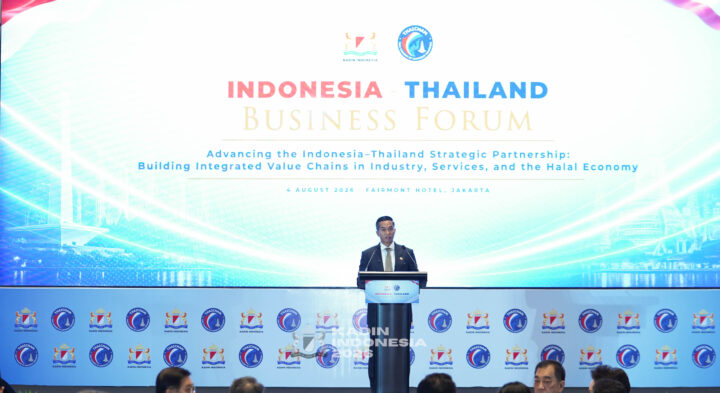
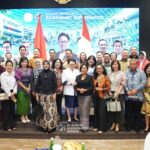
“We do not want to be merely competitive or successful. Indonesia and Thailand must become world-class players. The key is inclusive innovation that can create benefits for society at large,” Anindya, popularly known as Anin, said while opening the Indonesia–Thailand Business Forum, themed “Advancing the Indonesia–Thailand Strategic Partnership: Building Integrated Value Chains in Industry, Services, and the Halal Economy,” in Jakarta on Tuesday (August 4, 2026).
Anin said relations between Indonesia and Thailand had been established long before the creation of ASEAN or the emergence of the modern states of the two nations. For centuries, the peoples of both countries have been connected through trade, culture, traditions, and the shared influences of Southeast Asian civilization.
“History connects us. Now, business must strengthen that connection, and innovation will shape our shared future,” he said.
He noted that the visit of the Prime Minister of the Kingdom of Thailand to Indonesia was the first in 15 years and represented an important momentum to accelerate bilateral economic relations.
Indonesia and Thailand are currently the two largest economies in ASEAN, with a combined population of approximately 357 million and total economic output approaching US$2 trillion. Bilateral trade has reached around US$17.5 billion, while the two countries’ leaders have set a target of increasing it to US$30 billion by 2030, accompanied by greater two-way investment.
Anin emphasized that the business community is ready to support the target through increased investment, industrial collaboration, and the development of more integrated supply chains.
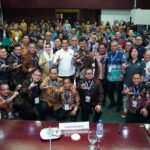
On the occasion, Kadin Indonesia and the Board of Trade of Thailand signed a memorandum of understanding (MoU) to strengthen business cooperation between the two countries. An MoU on carbon market development was also signed, aimed at accelerating investment in low-emission projects and supporting the establishment of a credible carbon market in the region.
According to Anin, carbon markets will become increasingly important as energy demand rises amid the rapid development of artificial intelligence (AI), data centers, and global industrialization.
“Companies around the world need credible mechanisms to offset their carbon emissions. Carbon markets represent one of the major investment opportunities of the future,” he said.
Beyond carbon markets, Kadin is also promoting closer cooperation in the halal economy, services, downstream industrial development, high-tech manufacturing, clean energy, and digital connectivity. However, Anin believes that food security offers the greatest potential for Indonesia and Thailand to become global leaders.
Thailand, he said, is internationally recognized as one of the world’s leading agricultural powers, with a range of flagship products, from jasmine rice to tropical fruits. Indonesia, meanwhile, possesses abundant natural resources, immense biodiversity, and an exceptionally large domestic market.
“Thailand has experience, innovation, and global leadership in agriculture. Indonesia has resources, biodiversity, and scale. If we combine these strengths, we can create food solutions that benefit not only ASEAN, but the world,” he said.
Anin said geopolitical shifts, disruptions to global supply chains, and growing challenges related to food and energy security require both countries to strengthen their strategic collaboration. He therefore called on businesses in both countries to increase joint investment, expand partnerships among entrepreneurs, strengthen collaboration among business families, and accelerate joint innovation so that Indonesia and Thailand can become new engines of growth for the region.
“History has connected us. Business will strengthen us. Innovation will shape our future. Indonesia brings scale, Thailand brings excellence. Together, we can deliver greater benefits, not only for our two countries, but for the world,” Anin concluded.