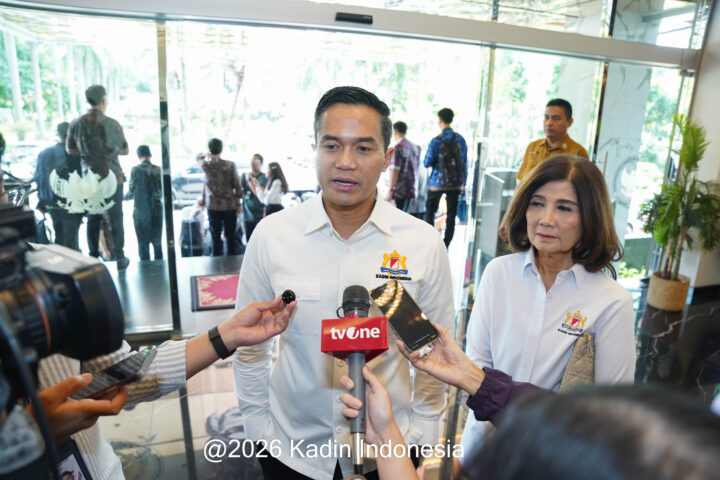
Jakarta - Chairman of the Indonesian Chamber of Commerce and Industry (Kadin), Anindya Novyan Bakrie, stated that the government is preparing to face an investigation by the United States Trade Representative (USTR).
The investigation refers to Section 301 of the Trade Act of 1974, focusing on two key issues: excess production capacity that may trigger dumping practices, and concerns over forced labor.
“For this investigation, thorough preparation must be carried out by both the government and the business community to ensure the entire process runs smoothly,” Anindya—commonly known as Anin—said after attending a limited coordination meeting (Rakortas) with Coordinating Minister for Economic Affairs Airlangga Hartarto, Minister of Manpower Yassierli, and Minister of Trade Budi Santoso at the Office of the Coordinating Ministry for Economic Affairs in Jakarta on Tuesday (March 17, 2026).
According to Anin, these preparations are crucial to protecting the domestic industrial ecosystem.
On the other hand, Indonesia must remain optimistic in facing trade challenges with the United States, while continuing to expand market access in regions that are opening up, such as the European Union and Canada.
“So we must think about maintaining and enhancing our industrial capacity at this time,” he added.
Despite the upcoming investigation, Anin expressed relief that the targeted subjects do not include Indonesia’s main export products to the U.S. Key commodities such as footwear, textiles, furniture, electronics, and palm oil are not expected to be directly affected.
“The most reassuring point is that all of Indonesia’s primary export sectors are not included in the scope of the investigation,” he explained.
Anin also believes that the two issues raised by the USTR are not present in Indonesia’s industrial practices.
From a regulatory standpoint, Indonesia strictly prohibits the use of forced labor for both export and import products.
Meanwhile, regarding the issue of excess capacity leading to dumping practices, Anin emphasized that this does not occur, as Indonesia’s industrial structure is currently more focused on meeting domestic demand and is complementary to the needs of the U.S. market.
“Finally, we must remain positive. After going through this process with the United States, we should not forget that newly opened market access—such as in the European Union, Canada, and others—also presents demand for similar products. Therefore, we must continue to maintain and enhance our capacity when the time comes,” Anin concluded.
Also present at the meeting were Kadin Indonesia Vice Chair for Human Development, Culture, and Sustainable Development Shinta W. Kamdani, and Vice Chair for Macro-Micro Economic Policy Aviliani.