Jakarta - The Indonesian Chamber of Commerce and Industry (Kadin Indonesia) has prepared four strategic agendas at the beginning of the year aimed at strengthening Indonesia’s position amid global economic dynamics, expanding investment and trade opportunities, and safeguarding national economic resilience.
The four agendas include Indonesia’s participation in the World Economic Forum (WEF) Annual Meeting in Davos, the organization of the ASEAN Business Advisory Council (ABAC) Business Conference, the Jakarta Food Security Summit, and the Indonesia Economic Outlook.
Chairman of Kadin Indonesia Anindya Novyan Bakrie emphasized that the WEF Davos, scheduled for January 19–23, 2026, will be the closest and most crucial agenda, serving as a global platform to promote Indonesia’s investment and trade potential.
According to Anindya, who is familiarly known as Anin, Davos is a strategic forum that brings together key decision-makers from the business sector, governments, and global non-governmental organizations.
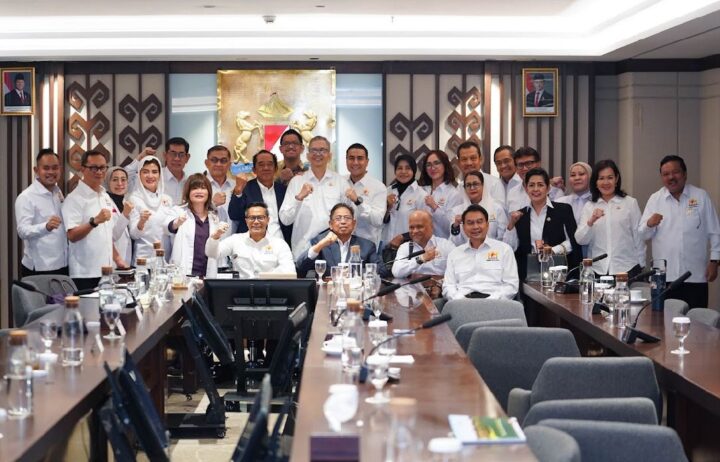
“The most immediate agenda is the World Economic Forum in Davos. All of this is under the leadership of the Ministry of Investment (and Downstreaming) of the Republic of Indonesia together with the CEO of Danantara. Davos is an excellent platform to promote investment and trade, and Kadin is highly enthusiastic about supporting the government in this forum,” Anin said after attending the Kadin Indonesia Executive Board Meeting at Kadin Indonesia Tower, Jakarta, on Friday (January 9, 2026).
Anin explained that Indonesian President Prabowo Subianto is scheduled to deliver a speech at a WEF plenary session on January 22, while the day before, Indonesian Night will be held as a strategic networking event for global business leaders. Kadin, together with Danantara and the Ministry of Investment and Downstreaming of the Republic of Indonesia, will serve as co-hosts of the event.
“We want to ensure that Indonesian business leaders who attend are able to speak at various congress forums, so that the perspectives of Indonesia’s business community can be conveyed alongside the government’s ideas,” Anin added.
Anin noted that the momentum of Davos this year is becoming increasingly important given the growing fragmentation of global geopolitics, climate change challenges, and the shift in the global economic order toward minilateralism.
“What’s interesting is that in Davos, there is a lot of discussion about the so-called triple bubble. The first is artificial intelligence (AI) — whether it has entered a bubble phase or not. The second is debt, as global debt levels are currently very high. And the third is crypto. All of these will be part of the discussions,” Anin said.
With the presence of around 70 heads of state and more than 3,000 global figures, Davos, according to Anin, provides a strategic space for Indonesia to balance its position amid major economic powers such as the United States, China, the G20, APEC, and BRICS.
“Ultimately, the goal is to bring prosperity to the Indonesian people through increased investment and trade,” Anin explained.
The second agenda prepared by Kadin is the Jakarta Food Security Summit, which will be held on May 20–21, 2026, at Balai Kartika, Jakarta.
Coordinating Vice Chairman (WKUK) for Export Development of Kadin Indonesia, Juan Permata Adoe, said the forum will focus on formulating strategic measures to maintain national food and energy security.
“The main issues at this event are food security and energy security, including discussions on B40–B50 biofuel and declining palm oil production. We will explore various policy options, ranging from opening new land and optimizing unproductive land to moratorium policies,” Juan said.
The next strategic agenda is the ABAC Business Conference, which will be held on February 7–9, 2026, at the Shangri-La Hotel Jakarta.
Vice Chairman (WKU) for Foreign Relations of Kadin Indonesia, Bernardino M. Vega, stated that the forum serves as an important platform for Indonesia to voice its ideas and interests in the Asia-Pacific region.
“The ABAC Business Conference will emphasize four key issues: connectivity, regional integration, sustainability, and ASEAN. Of the 21 Asia-Pacific economies, seven are ASEAN members, making the region strategically significant,” Bernardino explained.
Bernardino added that Indonesia will promote three main ideas at the forum: strengthening the green economy and energy transition, advancing digitalization to support regional integration, and industrial downstreaming in line with the government’s agenda.
Meanwhile, the fourth agenda is the Indonesia Economic Outlook, which will be held on January 15, 2026, at Kadin Indonesia Tower.
Vice Chairman (WKU) for Macro-Micro Economic Policy Analysis of Kadin Indonesia, Aviliani, said the forum will serve as a reference for the business community in formulating strategies for 2026.
“In general, conditions in 2026 will not be much different from 2025. Economic growth of around 5 percent is still achievable. However, if higher growth is desired, stronger contributions will be needed from state-owned enterprises, the private sector, and Danantara to replace infrastructure projects whose budgets have declined in the state budget,” Aviliani said.
Aviliani explained that the Indonesia Economic Outlook will discuss three main issues: global economic projections, perceptions and interest of foreign investors toward Indonesia, and regional economic conditions, which are currently facing challenges due to budget cuts and post-disaster recovery needs.
According to Aviliani, the economic recovery momentum in the second half of the year provides optimism, especially with the gradual increase in credit growth and household consumption following the lifting of budget efficiency policies.
“If government spending can be executed on time, including subsidies and transfers to regions, regional economies will start to move. This is crucial because regional budgets depend heavily on alignment between allocations and realization. If this is managed well, national economic growth will be more sustainable,” Aviliani concluded.
Also present at the meeting were members of the Kadin Indonesia leadership, including Coordinating Vice Chairman for Foreign Affairs James T. Riady, Coordinating Vice Chairman for Human Development, Culture, and Sustainable Development Shinta Widjaja Kamdani, Coordinating Vice Chairman for Food Affairs Mulyadi Jayabaya, Coordinating Vice Chairman for Infrastructure and Regional Development Carmelita Hartoto, Coordinating Vice Chairman for Social Affairs Nita Yudi, and Coordinating Vice Chairman for Law and Human Rights as well as Facilities and Infrastructure M. Aziz Syamsuddin.