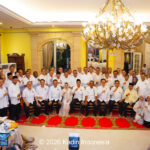
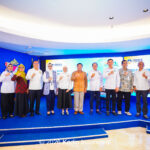
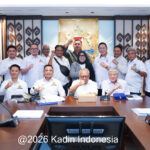
Jakarta - Chairman of the Indonesian Chamber of Commerce and Industry (Kadin Indonesia), Anindya Novyan Bakrie, shared the outcomes of his working visit to the United States during a press conference held at The Convergence Indonesia, Kuningan, South Jakarta, on Friday (May 9, 2025).
The visit aimed to strengthen trade ties, attract investment, and explore collaborative opportunities in the energy sector, particularly around energy transition and critical minerals. The delegation made stops in three key cities: New York, Washington D.C., and Los Angeles.
Anindya—commonly referred to as Anin—highlighted growing U.S. interest in Indonesia’s renewable energy potential and mineral downstreaming initiatives.
“Before heading to Washington D.C., I attended the Bloomberg New Energy Forum Summit 2025 in New York, which focused on energy transition and climate issues,” Anin said.
He emphasized Indonesia’s crucial role in climate discussions, particularly as an archipelagic nation highly vulnerable to rising sea levels.
“If the water rises, we’re all in trouble,” he warned.
While the U.S. federal government under former President Trump had withdrawn from the Paris Agreement, Anin noted that many U.S. states have remained committed to clean energy.
“Two-thirds of the 50 states still want to continue. Even Texas—known for oil and gas—is now the second-largest user of wind and solar energy after California,” he added.
In Washington D.C., Anin met with the U.S. Chamber of Commerce, where he stressed the seriousness of Indonesian businesses in forging partnerships with the U.S.
“We want to show that Indonesian businesses are serious about working with the U.S.—but we want a fair deal,” he said.
Although Indonesia currently enjoys a $ 18 billion trade surplus with the U.S., Anin argued that expanding trade volume is more important than simply balancing the ledger.
“Our goal isn’t just balance—we want to grow bilateral trade from the current $40 billion to $80 billion in 2–3 years. With the right strategy, we could even hit $120 billion within four years,” he projected.
He compared this with Indonesia’s trade with China, which now totals $130 billion.
“If we do this right, our trade with the U.S. could rival that with China,” Anin said.
He identified three key areas for growth: trade in goods (footwear, garments, electronics), U.S. exports (soybeans, dairy, meat), and co-investment in critical minerals such as nickel, copper, zinc, and bauxite, especially in processed form.
“If we’re importing oil and gas, why not co-own the fields over there? This is possible now, especially with financial institutions like Danantara, which manages $900 billion in assets,” he added.
Anin also met with the U.S. Dairy Export Council and the National Milk Producers Federation to discuss opportunities for U.S. dairy exports to Indonesia, currently dominated by Australia and New Zealand.
“If U.S. dairy products are competitive, why not? We need them, and they want to export,” he stated.
He also referenced a meeting with the National Cotton Council of America, which is eager to increase cotton exports to Indonesia. Anin stressed the importance of reciprocal tariff treatment.
“If we buy cotton from the U.S., that’s fine—but when we ship back textiles, the tariff should be zero or close to it. That’s fair,” he said.
On broader tariff issues, Anin echoed concerns from U.S. business leaders who oppose higher tariffs due to inflation and recession risks.
“The U.S. Chamber said if tariffs keep rising, recession is inevitable. So there has to be an end to it,” Anin explained.
The delegation also explored other sectors during the visit. In a key meeting with Nike—purchaser of 290 million pairs of shoes annually—Indonesia sought to improve its export position, which currently lags behind Vietnam.
In Los Angeles, Anin also engaged with financial and creative industries, including the Indonesian Night event attended by actor Chris Tucker.
“In L.A., I joined the Milken Institute Global Conference 2025—focused on finance. We’re here not just to attract investment, but also to bring Indonesian investment abroad. At Indonesian Night, Chris Tucker showed up too,” he said with a smile.
A meeting with the U.S. Secretary of the Treasury was also on the agenda.
“I asked the Secretary, ‘How do you feel about Indonesia?’ He said he felt good. There’s opportunity for an agreement based on three pillars: trade, mineral downstreaming, and co-investment,” Anin shared.
Despite not being part of the official government delegation, Anin underscored Kadin’s readiness to support policies that benefit the business community.
“We’re not the government—but whatever the government decides, we’ll work to ensure it benefits our businesses,” he affirmed.
Anin acknowledged the demanding nature of the multi-city trip but remained optimistic about its outcomes.
“Yes, it was exhausting—but worth it. And I want to share this with domestic media—not just the foreign press,” he concluded.