

“The relationship between Indonesia and India has stood the test of time. If in the past both nations were united by spice routes, religion, and civilization, then in the 21st century they are brought together by something equally strategic: technology, data, and the digital economy. From Borobudur to the Indonesia Open Network (ION), the Indonesia–India partnership continues to evolve—moving from building civilization to building digital sovereignty.”
By: Head of the Communications Office of Kadin Indonesia, Primus Dorimulu
Jakarta – The relationship between Indonesia and India is a civilizational bond. The connection between these two great nations extends far beyond mere diplomatic ties. Long before the birth of the modern state, the Indonesian archipelago (Nusantara) and the Indian subcontinent were intertwined through trade routes, religion, language, art, architecture, and philosophy. From India came Hindu and Buddhist influences that took deep root in Nusantara, giving birth to masterpieces such as the Prambanan and Borobudur temples, wayang (shadow puppetry), the epics of Ramayana and Mahabharata, as well as cultural values that remain core parts of the Indonesian identity.
Now, thousands of years later, this relationship enters a new chapter. While the past was marked by the exchange of spices, religion, and culture, the future of both countries will be defined by technology, artificial intelligence, the digital economy, cybersecurity, defense, and data sovereignty. This marks a profound transformation in Indonesia–India relations: from a shared civilizational heritage to a future-oriented partnership.
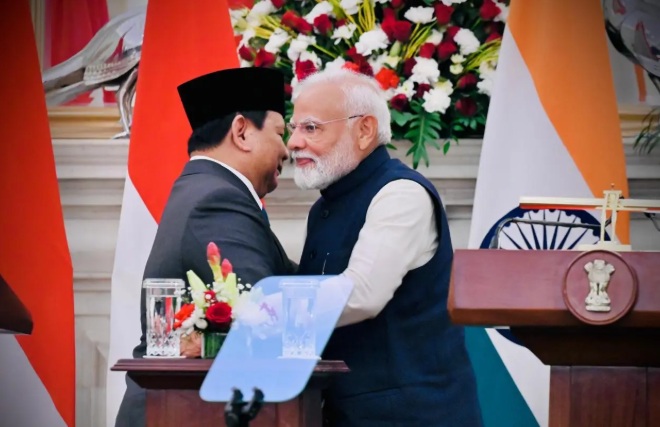
This momentum was significantly boosted following President Prabowo Subianto's visit to India to attend its Republic Day on January 26, 2025. In return, Prime Minister Narendra Modi visited Indonesia on July 7, 2026. The meeting between the two leaders symbolizes that Indonesia and India are no longer just talking about trade, but also about rebalancing a historically lopsided economic relationship, defense industry cooperation, digital technology, maritime connectivity, and human resource capacity building. Both nations also reinforced their strategic partnership in trade, investment, strategic industries, maritime affairs, and digital connectivity prior to PM Modi’s visit to Indonesia.
In trade, Indonesia has historically enjoyed a substantial surplus with India. Indonesian exports remain dominated by coal, palm oil, rubber, minerals, and resource-based commodities. Meanwhile, India is increasingly strong in pharmaceuticals, manufacturing, information technology, machinery, automotive, and digital services. While a trade surplus is financially beneficial to Indonesia, such a structure is insufficient to elevate the nation’s economic status. Indonesia requires value addition rather than just a surplus. Therefore, trade rebalancing must be directed toward investment, technology transfer, joint industrial development, and strengthening the national digital ecosystem.
This is where the Indonesia Open Network, or ION, becomes highly strategic. ION is not a marketplace. ION is Digital Public Infrastructure (DPI)—an open digital public infrastructure designed to connect buyer applications, seller applications, logistics providers, financial institutions, mobility services, and government services into a single, interoperable ecosystem. ION is inspired by the success of India's Open Network for Digital Commerce (ONDC), an initiative that promotes open digital commerce networks so that buyers, sellers, platforms, and retailers are not dependent on a single closed platform.
Through ION, Indonesia is laying the foundation for the next generation of its digital economy. The digital economy must not be monopolized by a handful of large platforms that develop closed networks. MSMEs, cooperatives, farmers, market traders, drivers, students, and rural communities must become key actors. More than 30 million registered MSMEs can gain digital storefronts, access to national buyers, integrated logistics, financing, insurance, government incentives, and AI-powered business matching. This is the democratization of digital commerce, made possible only through the open network developed by ION.
ION is also critical because it touches the heart of future matters: digital sovereignty. In the 21st century, national sovereignty is no longer solely determined by territory, militaries, and natural resources. Sovereignty is also dictated by who controls data, algorithms, digital infrastructure, payment systems, logistics networks, and artificial intelligence. A nation lacking its own digital infrastructure will become a mere market for foreign platforms. A country that does not control its data will lose control over its own economic direction.
Therefore, ION must be understood as an essential element of Indonesia's digital sovereignty. MSME data, transaction data, logistics data, financing data, mobility data, and market data must serve as national strategic assets. Data must no longer serve merely as fuel for large digital corporations; it must return tangible benefits to the people's economy. If designed with proper governance, ION can serve as a middle ground between market innovation and the protection of national interests.
Furthermore, ION paves the way toward AI sovereignty. Artificial intelligence is only as strong as the vast, structured, and locally relevant data supporting it. It is not enough for Indonesia to merely consume AI developed by other countries. Indonesia must build its own AI capabilities based on the Indonesian language, local consumer behavior, the unique character of Indonesian MSMEs, domestic agricultural patterns, and rural needs. Utilizing the AI-first Beckn 2.0 architecture and ready to enter the era of agentic commerce, ION can become the foundation for the rise of an indigenous Indonesian AI that works in the interest of the nation.
The third dimension is strategic autonomy. Indonesia adheres to a free and active foreign policy. In the digital economy, this principle must be translated into the ability to choose, build, and control our own technology without falling into dependency on any single global power bloc. Cooperation with India is vital because India is not just a trading partner, but a massive democracy that has successfully built Digital Public Infrastructure on a gargantuan scale. India has proven that digital technology does not always have to be controlled by closed platforms; it can be built as an open, inclusive, and competitive public infrastructure.
PM Modi’s visit to Indonesia on July 7, 2026, carried a significance that goes far beyond diplomatic ceremony. The official launch of ION serves as a symbol of a new era in Indonesia–India relations: shifting from cultural diplomacy to technological diplomacy; from commodity trade to a knowledge economy; from a trade surplus to a value-added surplus; and from digital dependency to digital sovereignty.
Just as India once inspired the creation of Borobudur, Prambanan, and wayang, in this digital age, India can be Indonesia's strategic partner in building the technological foundations of the future. However, Indonesia must not merely be a recipient of technology; it must own, develop, and control the direction of its own transformation.
India's success in building the Open Network for Digital Commerce (ONDC) serves as an outstanding example of how an open network can transform a digital economy inclusively. Through open standards and interoperability, millions of Indian MSMEs gained wider access to the digital marketplace without being dependent on a single dominant platform. This increasingly open ecosystem has accelerated financial inclusion, expanded public participation in the formal economy, and driven the growth of a retail investor base that has now become a new powerhouse in India's capital markets.
Inspired by the ONDC experience, Indonesia—with the assistance of experts from India—developed the Indonesia Open Network (ION) by adopting open network principles proven in India, while tailoring them to national needs, regulations, and economic characteristics. Thus, ION is not a mere technological copy paste, but a uniquely Indonesian development registered as intellectual property with the Ministry of Law. ION stands as a symbol of a new chapter in the Indonesia–India strategic partnership: India shares its digital innovations and experience, while Indonesia develops them into an open, inclusive, and sovereign national digital economy infrastructure for MSMEs, cooperatives, businesses, and the wider public.
The development process of ION received the full support of the Indian Government as a concrete manifestation of the strategic partnership between the two nations in the digital economy and Digital Public Infrastructure (DPI). Although inspired by ONDC, ION is an Indonesian-developed asset adapted to domestic needs, regulations, and economic characteristics. For this reason, ION has been registered as Indonesian intellectual property with the Ministry of Law, serving as a national strategic asset in building an open, inclusive, and interoperable digital economic ecosystem.
The official launch of ION was scheduled as the pinnacle event of the state ceremony during the meeting between President Prabowo Subianto and Prime Minister Narendra Modi at the State Palace on July 7, 2026. This momentum was not just the rollout of digital infrastructure, but a marker for the birth of a new era in Indonesia–India relations: transitioning from a partnership built on history, trade, and investment toward a strategic collaboration in constructing the future digital economy foundation. Just as relations between the two countries made history during the early days of independence, ION is expected to be a new milestone connecting Indonesia and India in forging digital sovereignty, strengthening MSME competitiveness, and expanding economic inclusion for millions.
Indonesia Emas (Golden Indonesia) 2045 requires toll roads, ports, dams, industrial zones, and energy infrastructure. However, Indonesia Emas 2045 also demands digital highways: open networks that connect MSMEs, farmers, cooperatives, traditional markets, villages, startups, universities, banks, fintech, logistics, and the government within an efficient, inclusive, and sovereign national ecosystem.
ION is not simply a tech project; it is a sovereignty project. If built with a grand vision, robust governance, and an open ecosystem, ION can become one of the most vital foundations for Indonesia's next-generation digital economy. From Borobudur and Prambanan, Indonesia inherited civilizational greatness. Through ION, Indonesia has the opportunity to build future greatness.
The progress of Indonesia–India relations in recent years also cannot be separated from the role of the Ambassador of India to Indonesia, Sandeep Chakravorty. Since assuming office in August 2023, the senior Indian diplomat has actively strengthened people-to-people diplomacy while expanding strategic cooperation between the two countries. One of his initiatives was building a communication bridge through exchange visits of mainstream media leaders. In January 2024, 15 Indonesian media leaders were invited to attend India’s Republic Day celebrations in New Delhi. This program was followed by a reciprocal visit of Indian media leaders to Indonesia in 2025, which deepened mutual understanding and networking between the media institutions of both nations.
In the development of ION, Sandeep Chakravorty also played a pivotal role as a liaison and catalyst for cooperation between Indonesia and India. Beyond executing behind-the-scenes diplomatic functions, he actively facilitated dialogues, brought stakeholders together, and encouraged the transfer of knowledge and experience from India's ONDC success to Indonesia. His contribution was a critical factor accelerating the birth of ION as the new foundation of Indonesia's digital economy.
In recognition of his contributions to strengthening bilateral relations, Ambassador Sandeep Chakravorty's tenure was extended by two years. During his diplomatic tour, the redevelopment of the Embassy of India complex on Jalan H.R. Rasuna Said, South Jakarta, was successfully completed. The new embassy building is not only a symbol of India's diplomatic presence in Indonesia but also reflects an tightening strategic partnership that has now grown from political and economic cooperation into collaboration in innovation, technology, and digital transformation.
History has proven that the relationship between Indonesia and India always yields a legacy that outlasts its era. In the past, this relationship enriched the civilization of Nusantara through knowledge, art, and culture. Today, the very same connection has the opportunity to forge a new foundation for Indonesia's digital economy. If Borobudur and Prambanan stand as monuments to the civilizational greatness of the past, ION is envisioned to become Indonesia's monument to digital sovereignty in the 21st century—a symbol that friendship between nations does not merely inherit history, but builds the future.

National Economy
Regional Economy
National Economy
Regional Economy