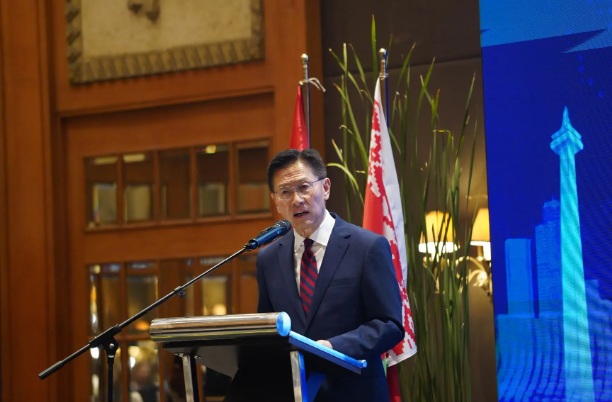
Jakarta – Coordinating Vice Chairman for Foreign Affairs of the Indonesian Chamber of Commerce and Industry (Kadin Indonesia), Dr. James T. Riady, has invited Belarusian businesses to view Indonesia not merely as an export market, but as a "second home" for investment, industrial development, and technology transfer. He emphasized that in an increasingly fragmented world shaped by geopolitical tensions and shifting global supply chains, building long-term economic partnerships is far more important than simply expanding trade volumes.
James delivered the remarks during the Indonesia–Belarus Business Forum and Business Matching, organized by Kadin Indonesia in collaboration with the Embassy of the Republic of Belarus in Jakarta at the Aryaduta Menteng Hotel Ballroom on Tuesday (June 30, 2026). The forum was held in conjunction with the official visit of a Belarusian government delegation led by Deputy Prime Minister Viktor Karankevich, accompanied by senior government officials and business leaders.
Among those attending the forum were Coordinating Minister for Economic Affairs Airlangga Hartarto, Belarusian Deputy Prime Minister Viktor Karankevich, Belarusian Minister of Foreign Affairs Maxim Ryzhenkov, Ambassador of Belarus to Indonesia Raman Ramanouski, Chairman of the Belarusian Chamber of Commerce and Industry Mikhael Miatlikov, and business leaders from both countries.
In his keynote address, James said the world is entering a new era in which geopolitical developments increasingly shape the global economy. The fragmentation of international trade and the restructuring of global supply chains, he noted, are prompting countries to seek more strategic and sustainable economic partnerships.
"We are living in an increasingly fragmented world. Supply chains are shifting, markets are becoming more uncertain, and geopolitics is playing a greater role in shaping the global economy. In this environment, countries need to forge new economic partnerships. Today's forum is therefore not simply about increasing trade—it is about building a long-term partnership between Indonesia and Belarus," he said.
James shared that, in preparation for the forum, he had taken the opportunity to learn more about Belarus and was impressed by the achievements of the country of approximately nine million people, particularly in engineering, industrial manufacturing, agricultural technology, fertilizers, heavy equipment, science, and technical education.
Indonesia, on the other hand, offers a different set of competitive advantages, including a population of nearly 285 million people, abundant natural resources, a demographic dividend, a dynamic private sector, and one of the world's largest domestic markets.
"Our strengths are highly complementary. Belarus brings technology, engineering expertise, manufacturing experience, and industrial capabilities. Indonesia offers economic scale, talent, entrepreneurship, natural resources, and a vast domestic market," he said.
James therefore encouraged Belarusian companies to look beyond exporting to Indonesia.
"I encourage Belarusian companies to make Indonesia their second home for investment. Build factories here, transfer technology, expand manufacturing operations in Indonesia, and partner with Indonesian companies. We have a strong private sector and many capable business partners," he said.
According to James, this vision is fully aligned with President Prabowo Subianto's national development agenda, which prioritizes strengthening manufacturing, downstream industrialization, food security, higher agricultural productivity, and technological advancement.
He also noted that Indonesia is becoming increasingly committed to creating a business-friendly investment climate through regulatory reforms and streamlined licensing procedures.
"Under President Prabowo's leadership, economic growth, industrialization, food security, downstream industries, and investment have become national priorities. We are also fortunate to have Coordinating Minister for Economic Affairs Airlangga Hartarto, who not only has a deep understanding of macroeconomic policy but also extensive experience in the private sector. He understands how businesses think and what investors need to maintain a competitive investment environment," James said.
James pointed to Japan's decades-long investment in Indonesia as a successful model. Rather than simply exporting products, Japanese companies established manufacturing facilities, localized production, developed Indonesian talent, and built long-term partnerships with domestic businesses.
"The result has been one of Asia's greatest industrial success stories. I believe Belarus can write its own success story in Indonesia," he said.
James further emphasized that the center of global economic growth has shifted from the Atlantic to the Asia-Pacific region. In this context, Indonesia serves as the largest economy in Southeast Asia and a strategic gateway to the ASEAN market of more than 680 million people.
"For Belarusian companies, Indonesia is far more than a market of nearly 285 million people. It is also the gateway to ASEAN. Likewise, we hope to see more Indonesian companies exploring business opportunities in Belarus as a gateway to the wider Eurasian region," he said.
Concluding his remarks, James stressed that while governments can establish frameworks for cooperation and strengthen diplomatic relations, it is the private sector that ultimately creates investment, jobs, technology transfer, and shared prosperity.
He encouraged all participants to use the forum not merely as an opportunity to exchange business cards, but to build strategic partnerships capable of delivering long-term benefits for both countries.
This year's Indonesia–Belarus Business Forum focused on a wide range of high-potential sectors, including food and beverages, pharmaceuticals, the digital economy, automotive industries, tractors and heavy equipment, education, transportation, and trade. Through the forum and business matching sessions, both governments and the business communities expressed their commitment to significantly expanding bilateral trade and investment in the years ahead.
As James concluded, in a world increasingly divided by geopolitics, lasting prosperity is built not through short-term trade alone, but through long-term investment, technology transfer, and mutually beneficial industrial partnerships.