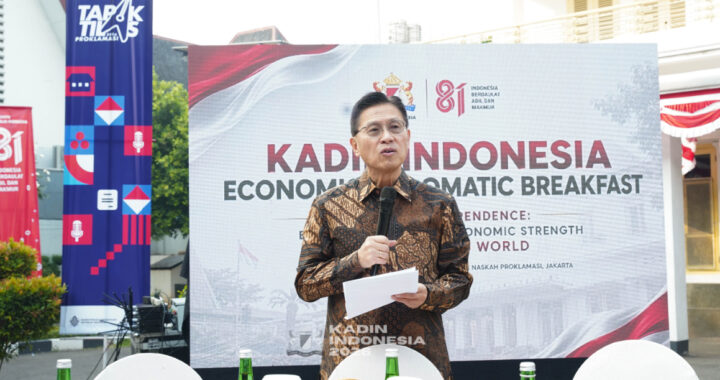
Jakarta – James T. Riady, Coordinating Deputy Chairman for Foreign Affairs of the Indonesian Chamber of Commerce and Industry (Kadin Indonesia), emphasized that after 81 years of political independence, the challenge for today’s generation of Indonesians is to build the “next independence” in the form of economic strength and self-reliance that enable all citizens to live productive and dignified lives. Economic independence, he stressed, does not mean Indonesia should isolate itself from the outside world.
On the contrary, Indonesia must build strong economic foundations at home while remaining open to trade, investment, technology, education, and international cooperation.
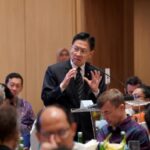
“Political independence was achieved in 1945. But independence is never completely finished. Every generation must build its meaning again,” James said in his opening remarks at the Kadin Monthly Economic Diplomatic Breakfast (KMED), themed “The Next Independence: Building Indonesia’s Economic Strength in a Changing World,” held at the Museum of the Proclamation Drafting, Jakarta, on Friday (August 14, 2026).
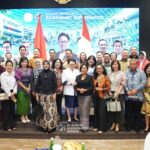
The event, held ahead of the 81st anniversary of the Independence of the Republic of Indonesia, was attended by Kadin Indonesia Chairman Anindya Novyan Bakrie, ambassadors and members of the diplomatic corps, regional Kadin leaders from across Indonesia, Kadin Indonesia officials, bilateral committees, foreign chambers of commerce, and business leaders.
According to James, the choice of the Museum of the Proclamation Drafting as the venue carried special significance. It was at this site, on the night before August 17, 1945, that the nation’s founding fathers discussed and formulated the words that would later become the Proclamation of Indonesian Independence.
The venue, he said, serves as a reminder that independence did not come on its own. Independence first had to be imagined, fought for, and decided upon, before ultimately being realized through nation-building.
Eighty-one years later, Indonesia faces a different but equally important question: what does independence mean for today’s generation? According to James, the answer lies in Indonesia’s ability to build its own economic strength.
Having secured political sovereignty in 1945, Indonesia now needs food and energy security, strong human resources, technological capabilities, competitive industries, productive employment opportunities, and institutions capable of giving people confidence in the future.
However, James cautioned that economic self-reliance is not synonymous with economic isolation.
“Economic independence does not mean economic isolation. Quite the opposite,” he said.
A confident Indonesia, he argued, must be strong at home, open to the world, and confident enough to work with anyone. In this context, James said Indonesia’s relationships with friendly nations are becoming increasingly important.
The diplomats attending the KMED are not merely observers of Indonesia’s economic journey. The countries they represent—including their companies, investors, universities, and people—are Indonesia’s partners in building the next chapter of growth.
Such cooperation can take the form of investment, trade, technology transfer and development, education, and food and energy security. Yet James emphasized that one fundamental element underpins all forms of cooperation: trust.
According to James, Kadin has a major responsibility in this process. While the government can determine the direction of development and establish policies, economic strength is ultimately built by society itself—from entrepreneurs, workers, farmers, educators, and innovators to communities across Indonesia.
Therefore, economic development must not be centered solely in Jakarta.
“Indonesia will not be built only from Jakarta,” James stressed.
Indonesia’s strength, he continued, must be built across all provinces, cities, regencies, and communities throughout the archipelago. The presence of regional Kadin leaders at the forum reflects the importance of connecting the national development agenda with economic strength at the regional level.
James also praised the leadership of Kadin Indonesia Chairman Anindya Bakrie in positioning Kadin as a bridge between the government and the business community, between the central government and regions, and between Indonesia and the international community.
He expressed hope that the Kadin Diplomatic Economic Breakfast would not remain merely a monthly event, but would evolve into a community built on strong relationships, open dialogue, mutual trust, and a shared interest in Indonesia’s future.
Ahead of the Independence Day commemoration, James invited the business community and international partners to look at Indonesia from a longer-term perspective: What kind of Indonesia do we want to build over the next 20 to 30 years?
According to James, the 1945 Proclamation gave Indonesia the sovereignty to determine its own destiny. The next challenge is to ensure that this sovereignty translates into real capabilities for every citizen.
“The first independence gave us sovereignty. The next independence must give every Indonesian capability,” he said.
The next independence, he explained, must ensure that every Indonesian has the ability to access education, work productively, build a business, participate in technological development, own a home, and live a dignified life.
This message also served as the central theme of James’ remarks. If the 1945 generation fought for independence so that the nation could determine its own destiny, today’s generation faces the task of giving that independence a strong economic foundation.
Eighty-one years after the Proclamation, the measure of independence is no longer limited to political sovereignty. Independence must also be reflected in food and energy security, human capital, technological capabilities, industrial competitiveness, employment opportunities, and the ability of people to improve their standard of living.
For this reason, James outlined three principles that should guide Indonesia’s future: strong at home, open to the world, and confident in working with anyone.
If the first independence gave Indonesia sovereignty, he concluded, the next independence must give Indonesians the capabilities to progress and live with dignity.