


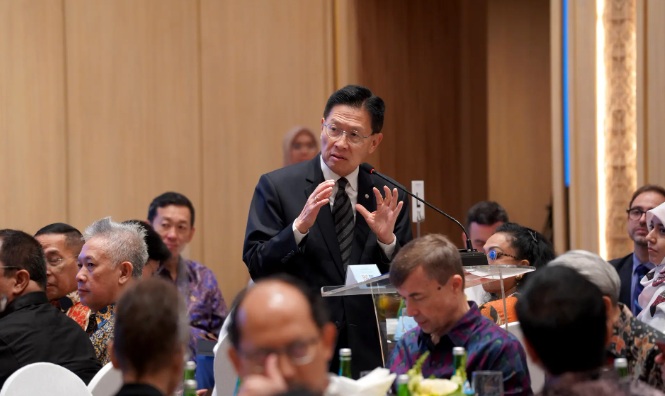
Jakarta – James T. Riady, Coordinating Deputy Chairman for Foreign Affairs at the Indonesian Chamber of Commerce and Industry (Kadin Indonesia), emphasized that healthcare transformation is an essential part of strengthening Indonesia’s economic foundations and improving its competitiveness. Healthcare determines the quality of human capital, productivity, and national resilience, while also creating investment opportunities and fostering international cooperation in pharmaceuticals, medical technology, research, and financing.
According to James, healthcare therefore needs to play a more prominent role in Indonesia’s economic diplomacy. Relations with partner countries must translate into partnerships that expand access to healthcare services, strengthen domestic industrial capabilities, and deliver tangible benefits to the public.
“Healthcare is not merely a social issue. It is also about human capital, productivity, resilience, investment, and technology, and it is increasingly intertwined with international cooperation,” James said at the Kadin Monthly Economic Diplomacy Breakfast, held at the Leimena Hall, Adhyatma Building, Ministry of Health of the Republic of Indonesia, Jakarta, on Friday (October 9, 2026).
The event was attended by Health Minister Budi Gunadi Sadikin, Kadin Indonesia Chairman Anindya Novyan Bakrie, ambassadors, and business representatives. Foreign Minister Arrmanatha Christiawan Nasir was represented by the Secretary-General of the Ministry of Foreign Affairs, who delivered the minister’s remarks and conveyed his greetings to the participants.
James explained that Kadin’s economic diplomacy forum, held every second Friday of the month, provides a platform for strengthening ties among the business community, government, and diplomatic community. Amid their respective busy schedules, the regular gathering is expected to foster a stronger sense of shared purpose and reinforce the understanding that global challenges require collective solutions.
“We usually talk about trade, investment, geopolitics, industry, and technology. Healthcare, however, is clearly a natural part of that same conversation,” he said.
According to James, an increasing number of important developments in healthcare transcend national borders. The pharmaceutical industry, medical technology, and artificial intelligence are advancing through international networks. The same applies to research, education and training, investment, supply chain management, and the exchange of knowledge and experts.
These developments place Indonesia’s healthcare transformation directly within the agenda of Kadin’s Foreign Affairs division. International partnerships can help connect national needs with financing, technology, expertise, and production capacity available in other countries.
“This morning’s meeting is essentially intended to connect Indonesia’s healthcare transformation with the international community,” James said.
He stressed that discussions on healthcare should encompass the entire architecture of the system. Key questions include how healthcare services are financed, organized, digitized, expanded, and delivered effectively to the public. Understanding the economics of healthcare is also necessary to assess the direction of change and the sustainability of the system.
In this context, James said Budi Gunadi Sadikin brings a distinctive perspective. His experience in technology, banking, and state-owned enterprises has given him a broad understanding of organizational management, financing, and the relationship between public needs and institutions’ ability to meet them.
James described Budi as someone who, during his career in banking, sought to understand customers’ needs and support the development of their businesses. In James’s view, this experience has also shaped Budi’s approach to healthcare challenges from multiple perspectives.
As a businessperson who helped build the Siloam Hospitals network, James said this approach offers a refreshing perspective. He expressed hope that the dialogue with the Health Minister would provide a clearer picture of how Indonesia’s healthcare architecture and economics have evolved, as well as the direction in which the system is heading.
The transformation agenda highlighted by James covers primary healthcare, referral services, health resilience, and financing. These elements need to be interconnected to ensure that the benefits of reform reach the wider public. He also underscored the importance of partnerships with clearly defined measures of success, particularly the tangible impact of the cooperation undertaken.
Amid global challenges, including the need to create jobs, socioeconomic pressures, and polarization, James said leadership capable of bringing together diverse interests is becoming increasingly important. Healthcare challenges likewise require the ability to build cooperation across national borders and sectors.
Against this backdrop, James expressed his support for Budi’s candidacy for Director-General of the World Health Organization (WHO). According to James, the President put forward Budi’s candidacy in May. He also shared his impression that Budi had received a positive reception during various international meetings they had attended together.
James expressed hope that Indonesia’s experience could contribute to improving global health. He therefore called for discussions to address worldwide challenges, including how healthcare services can be financed sustainably, managed effectively, and made accessible to more people.
“We want to hear not only about Indonesia, but also about the global health situation and what can be done,” he said.
Meanwhile, in his remarks, the Secretary-General of the Ministry of Foreign Affairs emphasized that strengthening the healthcare system is an economic necessity, an investment opportunity, and a foundation for national resilience. The COVID-19 pandemic demonstrated how a health crisis can disrupt tourism, trade, manufacturing, and supply chains, while undermining productivity and the quality of human capital.
He highlighted Indonesia’s dependence on imported pharmaceutical raw materials, which, according to his presentation, remains above 90%. This dependence leaves domestic industry vulnerable to disruptions in global supply. Reducing it will require investment, technology transfer, joint research, and stronger domestic manufacturing capabilities.
Indonesia’s ambition, he said, is to evolve from a major consumer of healthcare products into a competitive regional hub for pharmaceutical innovation, vaccine production, and medical technology. In this process, diplomacy plays a role in opening up partnerships, while the business community helps translate them into industrial and healthcare delivery capacity.
He also outlined two priorities for Indonesia’s health diplomacy: pathogen access and benefit-sharing arrangements under the WHO Pandemic Agreement, and stronger global health governance and sustainable financing. Indonesia is advocating equitable access to vaccines, medicines, and diagnostics, accompanied by meaningful technology transfer.
International financing, he added, needs to support national priorities, strengthen domestic capabilities, and deliver measurable benefits. The Ministry of Foreign Affairs and Indonesia’s overseas diplomatic missions also expressed their support for Budi’s candidacy for WHO Director-General.
The forum positioned Kadin and the private sector as important partners in connecting diplomacy with Indonesia’s healthcare development needs. International cooperation is expected to help build a stronger healthcare industry, make services more affordable, and create a more productive population—laying the foundation for a more resilient Indonesian economy.

National Economy
Regional Economy
National Economy
Regional Economy