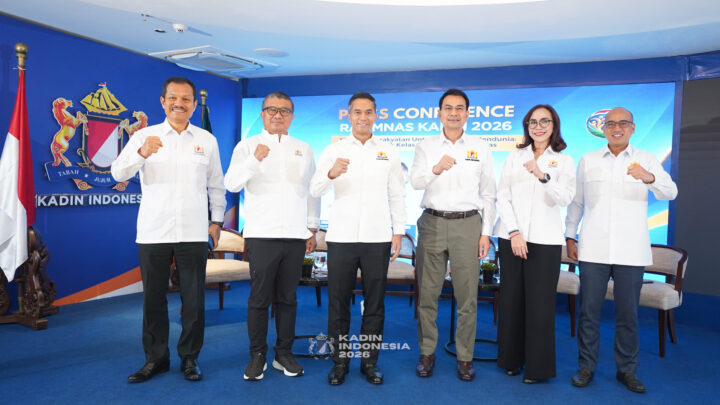
Jakarta – With the spirit of Indonesia Incorporated, the Indonesian Chamber of Commerce and Industry (Kadin Indonesia) is placing the restoration of investor confidence at the heart of its “Buy from Indonesia” and “Buy Indonesia” initiatives, which will be promoted at the 2026 Kadin National Leadership Meeting (Rapimnas) on October 29–30, 2026. The two initiatives aim to boost exports, stimulate investment, and expand business opportunities across the regions to create new economic players, in line with the theme of the 2026 Kadin Rapimnas: “People-Centered Economy for a Globally Competitive Indonesia (Elevating MSMEs and Building a Quality Economy).”
Kadin Indonesia Chairman Anindya Novyan Bakrie emphasized the importance of restoring confidence among both foreign direct investment (FDI) investors and portfolio investors. Such confidence must be built through legal certainty, consistent policies, transparent information, and protection of investor rights.
According to Anindya, popularly known as Anin, FDI investors need certainty to establish and develop businesses over the long term. Meanwhile, portfolio investors require transparent and liquid financial markets with strong trading integrity to assess investment opportunities and risks fairly.
Therefore, calls to buy Indonesian products and invest in Indonesia must be backed by demonstrable improvements in governance. Respect for contracts, protection of property rights, and consistent law enforcement are essential to retaining existing investments while attracting new capital.
“The message is simple: buy Indonesian products and invest in Indonesia. Kadin’s task is to ensure that this call is backed by competitive products, trustworthy companies, and projects that are financially viable,” Anin said in briefing materials ahead of the National Leadership Meeting on Thursday (October 22, 2026).
Anin explained that Buy from Indonesia encourages international buyers to increase their purchases of goods and services from Indonesia. Meanwhile, Buy Indonesia calls on domestic and foreign investors to invest in Indonesian companies and economic activities through both capital markets and direct investment.
Both initiatives must address the concrete needs of the business community. Businesses need buyers, companies need financing to grow, and regions need investments that create jobs. Kadin offices at all levels, down to regencies and cities, must identify market-ready products and businesses with viable investment opportunities.
“These two initiatives reinforce each other. Export orders create demand for investment. Investment expands capacity and improves production quality, enabling companies to fulfill more orders,” he explained.
The initiatives come amid pressure on financial markets. In his briefing materials, Anin highlighted the sharp decline in the Indonesia Stock Exchange Composite Index (IHSG) and the weakening rupiah, which at one point fell beyond Rp18,000 per US dollar. The preparatory materials also noted that foreign investors’ cumulative net selling in the stock market had exceeded Rp92 trillion from the beginning of the year through October 20, 2026.
Anin said MSCI’s proposal to reclassify Indonesia’s stock market from an emerging market to a standalone market had heightened investor concerns. Transparency in share ownership and coordinated trading practices had come under scrutiny. Although no final decision had been made, the proposal underscored the significant influence of investor confidence on investment decisions.
However, he cautioned that foreign investors’ stock sales do not automatically translate into capital outflows, as the proceeds may remain in Indonesia. Pressure on the rupiah can intensify when investors convert the proceeds into foreign currencies and transfer their funds abroad.
For businesses in the regions, a weaker rupiah can increase the cost of imported raw materials and machinery, as well as foreign-currency liabilities. Uncertainty may also delay corporate expansion plans. Kadin’s response, therefore, needs to focus on strengthening economic activity and ensuring a predictable business environment.
Despite these challenges, Anin emphasized that Indonesia has a strong production base and a proven track record of attracting investment. Citing the Central Statistics Agency’s (BPS) annual publication, he noted that Indonesia’s merchandise exports reached approximately US$266.53 billion in 2024, up 2.70 percent from 2023.
Meanwhile, investment realization data from the Ministry of Investment and Downstreaming/BKPM cited in his briefing materials showed that investment realization reached Rp1,931.2 trillion in 2025, growing 12.7 percent year-on-year. Domestic investment accounted for Rp1,030.3 trillion, while foreign investment contributed Rp900.9 trillion. A total of 51.3 percent of investment realization was recorded outside Java.
According to Anin, these figures demonstrate the significant role of domestic businesses and regional economies in driving investment. He also stressed that direct investment should be distinguished from stock market capital flows, as the two have different characteristics and investment horizons.
Indonesia’s industrial capabilities are also showcased in We Buy From Indonesia: Behind the World’s Greatest Products, a book compiled by Anin. The book highlights the contributions of Indonesian manufacturers to the supply chains of approximately 80 global brands, including Tesla, IKEA, and Uniqlo, through the provision of raw materials, components, and finished goods.
The 226-page book, listed in the University of Indonesia Publishing (UI Publishing) catalog as a 2026 publication, was prepared in Indonesian, English, and Mandarin. It covers industries ranging from footwear, food and beverages, cosmetics, and electronics to electric vehicles.
Anin hopes that the experiences of companies supplying global brands will help Kadin members better understand market requirements and production standards. Existing business relationships should also be explored further to identify opportunities for additional orders, capacity expansion, and the involvement of new suppliers from regional areas.
“The world is already buying from Indonesia. Our task is to expand markets and open up opportunities for more regional entrepreneurs,” he said.
To implement Buy from Indonesia, Anin called on provincial Kadin offices to select leading products based on market demand and supply capacity. Information on producers, production capacity, certifications, and business constraints must be readily available to ensure that promotional efforts translate into actual transactions.
MSMEs can participate as direct exporters or as suppliers to companies that already have established export networks. Opportunities are also available in the services sector, including tourism, technology, design, and professional services for overseas clients.
Through Buy Indonesia, Kadin will encourage companies and projects to strengthen their readiness to receive investment. In the capital market, Anin underscored the importance of accurate information, clear business strategies, and fair treatment of investors. Investment decisions must take business prospects and risks into account, as a decline in a stock’s price alone does not mean that the stock is undervalued.
He explained that purchases of shares in the secondary market support liquidity and price discovery, but the funds go to the selling shareholders. Companies raise new capital through mechanisms such as initial public offerings (IPOs), additional share issuances, or bond offerings.
For direct investment, every project must have a clearly identified person in charge and provide sufficient information on capital requirements, revenue sources, site readiness, and implementation risks. Relationships with global buyers can help demonstrate a business’s potential, but must still be accompanied by proper feasibility assessments.
Anin also called on Kadin to communicate business constraints to the government based on clear evidence, including stalled permits, lengthy administrative processes, and obstacles affecting exports or investment. This would ensure that business advocacy is directed toward measurable solutions.
“Confidence will grow when buyers’ and investors’ actual experiences match the promises we make,” he said.
To ensure that the benefits reach regional economies, Anin cited the connection between coffee sales and investment in processing facilities. In the fisheries sector, seafood sales contracts can support the development of freezing facilities and cold-chain infrastructure. Meanwhile, in industrial regions, additional export orders can create opportunities for factory expansion and the development of local suppliers.
Kadin’s central leadership will connect regional business offerings with buyer and investor networks, including through international partners and bilateral committees. Provincial Kadin offices will lead the mapping of products and projects, while regency and city-level offices will assist businesses and ensure that supply capacity is ready on the ground.
According to Anin, the success of these initiatives must be measured by completed transactions and realized investments. Export indicators will include shipment values, new buyers, and repeat purchases. Investment indicators will include realized capital, progress in business expansion, and the production activities and jobs created.
“Through these two initiatives, Kadin calls on all its members to increase exports, stimulate investment, and rebuild confidence through tangible results,” Anin emphasized.