Jakarta – Firlie H. Ganinduto, Head of the Digital Ecosystem Agency at the Indonesian Chamber of Commerce and Industry (Kadin Indonesia), said the digital economy is no longer simply a sector whose importance needs to be demonstrated, but must be developed into a new engine of growth capable of generating productivity, investment, employment, and added value for Indonesia.
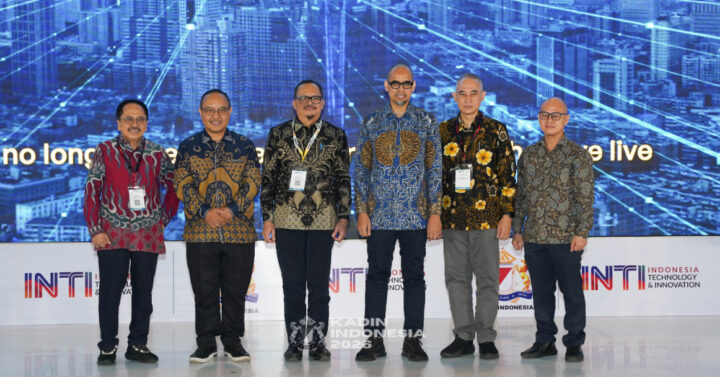
Firlie made the remarks during the Opening Ceremony of Indonesia Technology & Innovation (INTI) 2026, themed “The Nexus of: The Emerging Intelligent Era,” held at JIExpo Kemayoran, Jakarta, from August 11–13, 2026.
“The digital economy is the future. In my view, our challenge today is no longer to prove that the digital economy is important. The challenge is how we can turn it into a new engine of growth that creates productivity, investment, jobs, and added value in Indonesia,” Firlie said.
Firlie identified three areas that require greater attention and exposure: data centers, artificial intelligence (AI), and the development of digital assets or cryptocurrencies.
“There are three areas that I believe need greater attention and exposure. The first is data centers, the second is artificial intelligence, and the third is the development of digital assets or cryptocurrencies,” he said.
Firlie said AI development should be focused on practical applications that are easily accessible to businesses, including micro, small, and medium enterprises (MSMEs). He emphasized that AI should not be limited to large corporations.
“The second is artificial intelligence. We should not view AI as a technology that is only used by large companies. We need to promote AI that is practical and easily accessible to businesses,” he said.
He cited examples of how MSMEs can use AI to analyze demand patterns, develop promotional strategies, manage inventory, and improve customer service.
“Imagine MSMEs using AI to identify demand patterns, develop more targeted promotions, manage inventory, or improve customer service. When technology can help small businesses become more efficient, sell better, and make decisions faster, that is when AI begins to generate real economic value,” he explained.
For this reason, Firlie emphasized that AI development should not stop at discussions about technology, but should be directed toward practical applications in everyday activities.
“So, ladies and gentlemen, our focus in AI development must be on practical applications. It is not just about talking about technology, but about how AI can actually be used in our daily activities,” he said.
Furthermore, Firlie noted that AI development requires adequate infrastructure because the technology demands significant computing capacity. Therefore, the development of data centers is an important component in building Indonesia’s AI ecosystem.
“That is why, at INTI, we will also discuss how data centers need to continue to be developed to support AI capabilities in the future,” he explained.
In addition to infrastructure, Firlie identified digital talent development as another major challenge. Indonesia, he said, needs to ensure that its digital talent has the capabilities to make optimal use of AI.
“Because AI capabilities can have a significant impact when used properly,” he said.
The next challenge, Firlie continued, is developing sovereign AI that takes Indonesia’s data and technological sovereignty into account. Data security and quality must be safeguarded as AI development progresses.
“Sovereign AI is about maintaining our AI sovereignty. Data security must also be protected. There must be no data leaks in its use. And the data we use must be truly reliable,” he said.
Firlie also emphasized the importance of implementing ethical AI. AI must be used responsibly and should not be exploited for criminal purposes.
“Ethical AI is about using AI ethically. It must not be used for criminal activities. Every technology is a double-edged sword. It can be used for beneficial purposes, but it can also be used for harmful purposes,” he explained.
Meanwhile, Head of the Human Resources Development Agency at the Ministry of Communication and Digital Affairs (Komdigi) Boni Pudjianto, who attended on behalf of Minister of Communication and Digital Affairs Meutya Hafid, said AI development has now entered the stage of real-world implementation across various sectors.
According to Boni, AI is no longer in the experimental stage, but has become part of production processes in industry, public services, education, and even electronic transactions.
“We have entered the industrial process through production activities, government public services, education, and even electronic transactions,” Boni said.
Boni also cited data from Stanford showing the high level of AI adoption among organizations. According to him, the data demonstrates that AI has already become part of ongoing business processes.
“As a reference, the Stanford index in 2020 recorded that 88 percent of organizations were already using AI in their operations,” Boni said.
Meanwhile, Special Advisor to the Minister for the Acceleration of Industry 4.0 Transformation at the Ministry of Industry Andi Rizaldi, who attended on behalf of Minister of Industry Agus Gumiwang, said the government is currently promoting stronger domestic technology industries and production through various programs, including the facilitation of Domestic Component Level (TKDN) certification.
The Ministry of Industry, Andi said, provides a free TKDN certification program for businesses that meet certain criteria.
“At the Ministry of Industry, we also provide a free TKDN program. So, businesses that meet certain criteria can apply for their products to obtain TKDN certification free of charge,” he said.
The program, he added, is part of the government’s efforts to strengthen manufacturing and encourage more technology and innovation products to be produced by local manufacturers.
“This is also aimed at supporting manufacturing and future production, including ensuring that technology and innovation can increasingly be produced by local manufacturers,” he said.