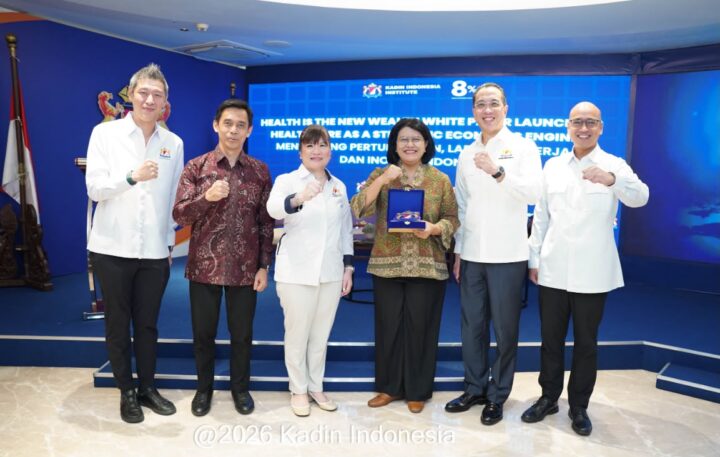
Jakarta – The Indonesian Chamber of Commerce and Industry (Kadin) Indonesia Institute (KII) hosted a socialization event for a White Paper titled “Health is the New Wealth,” which emphasizes health as an engine for economic growth, job creation, and innovation in Indonesia. The event took place during the KII 8% Club forum at Menara Kadin Indonesia, South Jakarta, on Wednesday (08/07/2026).
The Coordinating Vice Chairperson for Human Development, Culture, and Sustainable Development of Kadin Indonesia, Shinta W. Kamdani, stated that the theme "Health is the New Wealth" is not merely a slogan, but rather reflects a global paradigm shift where health has become the core foundation of economic development.
“Countries with robust healthcare systems have been proven to possess higher labor productivity, better economic resilience, and stronger competitiveness in attracting investment,” Shinta said.
According to Shinta, Indonesia is currently at the right momentum to strengthen its healthcare sector, driven by the demographic bonus that will unfold over the next decade, a growing middle class, rising demand for healthcare services, and the government's commitment to transforming the national healthcare system.
Shinta assessed that the healthcare sector has now become one of the most prospective sectors for long-term investment. This investment is not limited to building hospitals or producing medicines, but encompasses the development of an integrated national health ecosystem.
This ecosystem, Shinta explained, includes the pharmaceutical and raw medical materials industry, medical devices, biotechnology, vaccines, digital health services, artificial intelligence for medical services, research and development, healthcare professional education, as well as supporting industries such as logistics, cold chain, and high-tech manufacturing.
“Every investment in this sector will generate a significant multiplier effect on job creation, technological development, human resource quality improvement, and the strengthening of national industrial competitiveness. Therefore, we need to view health not merely as a state expenditure, but as a productive investment that generates economic growth,” Shinta stated.
Shinta acknowledged that Indonesia still faces several challenges, ranging from a high dependency on imports for pharmaceutical raw materials and medical devices, the need for enhanced research and innovation, accelerated technology transfer, to the strengthening of domestic supply chains. However, she believes these challenges actually present vast investment opportunities through close partnerships between the government and the business community to build a national healthcare industry that is more self-reliant, innovative, and competitive.
Furthermore, Shinta explained that the White Paper “Health is the New Wealth” is a tangible realization of this collaboration. The document offers various policy recommendations to enhance the investment climate, simplify regulations, support innovation, strengthen public-private partnerships, boost national industrial capacity, and establish Indonesia as a primary destination for healthcare investment in the region.
“We believe that collaboration is the key to the success of Indonesia's healthcare transformation. The government cannot work alone, and neither can the business community. We need synergy among all stakeholders so that incoming investments do not only create economic growth, but also deliver tangible social impact by improving the quality of public health,” she added.
Shinta noted that the Indonesia Emas (Golden Indonesia) 2045 vision can only be realized if Indonesia possesses a healthy, productive, and high-quality society.
“Investing in health is truly an investment in the nation's future. When the public is healthy, productivity rises. When productivity rises, economic competitiveness grows. And when the economy grows inclusively, public welfare will become increasingly solid,” Shinta remarked.
Meanwhile, the Vice Chairperson for Health of Kadin Indonesia, David Utama, stated that Indonesia's current healthcare expenditure stands at around 2.9 percent of the gross domestic product (GDP), or equivalent to approximately Rp700 trillion.
According to him, if Indonesia's economic growth continues to climb toward the 8 percent target, the national healthcare spending has the potential to increase significantly, thereby dealing a major impact on the national economy.
“Through this white paper, we have an excellent baseline regarding Indonesia's healthcare industry. The data is comprehensive, thorough, and highly accountable. I dare say this is one of the best scientific studies ever published in Indonesia for the healthcare industry,” David said.
Furthermore, the Director General of Pharmaceuticals and Medical Devices at the Ministry of Health of the Republic of Indonesia, Lucia Rizka Andalusia, explained that the White Paper, which has been under development since 2025, aims to capture the actual conditions, economic impact, and future direction of the healthcare industry in Indonesia.
According to Lucia, this industry is driven by several key factors, such as a surge in the elderly population requiring more intensive healthcare services, and rising public awareness regarding health. This awareness is marked by the widespread use of independent medical devices and the government's focus on expanding health screenings from newborns to the elderly to detect health issues early.
"The Healthcare Industry White Paper was compiled to capture the state of the healthcare industry in Indonesia, its impact on the Indonesian economy, and its outlook for the future. What the future plans look like, including recommendations on what we need to improve so that investments in the healthcare industry can run smoothly and grow," Lucia concluded.
The event was also attended by the Executive Director of the Kadin Indonesia Institute, Mulya Amri.